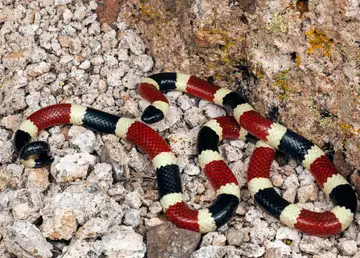
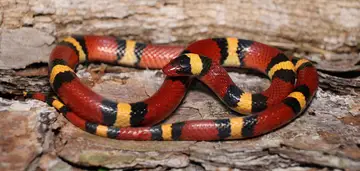
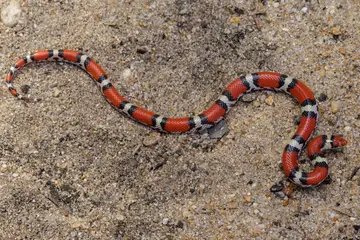
Yes. AZGFD says Arizona has 13 rattlesnake species, more than any other U.S. state; the Arizona poison center counts 15 types and says all are venomous. Arizona Game and Fish Department
Small: up to 24 in (Arizona Game and Fish); averages less than 2 ft (AZ Poison); body length 13-21 in (Tonto NPS).
How to recognize it
Black head and snout
Blunt head barely wider than the neck; short, blunt tail
Round pupils and smooth, shiny scales
Where in Arizona
This snake is found across most of the southern portion of the state below approximately 6,000′ elevation. Arizona Game and Fish Department
Conservation
HDMS: AZ SGCN Tier 2, state rank S3
JFMAMJJASOND
33 records by month.What the sources say
Habitat: The Sonoran Coral Snake is found in communities ranging form Sonoran, Mohave, and Chihuahuan desertscrubs, through Semidesert Grassland, and into the lower reaches of the woodlands. (Arizona Game and Fish Department)
Official presence. 10 states where a state list or official source names it. Gray means no official record in our data, not that it is absent.
Native or listed
Nonnative or not established
No official record in our data
Observation records. Open-licence records on GBIF for all US coral snakes (genera Micrurus and Micruroides) in 7 states. Records are sightings people shared, not confirmation that a population lives there.
“This snake is found across most of the southern portion of the state below approximately 6,000′ elevation.”
“The head and snout are black.”
“The blunt head is barely distinct from the neck and the tail is relatively short and blunt.”
“The pupils are round and the scales are smooth and shiny.”
“A small (up to 615 mm or 24″ in total length), slender, brightly-colored snake”
Reptiles (Nongame Management). Arizona Game and Fish Department. archived copy, captured June 9, 2016; checked November 3, 2026.Quoted passages (1)
“Among the snakes are 13 species of rattlesnakes, which is just over one-third of the world’s rattlesnakes, and more than can be found in any other U.S. state.”