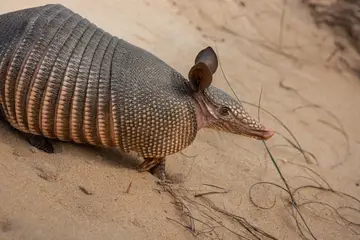
Armadillos are common in central and southern Georgia and spreading north along I-75; they may be absent from mountain counties.
University of Georgia Warnell School: “Armadillos are common in central and southern Georgia and can easily be found in most of Georgia’s 159 counties. They may be absent from the mountain counties but are found northward along the Interstate 75 corridor.” Source
Yes. Black bears occur in three regions — the north Georgia mountains, the Ocmulgee River drainage in central Georgia, and in/around the Okefenokee Swamp — with about 5,100 statewide; DNR records no bear attacks on humans in Georgia. Georgia DNR Wildlife Resources Division
Not established. DNR says no credible physical evidence of a mountain lion population exists in Georgia; only three credible sightings in 25 years, all related to the Florida panther. Georgia DNR Wildlife Resources Division
“Armadillos may carry diseases transmissible to humans, but reports are rare. Armadillos can acquire leprosy and are used in medical research to study this disease.” University of Georgia Warnell School
Size
Cat-sized: 15-17 in long not counting the tail, 8-17 lb (FWC); 24-32 in including a 9.5-14.5 in tail (UGA).
How to recognize it
Bony skin plates that form a shell, which make it easy to identify
Long scaly tail, deer-like ears, long pig-like snout
Tail encased in 12 bony rings; no canine or incisor teeth
WSFNR-17-36 Nine-banded Armadillo (M. T. Mengak). University of Georgia Warnell School (Extension publication series; PDF hosted on gadnrle.org). WSFNR-17-36; checked November 3, 2026.Quoted passages (3)
“Armadillos are common in central and southern Georgia and can easily be found in most of Georgia’s 159 counties. They may be absent from the mountain counties but are found northward along the Interstate 75 corridor.”
“No other mammal in Georgia has bony skin plates or a ‘shell’, which makes the armadillo easy to identify.”
“Armadillos may carry diseases transmissible to humans, but reports are rare. Armadillos can acquire leprosy and are used in medical research to study this disease.”
Black Bear Fact Sheet. Georgia DNR Wildlife Resources Division. Revised August 2021; checked November 3, 2026.Quoted passages (1)
“Black bears occur in three distinct regions in Georgia, but may range over the entire state at times in search of food or a territory of their own. Bear populations exist in the north Georgia mountains, along the Ocmulgee River drainage in central Georgia, and in/around the Okefenokee Swamp in southeast Georgia.”
Living with Coyotes (fact sheet). Georgia DNR Wildlife Resources Division. updated May 2020; checked November 3, 2026.Quoted passages (1)
“Coyotes (Canis latrans) are extremely adaptable to their environment and can be found throughout suburban and urban areas. … Coyotes are a non-native species in Georgia and can be harvested year-round on private property.”
“To date, no credible physical evidence (carcasses, trail camera pictures, photographs, film footage, etc.) has been found to substantiate the existence of a population of mountain lions in Georgia.”