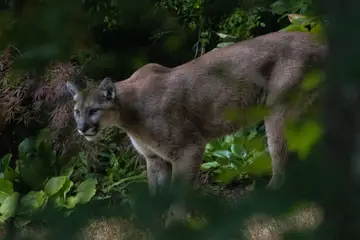
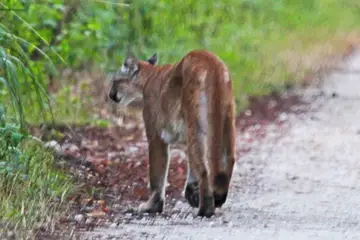
DNR says no credible physical evidence of a mountain lion population exists in Georgia; only three credible sightings in 25 years, all related to the Florida panther.
Georgia DNR Wildlife Resources Division: “To date, no credible physical evidence (carcasses, trail camera pictures, photographs, film footage, etc.) has been found to substantiate the existence of a population of mountain lions in Georgia.” Source
Yes. Black bears occur in three regions — the north Georgia mountains, the Ocmulgee River drainage in central Georgia, and in/around the Okefenokee Swamp — with about 5,100 statewide; DNR records no bear attacks on humans in Georgia. Georgia DNR Wildlife Resources Division
Yes. Armadillos are common in central and southern Georgia and spreading north along I-75; they may be absent from mountain counties. University of Georgia Warnell School
Related species on Georgia's list
These are on Georgia's official list and are related to, or often confused with, mountain lions. They are not the same animal.
Official sources confirm the mountain lion in 6 states: Arizona, California, Colorado, Florida, New Mexico and Texas. Florida borders Georgia.
Florida: “Florida panthers are the larger of Florida's two native cat species (panthers and bobcats). Florida panthers have been documented throughout much of the peninsula and even into Georgia. The core population, however, is found south of Lake Okeechobee.” Florida Fish and Wildlife Conservation Commission
What else it could be
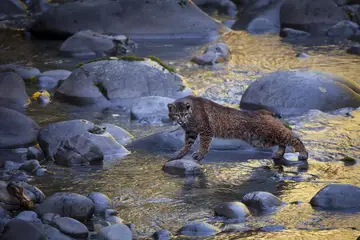
Photo: National Marine Sanctuaries · Public domain · Wikimedia Commons
Bobcats are smaller with short tails and are streaked and spotted with black; mountain lions are uniformly colored with a long tail. Bobcat tracks are under 2 inches wide.
Domestic dogs and coyotes (tracks)
Dog and coyote tracks are symmetrical, show one indent at the bottom of the pad and usually claw marks; mountain lion tracks are asymmetrical with three lobes and usually no claw marks.
Misidentified sightings (dogs, house cats, coyotes, bobcats)
Alabama: reported sightings are likely misidentified dogs, cats, coyotes and bobcats.
When mammals are seen in Georgia
JanFebMarAprMayJunJulAugSepOctNovDec
4,143 records (GBIF, CC0 and CC BY).
If you see one in Georgia
Keep your distance and do not try to catch or handle it. Wildlife conflict advice: Georgia DNR 1-800-366-2661. Mountain lion sightings: regional WRD Game Management office (Region 1 706-295-6041; Region 2 770-535-5700; Region 3 706-595-4222; Region 4 229-426-5267; Region 5 229-430-4254; Region 6 912-262-3173), after hours 800-241-4113. Georgia DNR Wildlife Resources Division
“To date, no credible physical evidence (carcasses, trail camera pictures, photographs, film footage, etc.) has been found to substantiate the existence of a population of mountain lions in Georgia.”
Black Bear Fact Sheet. Georgia DNR Wildlife Resources Division. Revised August 2021; checked November 3, 2026.Quoted passages (1)
“Black bears occur in three distinct regions in Georgia, but may range over the entire state at times in search of food or a territory of their own. Bear populations exist in the north Georgia mountains, along the Ocmulgee River drainage in central Georgia, and in/around the Okefenokee Swamp in southeast Georgia.”
Living with Coyotes (fact sheet). Georgia DNR Wildlife Resources Division. updated May 2020; checked November 3, 2026.Quoted passages (1)
“Coyotes (Canis latrans) are extremely adaptable to their environment and can be found throughout suburban and urban areas. … Coyotes are a non-native species in Georgia and can be harvested year-round on private property.”
WSFNR-17-36 Nine-banded Armadillo (M. T. Mengak). University of Georgia Warnell School (Extension publication series; PDF hosted on gadnrle.org). WSFNR-17-36; checked November 3, 2026.Quoted passages (1)
“Armadillos are common in central and southern Georgia and can easily be found in most of Georgia’s 159 counties. They may be absent from the mountain counties but are found northward along the Interstate 75 corridor.”