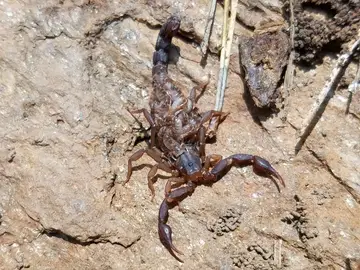
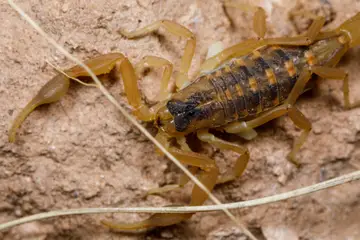
UGA (2003) says at least two scorpion species are native to Georgia, the Southern devil and the striped scorpion, and that they are not considered life-threatening.
UGA College of Agricultural and Environmental Sciences: “At least two species, Gray said, are native to Georgia: the Southern devil (Vejovis carolinianus) and striped (Centruroides vittatus) scorpions.” Source
Venom: “Bees, wasps, hornets, fire ants and scorpions that inject venom from the tip of their abdomen are sometimes considered beneficial because of their importance in pollination or because they prey on other pest insects.” (University of Georgia Cooperative Extension)
Habitat: "Scorpions prefer to nest under rocks, tree bark, boards, garbage cans, and rubbish piles." (UGA College of Agricultural and Environmental Sciences)
Usually about 2.5 inches. Sources range from 1 to 1.5 inches on average (Missouri Department of Conservation) to up to 3.5 inches (Oklahoma State).
How to recognize it
Slender pincers and a long, slender tail. The tail is longer on males than females.
Tail ends in a stinger, usually carried up and over the body.
Glows under ultraviolet light.
What the sources say
Venom: “Bees, wasps, hornets, fire ants and scorpions that inject venom from the tip of their abdomen are sometimes considered beneficial because of their importance in pollination or because they prey on other pest insects.” (University of Georgia Cooperative Extension)
Scorpions not as dangerous as they look. UGA College of Agricultural and Environmental Sciences (CAES Field Report/newswire). July 17, 2003; checked November 3, 2026.Quoted passages (3)
“At least two species, Gray said, are native to Georgia: the Southern devil (Vejovis carolinianus) and striped (Centruroides vittatus) scorpions.”
“Wear gloves when moving rocks or boards around the yard. Avoid putting your hands where your eyes can’t see. And be sure to wear shoes when walking outside at night.”
“‘Scorpions are nocturnal,’ Gray said, ‘and hide under debris, including boards, rocks, tree bark and rubbish piles during the day.”
“Bees, wasps, hornets, fire ants and scorpions that inject venom from the tip of their abdomen are sometimes considered beneficial because of their importance in pollination or because they prey on other pest insects.”