On this page The answer Which ones Where in the US Lookalikes Sources Yes.
MDC: northern cottonmouth, southeastern corner and a spotty distribution in the Ozark Region.
MDC: “Southeastern corner and a spotty distribution in the Ozark Region.” Source
How we answer questions
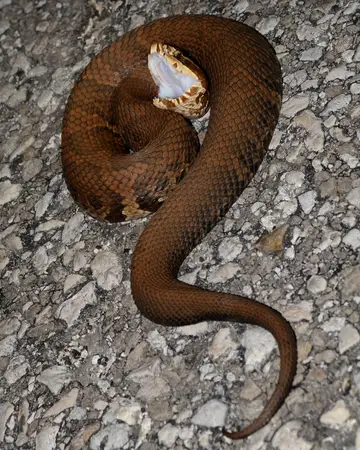
On Missouri's official list Photo: Geoff Gallice from Gainesville · CC BY 2.0 · Wikimedia Commons Agkistrodon piscivorus
Venomous per MDC
Danger to people “The cottonmouth is a dangerously venomous species that can deliver a fatal bite.” MDC Size Typically 30 to 48 inches (about 3 to 4 feet); recorded up to 75 inches. How to recognize it Heat-sensing pit between nostril and eye; no rattle Head much wider than the neck, with a dark bar from the eye to the jaw; vertical (cat-eye) pupils Gapes to show the white lining of its mouth when threatened Where in Missouri Southeastern corner and a spotty distribution in the Ozark Region. MDC
J F M A M J J A S O N D
65 records by month. What the sources say Venom: “There are only six species of venomous snakes in all of Missouri, and they are described in a separate section of this pamphlet.” (MDC)
Habitat: In Missouri, the northern cottonmouth occurs in two distinct habitats. (MDC)
Full Northern Cottonmouth guide
All snakes in the state: Missouri snakes .
Where the cottonmouth lives in the US Texas: on the state's official list Kentucky: on the state's official list Georgia: on the state's official list Missouri: on the state's official list Virginia: on the state's official list Tennessee: on the state's official list Louisiana: on the state's official list Florida: on an official source Illinois: on the state's official list Arkansas: on the state's official list Mississippi: on the state's official list North Carolina: on the state's official list Oklahoma: on the state's official list Indiana: on the state's official list South Carolina: on the state's official list Alabama: on the state's official list Kansas: on the state's official list Official presence. 17 states where a state list or official source names it. Gray means no official record in our data, not that it is absent.
Texas: 534 records Kentucky: 10 records Georgia: 46 records Missouri: 65 records Virginia: 45 records Tennessee: 127 records Louisiana: 218 records Florida: 16 records Illinois: 251 records Arkansas: 80 records Mississippi: 88 records North Carolina: 105 records Oklahoma: 19 records South Carolina: 60 records Alabama: 90 records Observation records. Open-licence records on GBIF in 15 states. Records are sightings people shared, not confirmation that a population lives there.
Cottonmouth: identification, range and danger
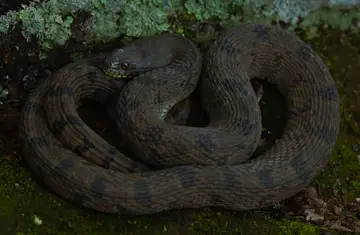
What else it could be Seen from directly above, a watersnake's eyes are visible but a cottonmouth's are not. Watersnakes have round pupils and no facial pit, and they usually have thin dark vertical lines on the lips.
Photo: Peter Paplanus from St. Louis, Missouri · CC BY 2.0 · Wikimedia Commons Diamond-backed Watersnake Alabama DCNR says this snake is often confused with the cottonmouth. TWRA: the diamond-backed watersnake is lighter, with a chain-like pattern; watersnakes in general lack the cottonmouth's facial pits (see the watersnake entry above).
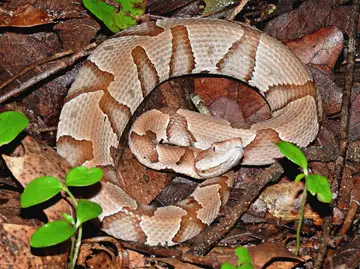
Photo: USFWSmidwest · Public domain · Wikimedia Commons On young cottonmouths the dark crossbands have many dark spots and speckles; copperhead bands have none or one. Adult copperheads keep the banded pattern, while adult cottonmouths are usually plain and dark. A cottonmouth's eye is hidden in a dark facial band; a copperhead's is not.
When snakes are seen in Missouri
Jan Feb Mar Apr May Jun Jul Aug Sep Oct Nov Dec
1,154 records (GBIF, CC0 and CC BY). Other questions about Missouri