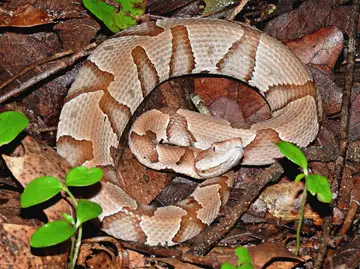
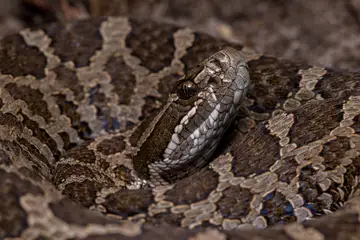
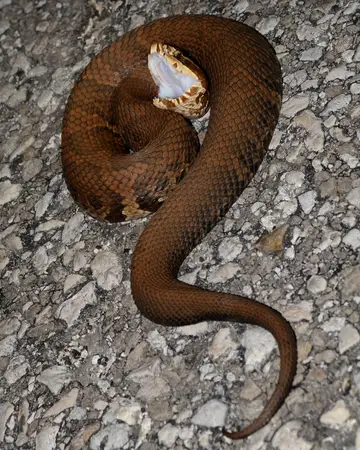
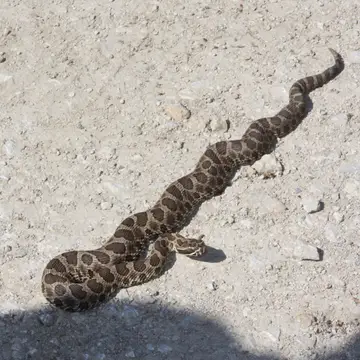
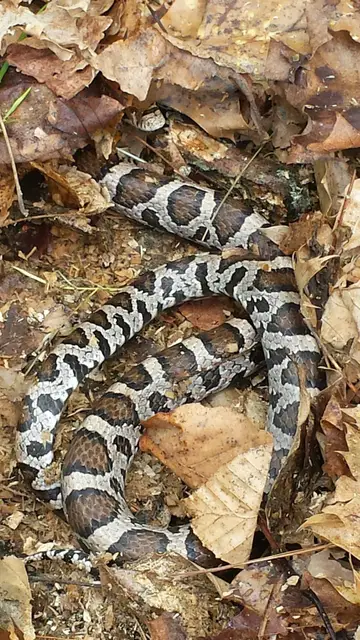
Missouri has 6 venomous snakes named by official sources: Eastern Copperhead, Northern Cottonmouth, Timber Rattlesnake, Eastern Massasauga, Prairie Massasauga and Western Pygmy Rattlesnake. Each one is labelled venomous by MDC. MDC snake guide lists the Eastern Massasauga as likely extirpated.
The 6 venomous snakes of Missouri
Recognize them from a distance; a photo cannot confirm that a snake is safe. Identifying animals safely.
“Human deaths caused by massasauga bites are rare, but studies show that the their venom is highly toxic, so these snakes must be respected and classified as dangerous.” MDC
Where in Missouri
North-central and northwestern corner of the state. MDC
Conservation
MDC snake guide: State Endangered; MDC field guide: Endangered, Species of Conservation Concern
What the sources say
Venom: “There are only six species of venomous snakes in all of Missouri, and they are described in a separate section of this pamphlet.” (MDC)
Habitat: In Missouri, massasaugas are restricted to marshes or moist prairie habitats located within or near large river floodplains or scattered moist prairie swales within upland grassland habitats. (MDC)
Venom: “There are only six species of venomous snakes in all of Missouri, and they are described in a separate section of this pamphlet.” (MDC)
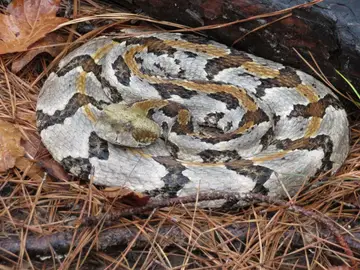
Habitat: This species prefers a habitat of mature forests and heavily wooded, rocky, south- and southwest-facing hillsides near streams and rivers. (MDC)
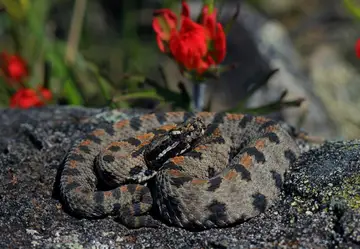
“Even though this snake is small and rarely bites people, its venom is quite toxic.” MDC
Where in Missouri
Counties bordering Arkansas and the eastern Missouri Ozarks. MDC
What the sources say
Venom: “There are only six species of venomous snakes in all of Missouri, and they are described in a separate section of this pamphlet.” (MDC)
Habitat: In Missouri, the western pygmy rattlesnake is most often observed in or near glades, in second-growth forests near rock ledges, and along the area between forests and open lands. (MDC)
See all 43 snakes, venomous and not, on Missouri snakes. MDC gives Missouri 49 snake species in all; that page lists the 43 that official sources name one by one.
Snakes people confuse
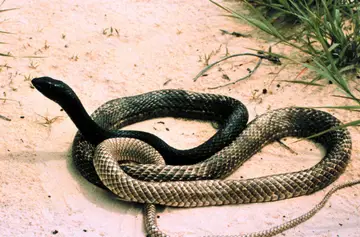
Black Racer or Cottonmouth?
Photo: Everglades NPS from Homestead, Florida, United States · Public domain · Wikimedia Commons
NPS says black racers can resemble the venomous water moccasin and advises leaving alone any snake you cannot identify. It gives no safe field mark, and none is offered here.
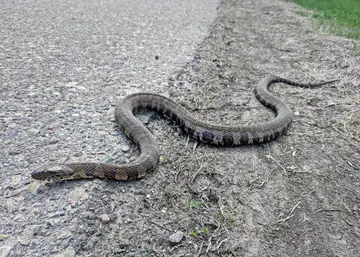
Black Racer or Timber rattlesnake?
Photo: Everglades NPS from Homestead, Florida, United States · Public domain · Wikimedia Commons
TWRA: the racer lacks the coachwhip's reddish tint along the sides of the tail; an all-black coachwhip is distinctly lighter or reddish toward the rear. Oklahoma: the coachwhip is much larger.
The copperhead's head is coppery with no marks; the milksnake's head is light with brownish marks (Pennsylvania). Tennessee: copperhead has a copper-colored, unmarked head and triangular shapes on the side of the body. Pennsylvania says the eastern milksnake is the snake most often killed by mistake for a copperhead. Belly colour is not used here: Pennsylvania's own pages describe the copperhead belly two different ways (uniform cream in one account, mottled white to gray in another).
Photos show typical adults; individuals vary. Never get close to compare.
When venomous snakes are active in Missouri
Records of snakes in Missouri peak in April to May and September to October. They show when people record snakes, not how many there are (about month bars).
JanFebMarAprMayJunJulAugSepOctNovDec
1,154 records of snakes in Missouri by month (GBIF, CC0 and CC BY records).
Copperheads are normally active mid-March to early November and enter overwintering sites mid-to-late October. MDC
Copperheads become nocturnal in June, July and August. MDC
Missouri snakes normally breed in spring after winter dormancy. MDC
Western pygmy rattlesnakes are normally active early April to mid-October. MDC
If you are bitten or stung
Call 911 or Poison Help at 1-800-222-1222 right away. Poison Help connects you to your local poison center, any time of day.
Official advice from Missouri Poison Center (SSM Health Cardinal Glennon Children's Hospital), Missouri's poison-control program and MDC:
Venomous snakes are dangerous; avoid them and any snake you cannot identify. Even freshly killed snakes can bite by reflex. MDC
Wear protective footwear where dangerous snakes may occur; never place your hands under rocks or logs; do not step over rocks or logs: step on them first, then over. MDC
Venomous Missouri snakes have elliptical (vertical) pupils and a single row of scales under the tail; a triangular head is not a reliable sign. MDC
All snakes native to Missouri are protected; MDC's exception is a venomous snake in close association with people, which could result in someone being bitten. MDC
How to report
Report sightings of black bears, elk, mountain lions, feral hogs, rare furbearers and some small mammals to MDC. MDC
Venom labels come only from official sources and link to them; "Not stated" never means harmless. How labels work.
Sources
Snake Facts (MDC Wildlife Facts). Missouri Department of Conservation (MDC). undated page; checked November 3, 2026.Quoted passages (2)
“The pupils of venomous snakes are elliptical, often appearing as vertical slits within the iris. … Our venomous species all have a single row of scales along the underside of the tail. … A triangle-shaped head doesn't necessarily mean danger.”
“Few Missourians realize that all snakes native to our state are protected. … There is a realistic exception, however: when a venomous snake is in close association with people, which could result in someone being bitten.”
“…has 49 species and subspecies of snakes (a subspecies is a geographic race of a species). … There are only six species of venomous snakes in all of Missouri … MDC news release: "Only six of the 49 snake species native to Missouri are venomous." MDC podcast (state herpetologist): "There's actually 43 different species of snakes in the state." The guide has 43 species accounts (37 non-venomous, 6 venomous).”
“Most of our snakes are harmless.”
“There are only six species of venomous snakes in all of Missouri, and they are described in a separate section of this pamphlet.”
“In Missouri, snakes normally breed in the spring, soon after they emerge from winter dormancy.”
“This snake is extremely similar in appearance to the Eastern massasauga and mainly identified to species based upon geographical range in Missouri (see distribution).”
“The eastern copperhead is the most common venomous snake in Missouri. Copperhead venom is considered mild compared to that of other venomous snakes, but medical treatment should still be sought if a person is bitten.”
“The cottonmouth is a dangerously venomous species that can deliver a fatal bite.”
“It is dangerously venomous, and medical attention must be sought immediately if someone is bitten.”
“Human deaths caused by massasauga bites are rare, but studies show that the their venom is highly toxic, so these snakes must be respected and classified as dangerous.”
“Even though this snake is small and rarely bites people, its venom is quite toxic.”
“Even freshly killed specimens can inflict a dangerous bite due to reflex action. … Finally, avoid any snake you cannot identify.”
“Wear protective footwear in habitats where dangerous snakes may occur. … Never place your hands under rocks or logs, and do not step over rocks or logs. Step on them first, then over.”
“Copperheads are normally active from mid-March through early November. … In Missouri, most copperheads enter overwintering sites from mid-to-late October.”
“In the hottest months (June, July, and August), they become nocturnal.”
“This species is normally active from early April to mid-October.”
“Copperheads, however, are stout-bodied and have hourglass-shaped markings on the back, vertical pupils in the eyes, a sensory pit between each nostril and eye, and, sometimes, especially in young copperheads, a yellow tail tip.”
“MDC is taking reports for sightings of black bears, elk, mountain lions, feral hogs, rare furbearers, and small mammals such as Franklin's ground squirrels and plains pocket gophers.”