States Wildlife

Are there rattlesnakes in New Jersey?

Last checked November 3, 2026 against official sources.

On this page
  1. The answer
  2. More official answers
  3. Which ones
  4. Where in the US
  5. Lookalikes
  6. Official advice
  7. Sources

Yes.

The timber rattlesnake (state endangered). Three populations remain: along the Kittatinny Ridge, in the Highlands, and in the Pine Barrens.

NJDEP Division of Fish & Wildlife, Endangered and Nongame Species Program: “…three populations remain: in NJ’s northern region along the Kittatinny Ridge and within the Highlands region and in southern NJ within the Pine Barrens” Source

How we answer questions

On New Jersey's official list

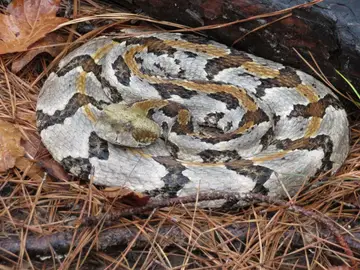
Timber Rattlesnake
Photo: NPS Photo · Public domain · Wikimedia Commons

Timber Rattlesnake

Crotalus horridus horridus

Venomous per NJDEP Division of Fish & Wildlife, Endangered and Nongame Species Program

Size
Most adults 36 to 60 inches (3 to 5 feet); record 74.5 inches.
How to recognize it
  • Black tail ending in a rattle
  • Heat-sensing pit between nostril and eye
  • Large, thick head distinct from the neck; cat-like vertical pupil
Where in New Jersey
Three populations: Kittatinny Ridge, the Highlands, and the Pine Barrens NJDEP Division of Fish & Wildlife, Endangered and Nongame Species Program
Conservation
State Endangered
What the sources say

Venom: “This is one of two VENOMOUS SNAKES found in NJ.” (NJDEP Division of Fish & Wildlife, Endangered and Nongame Species Program)

Habitat: Rocky wooded areas in the north (NJDEP Division of Fish & Wildlife, Endangered and Nongame Species Program)

Full Timber Rattlesnake guide

All snakes in the state: New Jersey snakes.

Where the timber rattlesnake lives in the US

Texas: on the state's official listKentucky: on the state's official listGeorgia: on the state's official listWisconsin: on the state's official listMissouri: on the state's official listVirginia: on the state's official listTennessee: on the state's official listLouisiana: on the state's official listNew York: on the state's official listFlorida: on the state's official listIllinois: on the state's official listMinnesota: on the state's official listMaryland: on the state's official listIowa: on the state's official listOhio: on the state's official listNebraska: on the state's official listArkansas: on the state's official listMississippi: on the state's official listNorth Carolina: on the state's official listOklahoma: on the state's official listWest Virginia: on the state's official listIndiana: on the state's official listMassachusetts: on the state's official listPennsylvania: on the state's official listSouth Carolina: on the state's official listMaine: on the state's official listRhode Island: on the state's official listConnecticut: on the state's official listAlabama: on the state's official listKansas: on the state's official listVermont: on the state's official listNew Jersey: on the state's official listNew Hampshire: on the state's official list
Official presence. 33 states where a state list or official source names it. Gray means no official record in our data, not that it is absent.
  • Native or listed
  • Nonnative or not established
  • No official record in our data
Texas: 79 recordsKentucky: 29 recordsGeorgia: 60 recordsWisconsin: 3 recordsMissouri: 22 recordsVirginia: 51 recordsTennessee: 42 recordsLouisiana: 16 recordsNew York: 155 recordsFlorida: 6 recordsIllinois: 9 recordsMinnesota: 2 recordsMaryland: 21 recordsIowa: 2 recordsOhio: 6 recordsNebraska: 5 recordsArkansas: 39 recordsMississippi: 20 recordsNorth Carolina: 41 recordsOklahoma: 7 recordsWest Virginia: 19 recordsIndiana: 4 recordsMassachusetts: 5 recordsPennsylvania: 144 recordsSouth Carolina: 32 recordsConnecticut: 2 recordsAlabama: 115 recordsKansas: 25 recordsNew Jersey: 11 records
Observation records. Open-licence records on GBIF in 29 states. Records are sightings people shared, not confirmation that a population lives there.
  • 1–9
  • 10–99
  • 100–999
  • 1,000+

Timber Rattlesnake: identification, range and danger

What else it could be

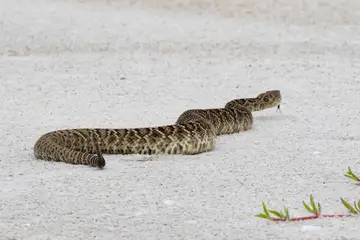
  • Eastern Diamondback Rattlesnake
    Photo: Kent P. McFarland · CC0 1.0 · iNaturalist

    Eastern Diamondback Rattlesnake

    Diamondback has a row of large dark diamonds with brown centers and cream borders, and a light-bordered dark stripe through each eye.

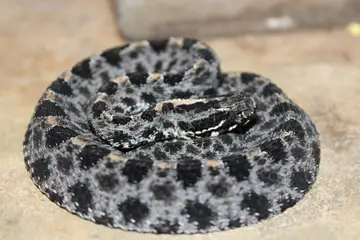
  • Pygmy Rattlesnake
    Photo: Jolieokefenokee · CC BY 4.0 · Wikimedia Commons

    Pygmy Rattlesnake

    Oklahoma (western pygmy rattlesnake): much smaller (usually under 2 feet), spots rather than crossbands, and a very small rattle; it has tiny scales on top of the head where the timber has large scales. Pygmies also have an orange to red-orange midline, so a back stripe does not separate them.

When snakes are seen in New Jersey

761 records (GBIF, CC0 and CC BY).

What official sources advise

Sources

  1. Snakes of New Jersey (brochure). NJDEP Division of Fish & Wildlife, Endangered and Nongame Species Program. PDF Last-Modified 2021-06-23; checked November 3, 2026.
    Quoted passages (5)
    “…three populations remain: in NJ’s northern region along the Kittatinny Ridge and within the Highlands region and in southern NJ within the Pine Barrens”
    “This is one of two VENOMOUS SNAKES found in NJ.”
    “Landowners that encounter timber rattlesnakes or northern copperheads on their property and wish to have them removed should contact ENSP immediately through the DEP Hotline: 1-877-WARN DEP (1-877-927-6337)”
    “They give birth to 6-17 young in mid-August to early October. … Six to 10 young are born in late August”
    “Often, the non-venomous northern water snake is misidentified as the water moccasin (cottonmouth) which does not occur in New Jersey.”
  2. GBIF.org occurrence records, human observations licensed CC0 1.0 or CC BY 4.0 only, accessed November 3, 2026. The datasets behind these counts are listed on our Sources page.