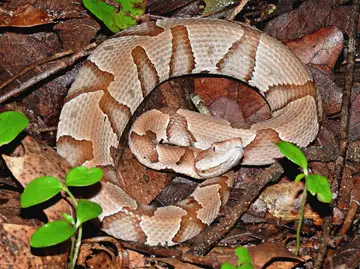
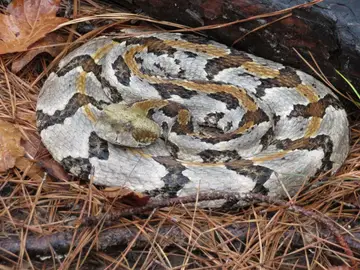
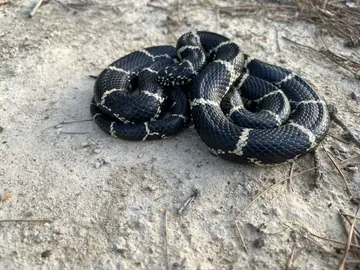
New Jersey has 2 venomous snakes named by official sources: Northern Copperhead and Timber Rattlesnake. Each one is labelled venomous by NJDEP Division of Fish & Wildlife, Endangered and Nongame Species Program.
The 2 venomous snakes of New Jersey
Recognize them from a distance; a photo cannot confirm that a snake is safe. Identifying animals safely.
Venom: “This is one of two VENOMOUS SNAKES found in NJ.” (NJDEP Division of Fish & Wildlife, Endangered and Nongame Species Program)
Habitat: Rocky fields, berry thickets, woodlands, farmlands, old mulch piles (NJDEP Division of Fish & Wildlife, Endangered and Nongame Species Program)
See all 23 snakes, venomous and not, on New Jersey snakes. NJDEP Division of Fish & Wildlife, Endangered and Nongame Species Program gives New Jersey 22 snake species in all; that page lists the 23 that official sources name one by one.
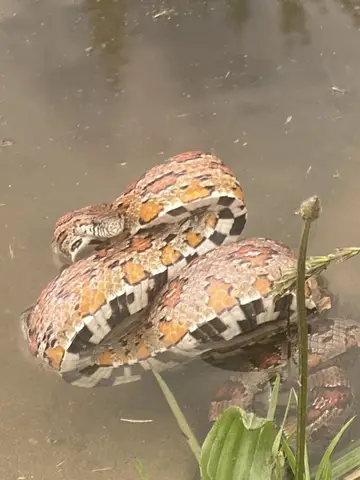
Tennessee: the corn snake has a spear-point pattern between the eyes and a striped underside of the tail; milksnakes lack striping under the tail. Both have checkerboard bellies, so the belly alone does not separate them.
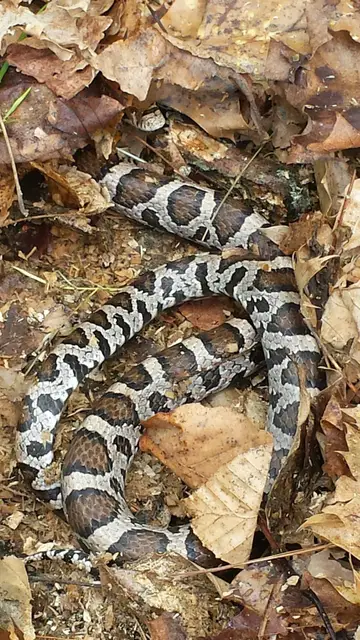
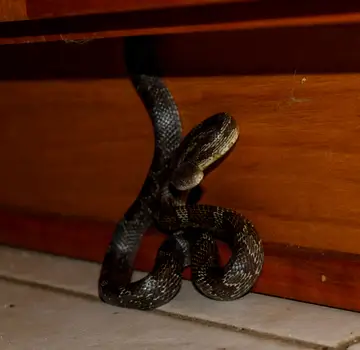
New Jersey DFW, for hatchling and yearling black rat snakes: the pattern runs down through the tip of a pointed tail, unlike the timber rattlesnake's 'velvet tail', where the last few inches before the rattle are solid black. New Jersey DFW also says timber rattlesnakes have yellow/light and black/dark color phases, and warns that many snakes shake their tails like a rattle, so the sound alone can mislead.
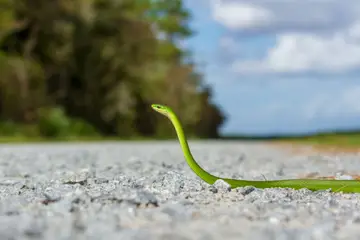
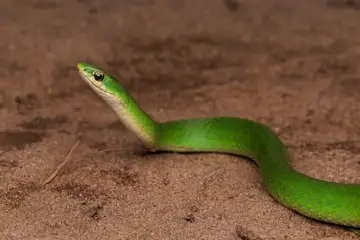
The smooth green snake has smooth scales, is generally smaller and rarely climbs. Missouri: the scales of a rough greensnake feel rough, and the smooth greensnake is a grassland species. SREL: the smooth green snake replaces this species in the Appalachian Mountains and the Northeast.
Photos show typical adults; individuals vary. Never get close to compare.
When venomous snakes are active in New Jersey
Records of snakes in New Jersey peak in April to June and September. They show when people record snakes, not how many there are (about month bars).
JanFebMarAprMayJunJulAugSepOctNovDec
761 records of snakes in New Jersey by month (GBIF, CC0 and CC BY records).
DEP 24-hour hotline 1-877-WARN DEP (1-877-927-6337) for venomous snakes on private land, bear damage or nuisance bears, and injured or dead bobcats; report endangered, threatened and special concern wildlife (and roadkill) with the NJ Wildlife Tracker app. NJDEP Fish & Wildlife
The species list comes from Snakes of New Jersey (brochure) (NJDEP Division of Fish & Wildlife, Endangered and Nongame Species Program, PDF Last-Modified 2021-06-23 (no date printed); conservation status from the 2026 list).
Venom labels come only from official sources and link to them; "Not stated" never means harmless. How labels work.
Snakes of New Jersey (brochure). NJDEP Division of Fish & Wildlife, Endangered and Nongame Species Program. PDF Last-Modified 2021-06-23; checked November 3, 2026.Quoted passages (12)
“22 species of snakes can still be found in the most densely populated state in the country.”
“Two of our snake species are venomous, the timber rattlesnake and the northern copperhead, and the remaining twenty species are non-venomous.”
“…most herpetologists believe the non-venomous queen snake is now extirpated (locally extinct) in New Jersey.”
“This is one of two VENOMOUS SNAKES found in NJ.”
“If you encounter a venomous snake, you should keep a safe distance (at least 5 feet) and keep young children and pets at your side for control.”
“Call 911 immediately”
“Landowners that encounter timber rattlesnakes or northern copperheads on their property and wish to have them removed should contact ENSP immediately through the DEP Hotline: 1-877-WARN DEP (1-877-927-6337)”
“Never walk barefoot!”
“…which makes it illegal for anyone to kill, collect, or harass our native snake species.”
“These snakes are the first to emerge in NJ, and can often be seen in mid-March during warm spells.”
“They give birth to 6-17 young in mid-August to early October. … Six to 10 young are born in late August”
“Often, the non-venomous northern water snake is misidentified as the water moccasin (cottonmouth) which does not occur in New Jersey.”
Black Bears in New Jersey. NJDEP Fish & Wildlife. archived copy, captured July 21, 2026; checked November 3, 2026.Quoted passages (1)
“To report black bear damage and nuisance behavior, call the DEP’s 24-hour, toll-free hotline: 1-877-WARN DEP (1-877-927-6337)”