On this page The answer More official answers Which ones Where in the US Sources Yes.
SCDNR publishes an armadillo nuisance-species sheet for SC; range detail is not stated in the passage used.
SCDNR: “South Carolina Species Information Armadillos” Source
How we answer questions
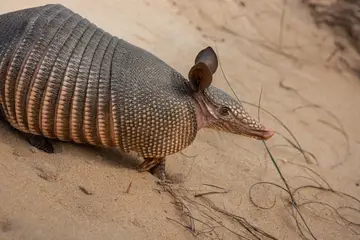
On South Carolina's official list Photo: MartinKlippel · CC BY-SA 4.0 · Wikimedia Commons · resized Dasypus novemcinctus
Size Cat-sized: 15-17 in long not counting the tail, 8-17 lb (FWC); 24-32 in including a 9.5-14.5 in tail (UGA). How to recognize it Bony skin plates that form a shell, which make it easy to identify Long scaly tail, deer-like ears, long pig-like snout Tail encased in 12 bony rings; no canine or incisor teeth Full Nine-banded Armadillo guide
All mammals in the state: South Carolina mammals .
Where the nine-banded armadillo lives in the US Texas: on the state's official list Kentucky: on the state's official list Georgia: on the state's official list (nonnative) Missouri: on the state's official list Virginia: on the state's official list (nonnative) Tennessee: on the state's official list Louisiana: on the state's official list Florida: on the state's official list (nonnative) Illinois: on the state's official list (nonnative) Iowa: on the state's official list Nebraska: on the state's official list Arkansas: on the state's official list Mississippi: on the state's official list North Carolina: on the state's official list (nonnative) Oklahoma: on the state's official list Indiana: on the state's official list South Carolina: on the state's official list New Mexico: on an official source Alabama: on the state's official list Kansas: on the state's official list Official presence. 20 states where a state list or official source names it. Gray means no official record in our data, not that it is absent.
Texas: 6 records Tennessee: 4 records Louisiana: 2 records New York: 1 record Florida: 6 records Arkansas: 2 records Mississippi: 1 record South Carolina: 2 records Kansas: 3 records Observation records. Open-licence records on GBIF in 9 states. Records are sightings people shared, not confirmation that a population lives there.
Nine-banded armadillo: identification, range and danger
When mammals are seen in South Carolina
Jan Feb Mar Apr May Jun Jul Aug Sep Oct Nov Dec
1,915 records (GBIF, CC0 and CC BY). Other questions about South Carolina Sources South Carolina Species Information: Armadillos . SCDNR (prepared by National Wildlife Control Training Program). undated page; checked November 3, 2026. Quoted passages (2) “South Carolina Species Information Armadillos” “Canine and incisor teeth are absent. … The long, tapering tail is encased in 12 bony rings.” Black Bear . South Carolina Department of Natural Resources. undated page; checked November 3, 2026. Quoted passages (1) “In South Carolina, there are two resident populations of black bears, one in the mountains and upper piedmont and one in the coastal plain.” Coyote . South Carolina Department of Natural Resources. undated page; checked November 3, 2026. Quoted passages (1) “Coyotes first appeared in the upstate in 1978, they are now present in all counties of South Carolina.” SC State Wildlife Action Plan 2025, Chapter 4: Overview of the Taxonomic Groups . South Carolina Department of Natural Resources. 2025; checked November 3, 2026. Quoted passages (1) “However, back in colonial times, South Carolina was also home to several additional species including the American Bison, Eastern Elk, Red Wolf, Gray Wolf, and Eastern Cougar.” GBIF.org occurrence records, human observations licensed CC0 1.0 or CC BY 4.0 only, accessed November 3, 2026. The datasets behind these counts are listed on our Sources page.