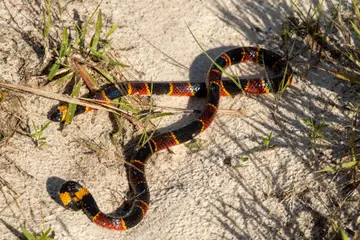
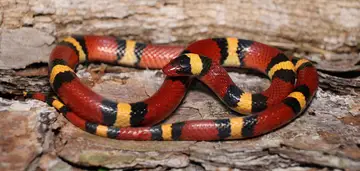
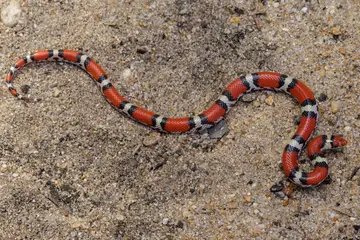
SCDNR and South Carolina Wildlife Magazine: “Coral snakes can occur in a wide range of habitats; however, they are never found commonly anywhere.” Source
Venom: “The six venomous species are the coral snake, pigmy rattlesnake, cottonmouth (aka water moccasin), copperhead, canebrake or timber rattlesnake, and the eastern diamondback rattlesnake.” (South Carolina Department of Natural Resources)
Habitat: The species is very secretive, spending much of its time underground, and loose, sandy soil typifies most of the habitats frequented by the coral snake. (SCDNR and South Carolina Wildlife Magazine)
Official presence. 10 states where a state list or official source names it. Gray means no official record in our data, not that it is absent.
Native or listed
Nonnative or not established
No official record in our data
Observation records. Open-licence records on GBIF for all US coral snakes (genera Micrurus and Micruroides) in 7 states. Records are sightings people shared, not confirmation that a population lives there.
Red bands bordered by black, not yellow; in Texas the bands stop at the belly, which is a uniform color.
Sonoran mountain kingsnake
Red bands bordered by black; coral snake red bands are bordered by yellow.
Western and Sonoran shovel-nosed snakes
Arizona coral snake has a black snout, which separates it from shovel-nosed snakes.
When snakes are seen in South Carolina
JanFebMarAprMayJunJulAugSepOctNovDec
882 records (GBIF, CC0 and CC BY).
If you see one in South Carolina
Keep your distance and do not try to catch or handle it. Alligator and other wildlife emergencies, injured manatees: SCDNR Operation Game Thief 1-800-922-5431. Herp questions: [email protected], (843) 527-8448. SCDNR does not remove nuisance snakes; it keeps a list of wildlife removal specialists. South Carolina Department of Natural Resources
“The six venomous species are the coral snake, pigmy rattlesnake, cottonmouth (aka water moccasin), copperhead, canebrake or timber rattlesnake, and the eastern diamondback rattlesnake.”
“In South Carolina, cottonmouths typically live in the sandhills and coastal plain regions, but do not enter the piedmont nor mountain regions of the state.”
American Alligator. South Carolina Department of Natural Resources. undated page; checked November 3, 2026.Quoted passages (1)
“For alligator and other wildlife emergencies, contact Operation Game Thief: 1-800-922-5431”