States Wildlife

Are there rattlesnakes in South Carolina?

Last checked November 3, 2026 against official sources.

On this page
  1. The answer
  2. More official answers
  3. Which ones
  4. Where in the US
  5. Lookalikes
  6. Sources

Yes.

Three: timber/canebrake, eastern diamondback, pigmy.

South Carolina Department of Natural Resources: “The six venomous species are the coral snake, pigmy rattlesnake, cottonmouth (aka water moccasin), copperhead, canebrake or timber rattlesnake, and the eastern diamondback rattlesnake.” Source

How we answer questions

The 3 on South Carolina's list

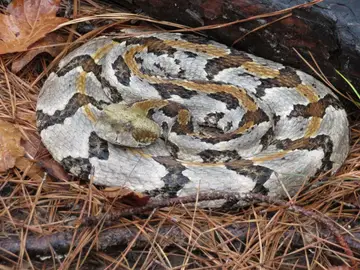
Timber (Canebrake) Rattlesnake
Photo: NPS Photo · Public domain · Wikimedia Commons

Timber (Canebrake) Rattlesnake

Crotalus horridus

Venomous per South Carolina Department of Natural Resources

Size
Most adults 36 to 60 inches (3 to 5 feet); record 74.5 inches.
How to recognize it
  • Black tail ending in a rattle
  • Heat-sensing pit between nostril and eye
  • Large, thick head distinct from the neck; cat-like vertical pupil
Where in South Carolina
Found throughout South Carolina SCDNR and South Carolina Wildlife Magazine
32 records by month.
What the sources say

Venom: “The six venomous species are the coral snake, pigmy rattlesnake, cottonmouth (aka water moccasin), copperhead, canebrake or timber rattlesnake, and the eastern diamondback rattlesnake.” (South Carolina Department of Natural Resources)

Habitat: The canebrake of the piedmont and coastal plain is a species of forested woodlands, wooded bluffs near rivers, river swamps and wet thickets. (SCDNR and South Carolina Wildlife Magazine)

Full Timber (Canebrake) Rattlesnake guide

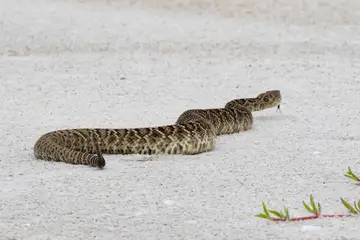
Eastern Diamondback Rattlesnake
Photo: Kent P. McFarland · CC0 1.0 · iNaturalist

Eastern Diamondback Rattlesnake

Crotalus adamanteus

Venomous per South Carolina Department of Natural Resources

Size
Most adults 33 to 72 inches (about 3 to 6 feet); record 99 inches.
How to recognize it
  • Light-bordered dark stripe running diagonally through each eye
  • Tail ends in a rattle, often held above the ground
  • Cat-like vertical pupil and a deep heat-sensing pit between nostril and eye
Where in South Carolina
Longleaf pine flatwoods, rolling pine-hills and in maritime grasslands of the lower coast SCDNR and South Carolina Wildlife Magazine
Conservation
"considered a species of concern in South Carolina"
What the sources say

Venom: “The six venomous species are the coral snake, pigmy rattlesnake, cottonmouth (aka water moccasin), copperhead, canebrake or timber rattlesnake, and the eastern diamondback rattlesnake.” (South Carolina Department of Natural Resources)

Habitat: Longleaf pine flatwoods, rolling pine-hills and in maritime grasslands of the lower coast (SCDNR and South Carolina Wildlife Magazine)

Full Eastern Diamondback Rattlesnake guide

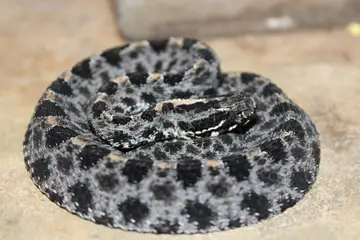
Pigmy Rattlesnake
Photo: Jolieokefenokee · CC BY 4.0 · Wikimedia Commons

Pigmy Rattlesnake

Sistrurus miliarius

Venomous per South Carolina Department of Natural Resources

Size
Adults usually 12-24 inches (30-61 cm); record 31-33 inches. Newborns about 5-6 inches.
How to recognize it
  • Tiny rattle at the end of a slender tail; buzz sounds like an insect
  • Pit viper: heat-sensing pit between nostril and eye, vertical (cat-like) pupils, keeled scales; nine large plates on top of the head
  • Large head scales (other rattlesnakes have small scales on the head)
Where in South Carolina
Throughout South Carolina, with the exception of the mountains SCDNR and South Carolina Wildlife Magazine
What the sources say

Venom: “The six venomous species are the coral snake, pigmy rattlesnake, cottonmouth (aka water moccasin), copperhead, canebrake or timber rattlesnake, and the eastern diamondback rattlesnake.” (South Carolina Department of Natural Resources)

Habitat: They occur in a variety of habitats but are seldom found far from fresh water, such as marshes, swamps and ponds. (SCDNR and South Carolina Wildlife Magazine)

Full Pigmy Rattlesnake guide

All snakes in the state: South Carolina snakes.

Where the Eastern diamondback rattlesnake lives in the US

Georgia: on the state's official listLouisiana: on the state's official listFlorida: on the state's official listMississippi: on the state's official listNorth Carolina: on the state's official listSouth Carolina: on the state's official listAlabama: on the state's official list
Official presence. 7 states where a state list or official source names it. Gray means no official record in our data, not that it is absent.
  • Native or listed
  • Nonnative or not established
  • No official record in our data
Georgia: 11 recordsFlorida: 135 recordsOhio: 1 recordMississippi: 6 recordsSouth Carolina: 1 record
Observation records. Open-licence records on GBIF in 5 states. Records are sightings people shared, not confirmation that a population lives there.
  • 1–9
  • 10–99
  • 100–999
  • 1,000+

Eastern Diamondback Rattlesnake: identification, range and danger

What else it could be

  • Timber Rattlesnake
    Photo: NPS Photo · Public domain · Wikimedia Commons

    Timber Rattlesnake

    Timber rattlesnake has black chevron-like crossbands, a reddish stripe down the middle of the back and a black tail; Florida Museum says it is the only other rattlesnake likely to be confused with the diamondback in Florida.

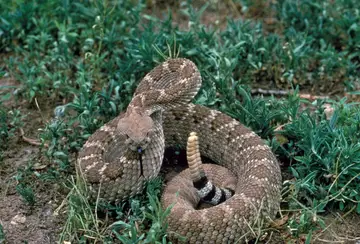
  • Western Diamondback Rattlesnake
    Photo: Gary Stolz (original) · Public domain · Wikimedia Commons

    Western Diamondback Rattlesnake

    Arizona Game and Fish: the western diamondback's tail has alternating black and white bands of roughly equal width, and a thin light stripe runs back and down from the rear corner of the eye to the upper lip.

When snakes are seen in South Carolina

882 records (GBIF, CC0 and CC BY).

Other questions about South Carolina

Sources

  1. Frequently Asked Questions about Reptile and Amphibians. South Carolina Department of Natural Resources. page footer 2020; checked November 3, 2026.
    Quoted passages (1)
    “The six venomous species are the coral snake, pigmy rattlesnake, cottonmouth (aka water moccasin), copperhead, canebrake or timber rattlesnake, and the eastern diamondback rattlesnake.”
  2. Venomous Snakes of South Carolina (poster). SCDNR and South Carolina Wildlife Magazine. SCDNR 03CE4028 3/03; checked November 3, 2026.
    Quoted passages (2)
    “The copperhead is South Carolina’s most common venomous snake.”
    “Coral snakes can occur in a wide range of habitats; however, they are never found commonly anywhere.”
  3. Upstate Snakes: Some Frequently Asked Questions. South Carolina Department of Natural Resources. page footer 2020; checked November 3, 2026.
    Quoted passages (1)
    “In South Carolina, cottonmouths typically live in the sandhills and coastal plain regions, but do not enter the piedmont nor mountain regions of the state.”
  4. GBIF.org occurrence records, human observations licensed CC0 1.0 or CC BY 4.0 only, accessed November 3, 2026. The datasets behind these counts are listed on our Sources page.