Manatee (West Indian manatee; in the US mainly the Florida manatee)
Trichechus manatus (US subspecies: Trichechus manatus latirostris, Florida manatee) · also called West Indian manatee, Florida manatee and sea cow · Last checked November 3, 2026.
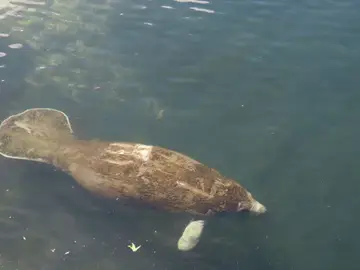
The manatee is a large, gray, plant-eating aquatic mammal. In the US it is the Florida manatee, a native subspecies of the West Indian manatee that lives in Florida's coastal waters, rivers and springs; in warm months some travel along the Atlantic coast into Georgia and the Carolinas and along the Gulf to Louisiana and occasionally Texas. It is federally listed as threatened and protected by state and federal law; FWC asks people to look but not touch, feed or give water to manatees. No official source checked describes manatees as venomous or as a danger to people. FWC
On this page
Is the manatee dangerous?
FWC's official guidance is about protecting manatees from people: look, but don't touch, don't feed them or give them water. FWC
“Look, but don't touch manatees. Also, don't feed manatees or give them water.”
No official source we use states whether this animal is venomous. That does not mean it is harmless: do not handle it.
How to identify a manatee
A photo or description can narrow it down, but cannot confirm what an animal is or that it is safe. Look from a distance and do not handle wild animals.
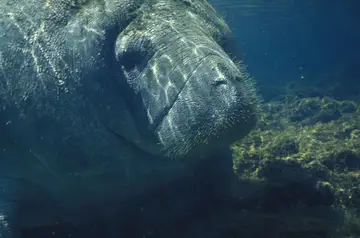

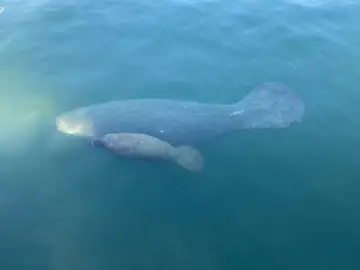
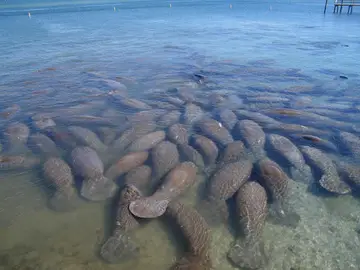
Size: Adults typically 9-10 ft long and about 1,000 lb; can exceed 13 ft and 3,500 lb. Calves weigh about 60-70 lb at birth. FWC
Colors: gray (often looks green or brown from algae); greyish brown; newborn calves very dark. Pattern: round scars from barnacles on coastal animals.
Key features
- two front flippers and a large, round, flattened paddle-shaped tail FWC
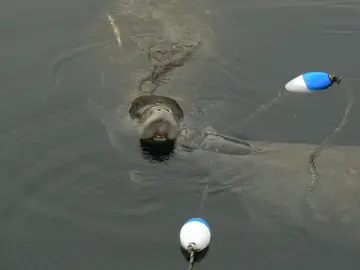
- often only the snout breaks the surface when it breathes FWC
- signs on the water: a swirl, or a back, snout, tail or flipper breaking the surface FWC
Young
Newborns average 4 to 4.5 ft and 60-70 lb; calves stay with the mother about two years.
Where the manatee lives
- Native or listed
- Nonnative or not established
- No official record in our data
- 1–9
- 10–99
- 100–999
- 1,000+
On our state guides
- Alabama sharks and marine life
- Georgia mammals
- Louisiana mammals
- Maryland mammals
- Massachusetts mammals
- Mississippi mammals
- North Carolina mammals
- Rhode Island mammals
- Texas mammals
- Virginia mammals
State boundaries: U.S. Census Bureau, cartographic boundary file cb_2024_us_state_20m.
When it is active
Year-round in Florida; in warm months some range north and west, and before the coldest winter months they return to Florida's warm-water sites. They cannot tolerate water below 68°F for long. FWC
US open-licence records peak in January to March and December.
Habitat and habits
Habitat: Marine, brackish and fresh water in coastal and river areas, near shore with seagrass or other submerged plants; in winter they rely on warm water from springs, power plant outfalls and thermal basins. US Fish and Wildlife Service
Behavior: Slow grazers that can reach 15 mph in short bursts; rest 2-12 hours a day; surface every 3-5 minutes when active and can hold their breath up to 20 minutes at rest. Semi-social outside winter gatherings.
Diet: Herbivore: seagrasses and other aquatic plants, grazing up to 8 hours a day and eating up to 10% of body weight daily.
Young: Gestation about 13 months; usually one calf every three to five years; births can happen all year but peak in spring.
Legal status and reporting
Federal: Threatened under the Endangered Species Act (reclassified from endangered in May 2017). FWC
Protection: Protected species. Federal law makes it illegal to harass, hunt, capture or kill manatees; Florida law makes it unlawful to annoy, molest, harass or disturb any manatee. FWC
Invasive status: Native, not invasive. FWC
Report: In Florida, report a distressed or dead manatee to FWC: 888-404-FWCC (888-404-3922); cell phones can call #FWC or *FWC. FWC
Sources
- Florida Manatee (species profile). Florida Fish and Wildlife Conservation Commission (FWC). archived copy, captured August 4, 2026; checked November 3, 2026. Archived copy.
Quoted passages (8)
“Adult manatees are typically 9-10 feet long from snout to tail (2.7-3 meters) and weigh around 1,000 pounds … they may grow to over 13 feet long (4 meters) and weigh more than 3,500 pounds … At birth, a manatee calf weighs around 60 - 70 pounds.”
“Manatees have two fore-limb flippers that they use for steering movements and to hold vegetation while eating and a large, round, flattened paddle-shaped tail that is used for swimming.”
“The manatee's snout is often the only part of its body that emerges out of the water when it breathes.”
“Manatees are aquatic herbivores. … usually spend up to eight hours a day grazing on seagrasses and other marine or freshwater vegetation, eating up to ten percent of their body weight in aquatic vegetation each day.”
“Strong swimmers, they can reach speeds of 15 miles per hour in short bursts. Manatees rest from 2 to 12 hours a day … When active, manatees must surface every three to five minutes to breathe, but can hold their breath for as long as 20 minutes when resting.”
“During the warmer months, some Florida manatees travel up the eastern coastline into Georgia and the Carolinas with a few animals traveling as far north as Massachusetts.”
“Manatees can breed and give birth throughout the year; however, birthing usually peaks in the spring. Females have a 13 month gestation time, and have a low reproductive rate, giving birth to an average of one calf every three to five years.”
“…is a subspecies of the West Indian manatee (Trichechus manatus) that lives in and is native to Florida.”
- Florida Manatee Program. Florida Fish and Wildlife Conservation Commission (FWC). archived copy, captured October 25, 2026; checked November 3, 2026. Archived copy.
Quoted passages (2)
“…the species was reclassified from an endangered to a threatened species under the federal Endangered Species Act in May 2017.”
“Report a distressed or dead manatee … Report violations online or call 888-404-FWCC (888-404-3922). Cellular phone users can also call #FWC or *FWC.”
- Manatee Viewing Guidelines. Florida Fish and Wildlife Conservation Commission (FWC). archived copy, captured August 19, 2026; checked November 3, 2026. Archived copy.
Quoted passages (3)
“Look, but don't touch manatees. Also, don't feed manatees or give them water.”
“You may see a swirl on the surface caused by the manatee when it dives; see an animal’s back, snout, tail, or flipper break the surface of the water”
“The manatee is protected under federal law by the Marine Mammal Protection Act of 1972 and by the Endangered Species Act of 1973, which makes it illegal to harass, hunt, capture or kill any marine mammal. … The manatee is also protected by the Florida Manatee Sanctuary Act of 1978, which states: "It is unlawful for any person, at any time, intentionally or negligently, to annoy, molest, harass, or disturb any manatee."”
- Florida Manatee (Trichechus manatus latirostris). U.S. Fish and Wildlife Service. archived copy, captured September 18, 2026; checked November 3, 2026. Archived copy.
Quoted passages (2)
“Newborn manatees average four to four and a half feet in length. … The mother manatee cares for her calf for about two years.”
“Manatees live in marine, brackish, and freshwater systems in coastal and riverine areas throughout their range. … To keep warm in cooler months, many manatees rely on the warm water from natural springs, power plant outfalls, and passive thermal basins.”
- GBIF.org occurrence records, human observations licensed CC0 1.0 or CC BY 4.0 only, accessed November 3, 2026. The datasets behind these counts are listed on our Sources page.
- State boundaries: U.S. Census Bureau, cartographic boundary file cb_2024_us_state_20m.