States Wildlife

Are there brown recluse spiders in Colorado?

Last checked November 3, 2026 against official sources.

On this page
  1. The answer
  2. More official answers
  3. Which ones
  4. Where in the US
  5. Lookalikes
  6. If you see one
  7. Sources

Rarely.

CSU Extension says brown recluse and all other recluse spiders are extremely rare in Colorado; sightings often come from spiders carried in from other states.

Colorado State University Extension: “The brown recluse, and all other recluse spiders, are extremely rare in Colorado.” Source

How we answer questions

On Colorado's official list

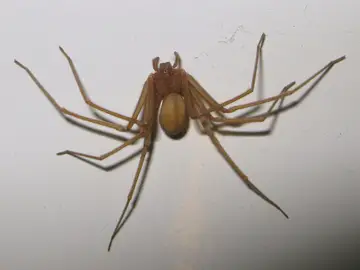
Mediterranean recluse
Photo: jacilluch · CC BY-SA 2.0 · Wikimedia Commons · resized

Mediterranean recluse

Loxosceles rufescens

Not stated

Venom
No official source we use states whether this animal is venomous. That does not mean it is harmless: do not handle it.

All spiders in the state: Colorado spiders.

Where the brown recluse spider lives in the US

Texas: on the state's official listCalifornia: named by an official source, answer “No”Kentucky: on the state's official listGeorgia: on the state's official listMissouri: on the state's official listVirginia: on the state's official listTennessee: on the state's official listLouisiana: on an official sourceFlorida: named by an official source, answer “Not established”Illinois: on the state's official listIowa: on the state's official listDistrict of Columbia: isolated occurrences only, per an official sourceOhio: on the state's official listNebraska: on the state's official listWashington: named by an official source, answer “No”Arkansas: on the state's official listMississippi: on the state's official listNorth Carolina: on the state's official listOklahoma: on the state's official listWyoming: on the state's official listIndiana: on the state's official listPennsylvania: on the state's official list (nonnative)Rhode Island: named by an official source, sources differMichigan: on the state's official listNew Mexico: on the state's official listAlabama: on the state's official listKansas: on the state's official listNew Jersey: isolated occurrences only, per an official sourceArizona: named by an official source, answer “No”
Official presence. 29 states where a state list or official source names it. Gray means no official record in our data, not that it is absent.
  • Native or listed
  • Nonnative or not established
  • No official record in our data
Texas: 103 recordsKentucky: 16 recordsGeorgia: 3 recordsMissouri: 129 recordsTennessee: 35 recordsLouisiana: 1 recordIllinois: 13 recordsMaryland: 5 recordsOhio: 2 recordsNebraska: 12 recordsArkansas: 37 recordsMississippi: 4 recordsNorth Carolina: 1 recordOklahoma: 118 recordsIndiana: 16 recordsAlabama: 15 recordsKansas: 79 records
Observation records. Open-licence records on GBIF in 17 states. Records are sightings people shared, not confirmation that a population lives there.
  • 1–9
  • 10–99
  • 100–999
  • 1,000+

Brown recluse spider: identification, range and danger

What else it could be

  • Wolf spiders

    UC IPM lists wolf spiders among the brown spiders often mistaken for recluses. They have 8 eyes, so they can be ruled out quickly.

  • Southern house spider (male)
    Photo: Sam Taylor · CC BY 4.0 · iNaturalist

    Southern house spider (male)

    UF/IFAS says males are often mistaken for brown recluses. The brown recluse has six eyes in three separate pairs, while the southern house spider has eight eyes bunched together at the front.

  • Huntsman spider
    Photo: kcthetc1 · CC0 1.0 · iNaturalist

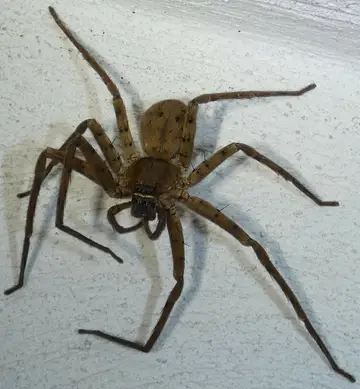
    Huntsman spider

    UF/IFAS says its carapace pattern is reversed: a light central mark on a dark background. Adults are also much larger than a brown recluse.

  • Woodlouse spider
    Photo: Meghan Cassidy · CC BY-SA 4.0 · iNaturalist · resized

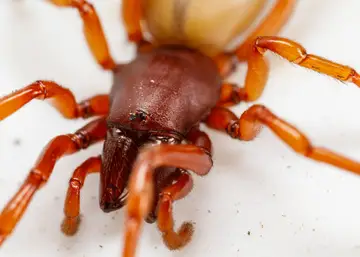
    Woodlouse spider

    Ohio DNR says it is sometimes confused with the recluse, perhaps because it also has six eyes; recluses are much smaller, dull brown and have tiny fangs. UC IPM says the woodlouse spider's six eyes are in two groups of three (a recluse has three pairs) and it has no body markings.

  • Mediterranean recluse
    Photo: jacilluch · CC BY-SA 2.0 · Wikimedia Commons · resized

    Mediterranean recluse

    Alabama Extension says the Mediterranean and Chilean recluses closely resemble the brown recluse and are difficult to tell apart from it; it has the same six eyes in three pairs. UC IPM says telling recluse species apart needs a high-magnification microscope and a spider expert. It is not native; Alabama Extension says it has been found in only a few small, isolated locations, and Ohio DNR reports it from buildings in several Ohio cities.

When spiders are seen in Colorado

3,428 records (GBIF, CC0 and CC BY).

If you see one in Colorado

Keep your distance and do not try to catch or handle it. Invasive species: file a report with CPW (online "Report a Sighting" form linked from cpw.state.co.us/invasive-wildlife). Injured/abandoned animals, feeding or illegal activity: CPW Denver Headquarters 303-297-1192 or any CPW office; anonymous: Operation Game Thief 877-265-6648. After-hours emergency: Colorado State Patrol 303-239-4500. Wildlife posing immediate danger: local CPW office or law enforcement. Colorado Parks and Wildlife
Other questions about Colorado

Sources

  1. Brown Recluse Spiders in Colorado: Recognition and Spiders of Similar Appearance. Colorado State University Extension. Published February 2008; checked November 3, 2026.
    Quoted passages (1)
    “The brown recluse, and all other recluse spiders, are extremely rare in Colorado.”
  2. Spiders in the Home (Fact Sheet 5.512). Colorado State University Extension. Published September 2013; checked November 3, 2026.
    Quoted passages (2)
    “Widow spiders, particularly the western widow (Latrodectus hesperus), are common in Colorado.”
    “Tarantulas are found in southeastern and southwestern Colorado.”
  3. Known Invasive Wildlife in Colorado. Colorado Parks and Wildlife. page states 2026-01-21T15:12:28-0700; checked November 3, 2026.
    Quoted passages (1)
    “If you spot any invasive species, file a report with CPW.”
  4. GBIF.org occurrence records, human observations licensed CC0 1.0 or CC BY 4.0 only, accessed November 3, 2026. The datasets behind these counts are listed on our Sources page.