Hobo Spider
Eratigena agrestis · also called aggressive house spider (old name, described by extension sources as a mistranslation) and Tegenaria agrestis (former scientific name) · Last checked November 3, 2026.
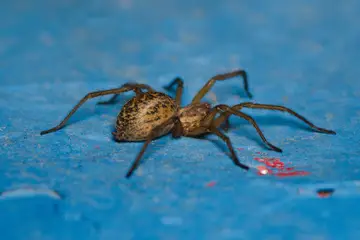

The hobo spider is a brown funnel-web spider from Europe that now lives in the Pacific Northwest and parts of the inland West. It was once said to cause flesh-wounds from its bite. University extension services now say that claim is not backed by evidence. UC IPM says its bite is not considered of medical importance, but that until there is proof, it is sensible to treat it as of minor medical importance. Utah State notes that the CDC does not list it among venomous spiders that are toxic to people. Official sources place it in Washington, Oregon, Idaho, Montana, Wyoming, Colorado and northern Utah. UC ANR
On this page
Is the hobo spider dangerous?
UC IPM: the hobo spider's bite is not considered of medical importance. Proof is still lacking either way, so UC IPM says it is prudent to treat it as of minor medical importance. UC ANR
“The bite of the hobo spider is not considered of medical importance. … These studies demonstrate that definitive proof is still lacking as to whether or not the hobo spider is a dangerous spider. Until proof is provided, however, it would be prudent to consider the hobo spider to be of minor medical importance.”
Bites and stings: Yes, in defense. Utah State Extension says bites cause mild pain and redness. A verified Oregon bite (cited by UC IPM) caused pain, redness and leg twitching for 12 hours.
No official source we use states whether this animal is venomous. That does not mean it is harmless: do not handle it.
If someone is bitten or stung, call 911 or Poison Help at 1-800-222-1222.
How to identify a hobo spider
A photo or description can narrow it down, but cannot confirm what an animal is or that it is safe. Look from a distance and do not handle wild animals.
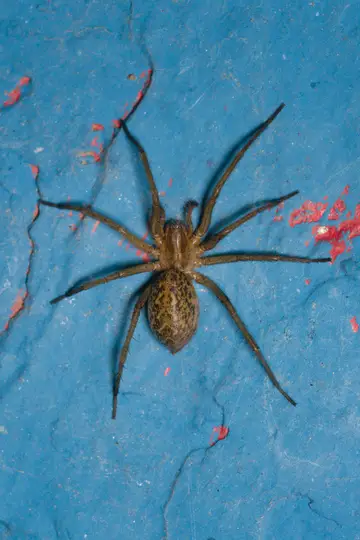

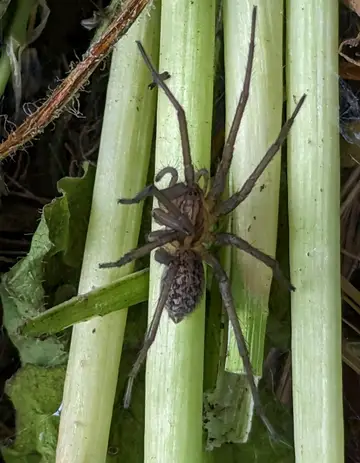
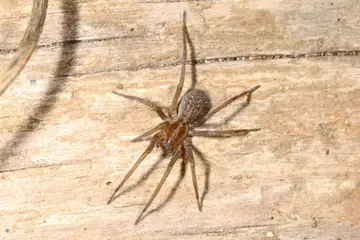
Size: Body length: females 3/8 to 5/8 in (9.5 to 16.5 mm); males 9/32 to 9/16 in (7 to 13.5 mm). About 1 to 1 3/4 in including legs. Utah State University Extension / Utah Plant Pest Diagnostic Lab
Colors: Brown front body with darker brown markings, brown legs; light brown with pale markings. Pattern: Yellow chevron markings on a gray abdomen (hard to see without a hand lens).
Key features
- No dark bands on the legs Utah State University Extension / Utah Plant Pest Diagnostic Lab
- Eight eyes in two rows of four UC ANR
- Cannot be identified by color alone; a sure ID needs a microscope and an expert Utah State University Extension / Utah Plant Pest Diagnostic Lab
- Males have enlarged pedipalps near the mouth that look like short legs Utah State University Extension / Utah Plant Pest Diagnostic Lab
Young
The chevron pattern is generally clearer in young spiders.
Animals mistaken for the hobo spider
Hobo Spider or Giant house spider?
Hobo Spider
Giant house spider Eratigena atrica
Commonly found in Washington homes and often misidentified as the hobo spider. The two need an expert to separate: the male hobo spider's palp has two prongs, the giant house spider's has one.
Hobo Spider or Domestic house spider (barn funnel weaver)?
Hobo Spider
Domestic house spider (barn funnel weaver) Tegenaria domestica
Very similar in color; an arachnologist is needed. Males have one palp prong (hobo: two).
UC IPM: not considered toxic to humans (quote: "Neither of these spiders is considered toxic to humans even though they are closely related to the hobo spider.")
Hobo Spider or Grass spiders?
Hobo Spider
Grass spiders Agelenopsis spp.
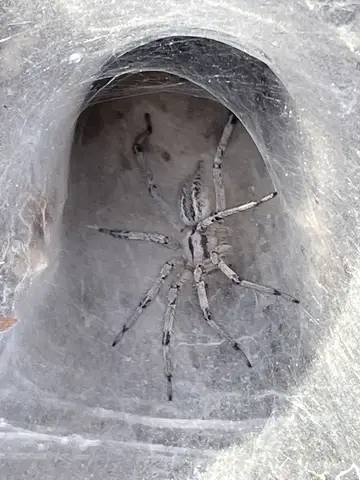
Officially named as a common hobo spider look-alike (Utah State). Utah State University Extension / Utah Plant Pest Diagnostic Lab
Hobo Spider or Wolf spiders?
Hobo Spider
Wolf spiders Lycosidae
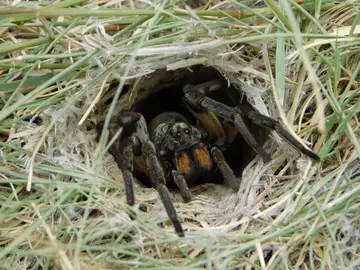

Wolf spiders are often larger (up to 1 inch) and do not build webs. Utah State University Extension / Utah Plant Pest Diagnostic Lab
Hobo Spider or Brown recluse?
Hobo Spider
Brown recluse Loxosceles reclusa
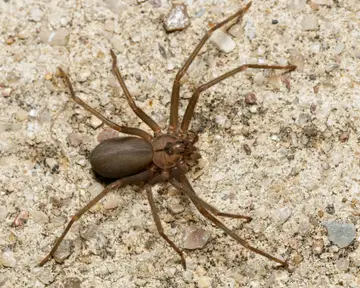
Recluse spiders have 6 eyes in 3 pairs; hobo spiders have 8 eyes in two rows of four.
CDC/NIOSH names the brown recluse as a venomous spider found in the United States.
Where the hobo spider lives
- Native or listed
- Nonnative or not established
- No official record in our data
- 1–9
- 10–99
- 100–999
- 1,000+
On our state guides
- Alaska spiders
- Idaho spidersNonnative
- Montana spidersNonnative
- Oregon spiders
- Utah spidersNonnative
- Washington spiders
State boundaries: U.S. Census Bureau, cartographic boundary file cb_2024_us_state_20m.
When it is active
Most often seen in Utah homes from August through October, when males wander looking for mates. Utah State University Extension / Utah Plant Pest Diagnostic Lab
US open-licence records peak in July to September.
Habitat and habits
Habitat: Sheltered places outdoors: wood and rock piles, retaining walls, tall grass and foundation cracks. Indoors, usually found at ground level, such as basements. Utah State University Extension / Utah Plant Pest Diagnostic Lab
Behavior: Not aggressive and unlikely to bite; the old name 'aggressive house spider' comes from a mistranslation of agrestis ('of the field'). Large hobo spiders cannot climb smooth surfaces, so they often turn up in bathtubs and sinks.
Diet: Catches prey that touches its web; the sources checked do not list prey types.
Young: Takes about 2 years to mature (Utah). Egg sacs are laid in fall (1 to 4 per female, from September) and hatch in late spring. Males die after mating.
Legal status and reporting
Invasive status: Introduced from Europe. None of the official sources checked lists it as a regulated invasive species. Utah State University Extension / Utah Plant Pest Diagnostic Lab
Report: Montana: for a suspected infestation or to submit a sample, contact your local extension agent, the Schutter Diagnostic Lab at Montana State University, or the Montana Department of Agriculture. Utah: take the spider to a local expert for identification. Montana State University Extension IPM Program
Questions about the hobo spider
Hobo spider bite
Hobo spiders bite in defense, and Utah State Extension says this causes mild pain and redness. UC IPM says the bite is not considered of medical importance, but says it is prudent to treat it as of minor medical importance until there is proof. Extension sources say there is no conclusive evidence of flesh-destroying (necrotic) bites. For any bite emergency, call 911 or Poison Help at 1-800-222-1222.
Are there hobo spiders in washington state?
Yes. WSU says it is one of the most commonly found funnel-web spiders in some parts of Washington. UC IPM adds that in Seattle it has been partly displaced by the giant house spider.
Hobo spider washington
WSU says the hobo spider is common in some parts of Washington and that the similar-looking giant house spider is often misidentified as it.
Are there hobo spiders in oregon?
Yes. UC IPM includes Oregon in the hobo spider's North American range.
Hobo spider oregon
UC IPM includes Oregon in the hobo spider's range. It also cites a 2014 Oregon study that verified only one hobo spider bite, which caused pain, redness and leg twitching that went away within 12 hours.
Are there hobo spiders in idaho?
Yes. University of Idaho Extension publishes a fact sheet on hobo spiders in Idaho. It says they can bite but are no longer thought to be poisonous.
Are there hobo spiders in montana?
Yes. Montana State University Extension says hobo spiders have long been prevalent in Montana and enter homes in late summer and early fall.
Hobo spider montana
Montana State University Extension says hobo spiders have long been common in Montana and are not known to be aggressive. For a suspected infestation, it suggests contacting your local extension agent, the Schutter Diagnostic Lab or the Montana Department of Agriculture.
Are there hobo spiders in utah?
Yes. Utah State University Extension says the species is now found throughout northern Utah.
Hobo spider utah
Utah State Extension says hobo spiders live throughout northern Utah and are most often seen in homes from August through October. They bite only in defense, causing mild pain and redness.
Are there hobo spiders in colorado?
Yes. UC IPM includes Colorado in the hobo spider's range.
Are there hobo spiders in ohio?
Ohio DNR (2012) says a look-alike spider produces many false reports of hobo spiders in Ohio, but there are no valid hobo spider records there.
Are there hobo spiders in Michigan, Tennessee and Wisconsin?
Not confirmed. No official source we checked records hobo spiders in these states.
Hobo spider vs brown recluse
Count the eyes. Recluse spiders have 6 eyes in 3 pairs, while hobo spiders have 8 eyes in two rows of four. CDC/NIOSH names the brown recluse as a venomous US spider. It does not name the hobo spider. UC IPM says neither species lives in California.
Brown recluse vs hobo spider
Brown recluses have 6 eyes in 3 pairs, while hobo spiders have 8 eyes in two rows of four. CDC/NIOSH lists the brown recluse, not the hobo spider, as a venomous US spider.
Brown recluse hobo spider utah
Utah State Extension says hobo spiders live throughout northern Utah.
Hobo spider vs giant house spider
They look very similar, and WSU says the giant house spider is often mistaken for the hobo spider. Only an expert can reliably tell them apart: a male hobo spider's palp has two prongs, while the giant house spider's has one.
Hobo spider vs wolf spider
Wolf spiders are often larger, up to 1 inch, and do not build webs. Hobo spiders build funnel webs.
Hobo spider web
UC IPM says hobo spider webs are almost always hidden under objects and are not noticeably funnel-like. Utah State describes funnel webs in wood and rock piles, retaining walls, tall grass and foundation cracks.
Sources
- Pest Notes: Hobo Spider (UC ANR Publication 7488). University of California Statewide IPM Program (UC ANR). 2015-11; checked November 3, 2026.
Quoted passages (2)
“The bite of the hobo spider is not considered of medical importance. … These studies demonstrate that definitive proof is still lacking as to whether or not the hobo spider is a dangerous spider. Until proof is provided, however, it would be prudent to consider the hobo spider to be of minor medical importance.”
“Exceptions are the spiders of the genera Tegenaria and Eratigena, which have eyes that are in the more common pattern of two rows of four.”
- Hobo Spider (Utah Pests fact sheet). Utah State University Extension / Utah Plant Pest Diagnostic Lab. April 2023; checked November 3, 2026.
Quoted passages (13)
“Mature female hobo spiders are 9.5–16.5 mm (3/8–5/8 in.) long, and male hobo spiders are 7–13.5 mm (9/32–9/16 in.) in body length.”
“Unlike many other similar-looking spiders, hobo spiders do not have dark bands on their legs.”
“Because of the wide variation of color and size seen in hobo spiders and other similar species, hobo spiders cannot be identified by color alone.”
“Males have enlarged pedipalps located near the mouth, resembling short legs (Fig. 2).”
“The pattern is generally more distinctive in immature specimens.”
“Hobo spiders are commonly found outdoors in sheltered areas. Places such as wood and rock piles, retaining walls, tall grass, and foundation cracks provide excellent places where they can make their characteristic funnel webs (Fig. 8).”
“The spider waits at the small hole at the bottom of the funnel for prey to make contact.”
“Hobo spiders are nonaggressive and unlikely to bite.”
“Males will seek females for mating from August through October, and this is when they are most frequently encountered in homes.”
“Eggs sacs are deposited in the fall (Fig. 7) and typically hatch in late spring. … Mated females begin laying egg sacs in September, with one to four egg sacs produced. Male spiders die after mating.”
“The hobo spider is native to Europe but was detected in the Pacific Northwest in 1936.”
“Some common hobo spider look-alikes include other members of the funnel-web spider family (Agelenidae), such as the domestic house spider (Tegenaria domestica; Fig. 10) and grass spiders (Agelenopsis spp.; Fig. 11) which are commonly found in home gardens. … The only sure way to identify a spider as a hobo spider is to compare its reproductive structures that define it as a species”
“However, wolf spiders are often larger, reaching up to 1 inch in size, and they do not construct webs.”
- Hobo spider (Pestsense fact sheet). Washington State University (CAHNRS Pestsense). undated page; checked November 3, 2026.
- Hobo Spiders, Eratigena agrestis (MSU Extension IPM fact sheet). Montana State University Extension IPM Program. August 2021; checked November 3, 2026.
Quoted passages (1)
“If you suspect hobo spider infestation on your property or have an insect sample, contact your local extension agent, the Schutter Diagnostic Lab at Montana State University, or the Montana Department of Agriculture.”
- CIS-1221 Hobo Spiders in Idaho (publication page). University of Idaho Extension. December 31, 2015; checked November 3, 2026.
- Common Spiders of Ohio Field Guide (Publication 5140). Ohio Department of Natural Resources, Division of Wildlife. PUBLICATION 5140; checked November 3, 2026.
- Pest Notes: Brown Recluse and Other Recluse Spiders (UC ANR Publication 7468). University of California Statewide IPM Program (UC ANR). 2018-11; checked November 3, 2026.
- Venomous Spiders (Outdoor Workers). CDC / NIOSH. archived copy, captured September 29, 2026; checked November 3, 2026.
- GBIF.org occurrence records, human observations licensed CC0 1.0 or CC BY 4.0 only, accessed November 3, 2026. The datasets behind these counts are listed on our Sources page.
- State boundaries: U.S. Census Bureau, cartographic boundary file cb_2024_us_state_20m.