States Wildlife

Are there armadillos in Tennessee?

Last checked November 3, 2026 against official sources.

On this page
  1. The answer
  2. More official answers
  3. Which ones
  4. Where in the US
  5. Sources

Yes.

Status in Tennessee: Population seems to be increasing, and spreading from west to east.

Tennessee Wildlife Resources Agency: “Status in Tennessee: Population seems to be increasing, and spreading from west to east.” Source

How we answer questions

On Tennessee's official list

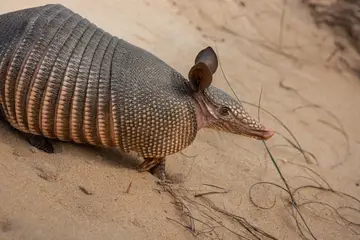
Nine-Banded Armadillo
Photo: MartinKlippel · CC BY-SA 4.0 · Wikimedia Commons · resized

Nine-Banded Armadillo

Dasypus novemcinctus

Size
Cat-sized: 15-17 in long not counting the tail, 8-17 lb (FWC); 24-32 in including a 9.5-14.5 in tail (UGA).
How to recognize it
  • Bony skin plates that form a shell, which make it easy to identify
  • Long scaly tail, deer-like ears, long pig-like snout
  • Tail encased in 12 bony rings; no canine or incisor teeth
Where in Tennessee
These unusual looking animals have only reached Tennessee in the last thirty years or so, but their range continues to expand … Tennessee Wildlife Resources Agency
What the sources say

Range: These unusual looking animals have only reached Tennessee in the last thirty years or so, but their range continues to expand. They occur across the state except in eastern Tennessee.

Habitat: Generally prefer forests of mature shortleaf pine, oak, and hickory. (Tennessee Wildlife Resources Agency)
Full Nine-Banded Armadillo guide

All mammals in the state: Tennessee mammals.

Where the nine-banded armadillo lives in the US

Texas: on the state's official listKentucky: on the state's official listGeorgia: on the state's official list (nonnative)Missouri: on the state's official listVirginia: on the state's official list (nonnative)Tennessee: on the state's official listLouisiana: on the state's official listFlorida: on the state's official list (nonnative)Illinois: on the state's official list (nonnative)Iowa: on the state's official listNebraska: on the state's official listArkansas: on the state's official listMississippi: on the state's official listNorth Carolina: on the state's official list (nonnative)Oklahoma: on the state's official listIndiana: on the state's official listSouth Carolina: on the state's official listNew Mexico: on an official sourceAlabama: on the state's official listKansas: on the state's official list
Official presence. 20 states where a state list or official source names it. Gray means no official record in our data, not that it is absent.
  • Native or listed
  • Nonnative or not established
  • No official record in our data
Texas: 6 recordsTennessee: 4 recordsLouisiana: 2 recordsNew York: 1 recordFlorida: 6 recordsArkansas: 2 recordsMississippi: 1 recordSouth Carolina: 2 recordsKansas: 3 records
Observation records. Open-licence records on GBIF in 9 states. Records are sightings people shared, not confirmation that a population lives there.
  • 1–9
  • 10–99
  • 100–999
  • 1,000+

Nine-banded armadillo: identification, range and danger

When mammals are seen in Tennessee

3,850 records (GBIF, CC0 and CC BY).

Other questions about Tennessee

Sources

  1. Mammals » Bats, Large, Medium, Small (Tennessee Watchable Wildlife species accounts). Tennessee Wildlife Resources Agency (Tennessee Watchable Wildlife website). undated page; checked November 3, 2026.
    Quoted passages (3)
    “Status in Tennessee: Population seems to be increasing, and spreading from west to east.”
    “Status in Tennessee: Cougars in TN are a rare and infrequent sighting. However there were mulitple confirmed sightings in the fall of 2015.”
    “Status in Tennessee: The Tennessee black bear population has significantly increased since the 1970's through management and enforcement.”
  2. GBIF.org occurrence records, human observations licensed CC0 1.0 or CC BY 4.0 only, accessed November 3, 2026. The datasets behind these counts are listed on our Sources page.