States Wildlife

Are there fire ants in Tennessee?

Last checked November 3, 2026 against official sources.

On this page
  1. The answer
  2. Which ones
  3. Where in the US
  4. Lookalikes
  5. Sources

Yes.

UT says Tennessee has an Imported Fire Ant Quarantine Rule, established in 1990, and publishes a 2024 county list. The black imported fire ant's range includes southern Tennessee.

University of Tennessee Institute of Agriculture: “In Tennessee the Department of Agriculture, Division of Regulatory Services established the Imported Fire Ant Quarantine Rule in 1990.” Source

How we answer questions

The 2 on Tennessee's list

Red Imported Fire Ant
Photo: Judy Gallagher · CC BY 2.0 · Wikimedia Commons

Red Imported Fire Ant

Solenopsis invicta

Not stated Nonnative

Venom
No official source we use states whether this animal is venomous. That does not mean it is harmless: do not handle it.
Danger to people
“The red imported fire ant, Solenopsis invicta Buren, the black imported fire ant, Solenopsis richteri Forel, and their hybrid are nuisance insects and their stings can cause serious medical problems.” University of Tennessee Institute of Agriculture, Department of Entomology and Plant Pathology
No confirmed photo of Black Imported Fire Ant

Black Imported Fire Ant

Solenopsis richteri

Not stated Nonnative

Venom
No official source we use states whether this animal is venomous. That does not mean it is harmless: do not handle it.
Danger to people
“The red imported fire ant, Solenopsis invicta Buren, the black imported fire ant, Solenopsis richteri Forel, and their hybrid are nuisance insects and their stings can cause serious medical problems.” University of Tennessee Institute of Agriculture, Department of Entomology and Plant Pathology

All insects in the state: Tennessee insects and bugs.

Where fire ants live in the US

Texas: nonnative, on an official sourceCalifornia: nonnative, on an official sourceGeorgia: nonnative, on an official sourceVirginia: nonnative, on an official sourceTennessee: nonnative, on an official sourceLouisiana: nonnative, on an official sourceFlorida: nonnative, on an official sourceArkansas: nonnative, on an official sourceMississippi: nonnative, on an official sourceNorth Carolina: nonnative, on an official sourceOklahoma: nonnative, on an official sourceSouth Carolina: nonnative, on an official sourceHawaii: on an official sourceNew Mexico: on an official sourceAlabama: nonnative, on an official sourceArizona: on an official source
Official presence. 17 states where a state list or official source names it. Gray means no official record in our data, not that it is absent.
  • Native or listed
  • Nonnative or not established
  • No official record in our data
Texas: 1,279 recordsCalifornia: 262 recordsGeorgia: 265 recordsVirginia: 41 recordsTennessee: 5 recordsLouisiana: 222 recordsFlorida: 607 recordsMaryland: 2 recordsArkansas: 17 recordsMississippi: 66 recordsNorth Carolina: 130 recordsUtah: 1 recordOklahoma: 26 recordsNevada: 4 recordsSouth Carolina: 165 recordsHawaii: 22 recordsNew Mexico: 11 recordsAlabama: 48 recordsArizona: 119 records
Observation records. Open-licence records on GBIF for the five US fire ants named on this page (Solenopsis invicta, S. richteri, S. geminata, S. xyloni and S. aurea) in 19 states. Records are sightings people shared, not confirmation that a population lives there.
  • 1–9
  • 10–99
  • 100–999
  • 1,000+

Fire ants: identification, range and danger

What else it could be

  • Tropical fire ant
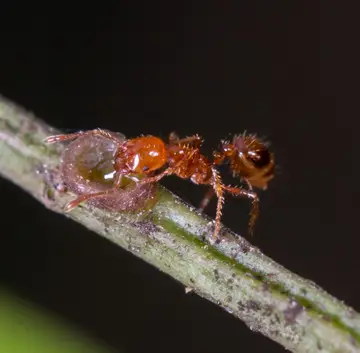
    Photo: portioid · CC BY-SA 4.0 · Wikimedia Commons · resized

    Tropical fire ant

    Its colonies contain big workers with square heads that are large for their bodies; red imported fire ant workers do not have oversized heads (UF/IFAS). Hawaii's HISC says a microscope is required to tell the two apart.

  • Southern fire ant
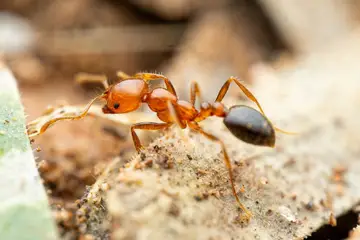
    Photo: Jake Nitta · CC BY 4.0 · Wikimedia Commons

    Southern fire ant

    About the same size and color as the red imported fire ant; its nests are irregular, scattered soil with several hidden entrances rather than a dome; less aggressive. Definite ID needs a microscope (2 clypeal teeth vs 3).

  • California harvester ant ("red ants")

    Workers are all the same size (about 1/5 inch) and red; many people call these red ants. Fire ant workers vary in size within a colony.

  • Little fire ant

    Much smaller (about 1/16 inch, all workers the same size), uniform yellow-red to light brown, and does NOT build mounded dirt nests; nests in trees, potted plants, irrigation lines and electrical boxes and often falls on people from above.

  • Argentine ant
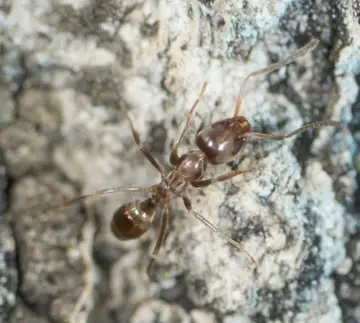
    Photo: Jesse Rorabaugh · CC0 1.0 · iNaturalist

    Argentine ant

    Small grayish-black ant, all the same size (about 1/10 inch), moving in long trails.

When insects are seen in Tennessee

40,689 records (GBIF, CC0 and CC BY).

Other questions about Tennessee

Sources

  1. Quarantine | Fire Ants in Tennessee. University of Tennessee Institute of Agriculture. undated page; checked November 3, 2026.
    Quoted passages (1)
    “In Tennessee the Department of Agriculture, Division of Regulatory Services established the Imported Fire Ant Quarantine Rule in 1990.”
  2. Fire Ants in Tennessee. University of Tennessee Institute of Agriculture, Department of Entomology and Plant Pathology. undated page; checked November 3, 2026.
    Quoted passages (1)
    “The red imported fire ant, Solenopsis invicta Buren, the black imported fire ant, Solenopsis richteri Forel, and their hybrid are nuisance insects and their stings can cause serious medical problems.”
  3. GBIF.org occurrence records, human observations licensed CC0 1.0 or CC BY 4.0 only, accessed November 3, 2026. The datasets behind these counts are listed on our Sources page.