Are there coral snakes in Tennessee?
Last checked November 3, 2026 against official sources.
On this page
No.
The Scarletsnake is a mimic of the venomous Coral Snake, which does not occur in Tennessee.
Tennessee Wildlife Resources Agency: “The Scarletsnake is a mimic of the venomous Coral Snake, which does not occur in Tennessee.” Source
More official answers for Tennessee
Are there alligators in Tennessee?
Yes. TWRA: "Since 2018, confirmed sightings in Shelby, Fayette, and Hardin counties have been recorded by the TWRA", and an alligator was caught in Norris Lake in East Tennessee in March 2024. TWRA says alligators are expanding their range naturally from southern border states. USGS NAS separately lists two nonindigenous records (Marion 2009, Union 2024), both status "failed". Tennessee Wildlife Resources Agency
Are there water moccasins (cottonmouths) in Tennessee?
Yes. These venomous snakes, also commonly known as “water moccasin,” occur in the western third of Tennessee, including counties on the northern Highland Rim. TWRA poster: "COTTONMOUTHS (Agkistrodon piscivorus) DO NOT OCCUR IN EAST TENNESSEE. MOST REPORTED SIGHTINGS CAN BE ATTRIBUTED TO MISIDENTIFICATION OF THE NORTHERN WATERSNAKE." Tennessee Wildlife Resources Agency
Are there rattlesnakes in Tennessee?
Yes. TWRA lists two: the Timber Rattlesnake and the Pygmy Rattlesnake. This is the largest, and the most dangerous, of the 4 venomous snakes in Tennessee; it occurs across the state. Tennessee Wildlife Resources Agency
Are there eastern diamondback rattlesnakes in Tennessee?
The Eastern Diamondback Rattlesnake (Crotalus adamanteus) is not usually found in Tennessee. Tennessee Poison Center (Vanderbilt University Medical Center), Tennessee's poison-control program
Are there venomous lizards in Tennessee?
Southeastern Five-lined Skink account: "Both the five-lined skinks are mistakenly thought to be venomous." Tennessee Wildlife Resources Agency
Where coral snakes live in the US
- Native or listed
- Nonnative or not established
- No official record in our data
- 1–9
- 10–99
- 100–999
- 1,000+
Where official sources do confirm it
Official sources confirm coral snakes in 10 states: Alabama, Arizona, Florida, Georgia, Louisiana, Mississippi, New Mexico, North Carolina, South Carolina and Texas. Alabama, Georgia, Mississippi and North Carolina border Tennessee.
- Alabama: “There are six species of venomous snakes in Alabama. Those species include the copperhead, cottonmouth, eastern diamondback rattlesnake, timber rattlesnake, pygmy rattlesnake, and eastern coral snake.” Alabama Department of Conservation and Natural Resources (Outdoor Alabama)
- Georgia: “In Georgia, coral snakes are mainly found in the Coastal Plain, though there is a population that occurs in the lower Piedmont along the Flint River basin.” Georgia DNR Wildlife Resources Division
- Mississippi: “Coral snakes inhabit sandy pinewoods in the southeastern counties of Mississippi. They are secretive and generally uncommon, even rare.” Mississippi Department of Wildlife, Fisheries, and Parks
- North Carolina: “These rare snakes are currently located only in the southeastern corner of North Carolina.” NC State Extension (N.C. Cooperative Extension, NC State University)
What else it could be
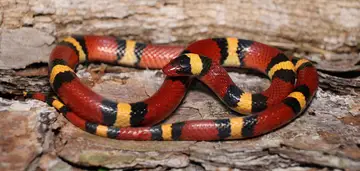
Photo: MH Herpetology · CC BY-SA 4.0 · Wikimedia Commons · resized Scarlet kingsnake
Red snout; yellow rings touch only black rings, never red.
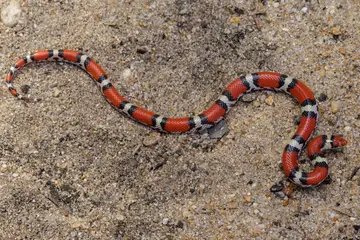
Photo: Stanton · CC BY-SA 4.0 · Wikimedia Commons · resized Scarlet snake
Red, pointed snout; red blotches outlined in black on the back; plain white belly (rings do not go all the way around).
Milk snakes (Louisiana and Mexican milk snakes in Texas; milk snake in New Mexico)
Red bands bordered by black, not yellow; in Texas the bands stop at the belly, which is a uniform color.
Sonoran mountain kingsnake
Red bands bordered by black; coral snake red bands are bordered by yellow.
Western and Sonoran shovel-nosed snakes
Arizona coral snake has a black snout, which separates it from shovel-nosed snakes.


When snakes are seen in Tennessee
If you see one in Tennessee
Keep your distance and do not try to catch or handle it. TWRA "Report Wildlife Encounters, Incidents, or Illness" page (https://www.tn.gov/twra/wildlife/report-wildlife.html): bear conflicts (800) 831-1174; online forms for bear sightings, sick deer, and dead or sick birds. Rare birds: [email protected] (2013 checklist). Aquatic invasive species: TWRA directs people to its Invasive Fish Species page. Tennessee Wildlife Resources Agency
Other questions about Tennessee
Sources
- Reptiles » Snakes (Tennessee Watchable Wildlife species accounts). Tennessee Wildlife Resources Agency (Tennessee Watchable Wildlife website). undated page; checked November 3, 2026.
Quoted passages (3)
“The Scarletsnake is a mimic of the venomous Coral Snake, which does not occur in Tennessee.”
“These venomous snakes, also commonly known as ‘water moccasin,’ occur in the western third of Tennessee, including counties on the northern Highland Rim.”
“This is the largest, and the most dangerous, of the 4 venomous snakes in Tennessee; it occurs across the state.”
- Alligators in Tennessee. Tennessee Wildlife Resources Agency. archived copy, captured October 22, 2026; checked November 3, 2026.
Quoted passages (1)
“There have been several confirmed sightings of alligators in Southwest Tennessee in recent years.”
- Bites & Stings | Tennessee Poison Center. Tennessee Poison Center (Vanderbilt University Medical Center), Tennessee's poison-control program. undated page; checked November 3, 2026.
Quoted passages (1)
“The Eastern Diamondback Rattlesnake (Crotalus adamanteus) is not usually found in Tennessee.”
- Reptiles » Lizards (Tennessee Watchable Wildlife species accounts). Tennessee Wildlife Resources Agency (Tennessee Watchable Wildlife website). undated page; checked November 3, 2026.
Quoted passages (1)
“Both the five-lined skinks are mistakenly thought to be venomous.”
- Report Wildlife Encounters, Incidents, or Illness. Tennessee Wildlife Resources Agency. archived copy, captured August 11, 2026; checked November 3, 2026.
Quoted passages (1)
“To report bear conflicts, call (800) 831-1174”
- GBIF.org occurrence records, human observations licensed CC0 1.0 or CC BY 4.0 only, accessed November 3, 2026. The datasets behind these counts are listed on our Sources page.