Tennessee has 4 venomous snakes named by official sources: Copperhead, Cottonmouth, Timber Rattlesnake and Pygmy Rattlesnake. Each one is labelled venomous by Tennessee Wildlife Resources Agency.
The 4 venomous snakes of Tennessee
Recognize them from a distance; a photo cannot confirm that a snake is safe. Identifying animals safely.
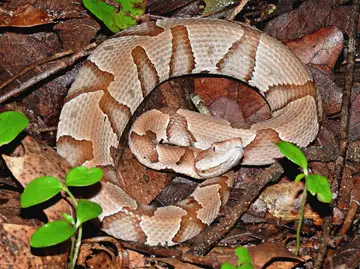
Venom: “One of 4 venomous snakes in Tennessee; this pit viper occurs across the entire state.” (Tennessee Wildlife Resources Agency)
Range: One of 4 venomous snakes in Tennessee; this pit viper occurs across the entire state. Two subspecies are found in Tennessee: Southern Copperhead (A. c. contortrix), which occurs in extreme West Tennessee, and Northern Copperhead (A. c. mokasen), which occurs across the rest of the state.
Habitat: Generally prefers forested habitat and avoids open areas such as pastures and agricultural fields. Often found on rocky, wooded hillsides with abundant logs, leaf litter, or rocks for cover. Copperheads can also be found in urban and suburban environments, as well as near wetland and stream edges. (Tennessee Wildlife Resources Agency)
Typically 30 to 48 inches (about 3 to 4 feet); recorded up to 75 inches.
How to recognize it
Heat-sensing pit between nostril and eye; no rattle
Head much wider than the neck, with a dark bar from the eye to the jaw; vertical (cat-eye) pupils
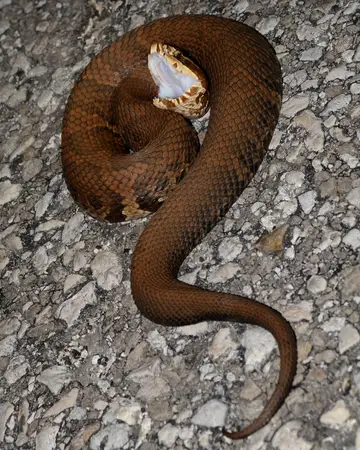
Gapes to show the white lining of its mouth when threatened
Where in Tennessee
These venomous snakes, also commonly known as “water moccasin,” occur in the western third of Tennessee, including counties on the northern Highland Rim … Tennessee Wildlife Resources Agency
JFMAMJJASOND
127 records by month.What the sources say
Venom: “These venomous snakes, also commonly known as ‘water moccasin,’ occur in the western third of Tennessee, including counties on the northern Highland Rim.” (Tennessee Wildlife Resources Agency)
Range: These venomous snakes, also commonly known as “water moccasin,” occur in the western third of Tennessee, including counties on the northern Highland Rim. One subspecies, Western Cottonmouth (A. p. leucostoma), is recognized in the state.
Habitat: Occurs mainly in the swamps, sloughs, wetlands, and drainage ditches of western coastal plain; occasionally found around rivers and lakes. They can be found swimming in the water, coiled on the bank, or in vegetation along the shore. (Tennessee Wildlife Resources Agency)
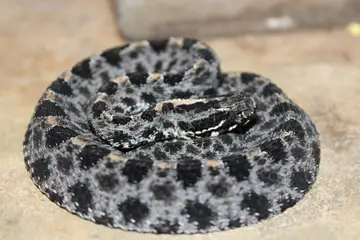
Adults usually 12-24 inches (30-61 cm); record 31-33 inches. Newborns about 5-6 inches.
How to recognize it
Tiny rattle at the end of a slender tail; buzz sounds like an insect
Pit viper: heat-sensing pit between nostril and eye, vertical (cat-like) pupils, keeled scales; nine large plates on top of the head
Large head scales (other rattlesnakes have small scales on the head)
Where in Tennessee
The Pygmy Rattlesnake (also Pigmy) is the smallest, and one of the least known, venomous snakes in Tennessee … Tennessee Wildlife Resources Agency
What the sources say
Venom: “The Pygmy Rattlesnake (also Pigmy) is the smallest, and one of the least known, venomous snakes in Tennessee.” (Tennessee Wildlife Resources Agency)
Range: The Pygmy Rattlesnake (also Pigmy) is the smallest, and one of the least known, venomous snakes in Tennessee. One subspecies, Western Pygmy Rattlesnake (S. m. streckeri), occurs along the western Highland Rim from Stewart County to the southern border.
Habitat: Found in a variety of habitats, but is usually in close proximity to water. Occurs in flood plains, wetlands, and moist fields; occasionally found in rocky uplands, pine woods, and glades. (Tennessee Wildlife Resources Agency)
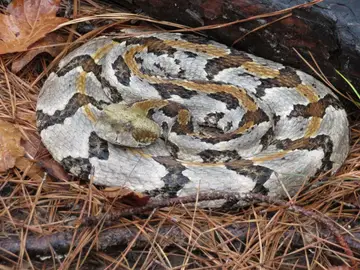
Most adults 36 to 60 inches (3 to 5 feet); record 74.5 inches.
How to recognize it
Black tail ending in a rattle
Heat-sensing pit between nostril and eye
Large, thick head distinct from the neck; cat-like vertical pupil
Where in Tennessee
This is the largest, and the most dangerous, of the 4 venomous snakes in Tennessee; it occurs across the state. Tennessee Wildlife Resources Agency
JFMAMJJASOND
42 records by month.What the sources say
Venom: “This is the largest, and the most dangerous, of the 4 venomous snakes in Tennessee; it occurs across the state.” (Tennessee Wildlife Resources Agency)
Habitat: Prefers mature, heavily wooded forests with rocky, south-facing hillsides; often associated with bluffs or ledges. They can also be found around mountains, swamps, cane thickets, wooded stream corridors, and rural habitats. It is common to see Timber Rattlesnakes coiled near fallen logs or sunning on rocks. (Tennessee Wildlife Resources Agency)
For 11 other snakes on Tennessee's list, no official source we use states whether it is venomous: Coachwhip, Common Kingsnake, Diamond-backed Watersnake, Mississippi Green Watersnake, Plain-bellied Watersnake, Red-bellied Mudsnake, Rough Earthsnake and Southeastern Crowned Snake and others. That does not make them harmless. Leave every snake alone.
See all 32 snakes, venomous and not, on Tennessee snakes. Tennessee Poison Center (Vanderbilt University Medical Center), Tennessee's poison-control program gives Tennessee 34 snake species in all; that page lists the 32 that official sources name one by one.
Snakes people confuse
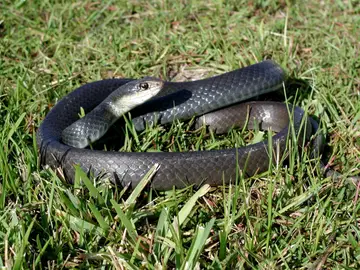
Black Racer or Cottonmouth?
Photo: Everglades NPS from Homestead, Florida, United States · Public domain · Wikimedia Commons
NPS says black racers can resemble the venomous water moccasin and advises leaving alone any snake you cannot identify. It gives no safe field mark, and none is offered here.
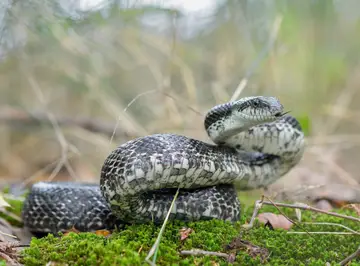
Black Racer or Timber rattlesnake?
Photo: Everglades NPS from Homestead, Florida, United States · Public domain · Wikimedia Commons
TWRA "Report Wildlife Encounters, Incidents, or Illness" page (https://www.tn.gov/twra/wildlife/report-wildlife.html): bear conflicts (800) 831-1174; online forms for bear sightings, sick deer, and dead or sick birds. Rare birds: [email protected] (2013 checklist). Aquatic invasive species: TWRA directs people to its Invasive Fish Species page. Tennessee Wildlife Resources Agency
“A large, slender, solid black snake (36.0 to 60.0 inches in length) with smooth and shiny scales.”
“The top of the head is dark and a dark, downward streak occurs on each side of the head.”
“One of 4 venomous snakes in Tennessee; this pit viper occurs across the entire state.”
“These venomous snakes, also commonly known as ‘water moccasin,’ occur in the western third of Tennessee, including counties on the northern Highland Rim.”
“This is the largest, and the most dangerous, of the 4 venomous snakes in Tennessee; it occurs across the state.”
“The Pygmy Rattlesnake (also Pigmy) is the smallest, and one of the least known, venomous snakes in Tennessee.”
“Gray Ratsnake has keeled scales and body has loaf of bread shape”
“Eastern Coachwhip (black variant) is distinctly lighter or reddish towards rear of body.”
“Red Cornsnake has a spearpoint pattern between the eyes and underside of tail is striped.”
“North American Racer does not have reddish tint along the sides of the tail.”
“Ring-necked Snakes have smooth scales and yellow bellies with paired dots down the center.”
“DeKay’s Brownsnake has a yellowish, tan, or pinkish belly with very small black dots on the sides.”
Snakes of East Tennessee (poster). Tennessee Wildlife Resources Agency, Region IV. archived copy, captured September 2, 2025; checked November 3, 2026.Quoted passages (17)
“NONVENOMOUS SNAKES FOUND IN EAST TENNESSEE … EASTERN WORMSNAKE Carphophis amoenus”
“NONVENOMOUS SNAKES FOUND IN EAST TENNESSEE … SCARLETSNAKE Cemophora coccinea”
“NONVENOMOUS SNAKES FOUND IN EAST TENNESSEE … BLACK RACER Coluber constrictor”
“NONVENOMOUS SNAKES FOUND IN EAST TENNESSEE … RING-NECKED SNAKE Diadophis punctatus”
“NONVENOMOUS SNAKES FOUND IN EAST TENNESSEE … CORNSNAKE Elaphe guttata … The poster uses the older genus Elaphe; TWRA Watchable Wildlife uses Pantherophis for the same species name.”
“NONVENOMOUS SNAKES FOUND IN EAST TENNESSEE … RATSNAKE Elaphe spiloides … The poster uses the older genus Elaphe; TWRA Watchable Wildlife uses Pantherophis for the same species name.”
“NONVENOMOUS SNAKES FOUND IN EAST TENNESSEE … EASTERN HOG-NOSED SNAKE Heterodon platirhinos”
“NONVENOMOUS SNAKES FOUND IN EAST TENNESSEE … EASTERN MILKSNAKE Lampropeltis triangulum … SCARLET KINGSNAKE Lampropeltis elapsoides”
“NONVENOMOUS SNAKES FOUND IN EAST TENNESSEE … NORTHERN WATERSNAKE Nerodia sipedon”
“NONVENOMOUS SNAKES FOUND IN EAST TENNESSEE … ROUGH GREENSNAKE Opheodrys aestivus”
“NONVENOMOUS SNAKES FOUND IN EAST TENNESSEE … NORTHERN PINESNAKE Pituophis melanoleucus”
“NONVENOMOUS SNAKES FOUND IN EAST TENNESSEE … QUEEN SNAKE Regina septemvittata”
“NONVENOMOUS SNAKES FOUND IN EAST TENNESSEE … DEKAY'S BROWNSNAKE Storeria dekayi”
“NONVENOMOUS SNAKES FOUND IN EAST TENNESSEE … RED-BELLIED SNAKE Storeria occipitomaculata”
“NONVENOMOUS SNAKES FOUND IN EAST TENNESSEE … EASTERN RIBBONSNAKE Thamnophis sauritus”
“NONVENOMOUS SNAKES FOUND IN EAST TENNESSEE … COMMON GARTERSNAKE Thamnophis sirtalis”
“NONVENOMOUS SNAKES FOUND IN EAST TENNESSEE … SMOOTH EARTHSNAKE Virginia valeriae”