States Wildlife

Are there mountain lions (cougars) in Tennessee?

Last checked November 3, 2026 against official sources.

On this page
  1. The answer
  2. More official answers
  3. Which ones
  4. Where in the US
  5. Lookalikes
  6. If you see one
  7. Sources

Rarely.

Status in Tennessee: Cougars in TN are a rare and infrequent sighting. However there were mulitple confirmed sightings in the fall of 2015.

Tennessee Wildlife Resources Agency: “Status in Tennessee: Cougars in TN are a rare and infrequent sighting. However there were mulitple confirmed sightings in the fall of 2015.” Source

How we answer questions

On Tennessee's official list

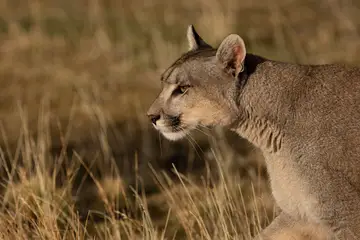
Cougar
Photo: ArgentinaTurismo · CC BY 4.0 · Wikimedia Commons

Cougar

Puma concolor

Size
Total length 5 to 8.5 feet including a 21 to 37.5 inch tail; males 79 to 265 lb, females 64 to 141 lb (Missouri Department of Conservation).
How to recognize it
  • Very large, slender cat with a small head, small rounded ears without tufts and a long, heavy tail.
  • The tail may be one-third of the total length; much larger than a bobcat or lynx.
  • Tracks: 2.75 to 3.75 inches wide, three lobes at the bottom of the heel pad, claw marks usually absent.
Where in Tennessee
Historically, the Cougar could be found roaming all across Tennesseee and was considered the most widely distributed land mammal in the Western Hemisphere … Tennessee Wildlife Resources Agency
What the sources say

Range: Historically, the Cougar could be found roaming all across Tennesseee and was considered the most widely distributed land mammal in the Western Hemisphere. It was believed that persecution and loss of their preferred isolated and undisturbed habitat, it was believed that they had been eliminated in Tennessee and across much of their original range in the eastern U.S.

Habitat: Cougars occupied a wide range of habitats, but preferred dense cover or rocky, rugged, mountainous areas in areas with low human densities. (Tennessee Wildlife Resources Agency)

Full Cougar guide

All mammals in the state: Tennessee mammals.

Where the mountain lion lives in the US

Texas: on the state's official listCalifornia: on the state's official listWisconsin: on the state's official listTennessee: on the state's official listNew York: on the state's official listIdaho: on the state's official listFlorida: on an official sourceMontana: on the state's official listMinnesota: on the state's official listMaryland: on the state's official listIowa: on the state's official listNebraska: on the state's official listWashington: on the state's official listSouth Dakota: on the state's official listArkansas: on the state's official listMississippi: on the state's official listColorado: on the state's official listUtah: on the state's official listOklahoma: on the state's official listWyoming: on the state's official listWest Virginia: on the state's official listMassachusetts: on the state's official listNevada: on the state's official listNorth Dakota: on the state's official listRhode Island: on the state's official listMichigan: on the state's official listAlaska: on the state's official listNew Mexico: on the state's official listAlabama: on the state's official listKansas: on the state's official listArizona: on the state's official list
Official presence. 31 states where a state list or official source names it. Gray means no official record in our data, not that it is absent.
  • Native or listed
  • Nonnative or not established
  • No official record in our data
Texas: 9 recordsCalifornia: 325 recordsOregon: 11 recordsNew York: 19 recordsIdaho: 11 recordsFlorida: 15 recordsMontana: 19 recordsOhio: 1 recordNebraska: 792 recordsWashington: 20 recordsSouth Dakota: 3 recordsColorado: 34 recordsUtah: 14 recordsWyoming: 4 recordsNevada: 6 recordsConnecticut: 1 recordNew Mexico: 13 recordsNew Hampshire: 1 recordArizona: 28 records
Observation records. Open-licence records on GBIF in 19 states. Records are sightings people shared, not confirmation that a population lives there.
  • 1–9
  • 10–99
  • 100–999
  • 1,000+

Mountain lion: identification, range and danger

What else it could be

  • Bobcat
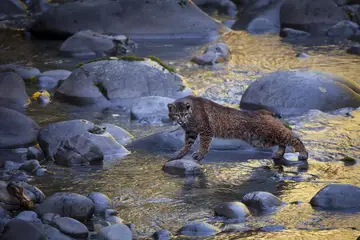
    Photo: National Marine Sanctuaries · Public domain · Wikimedia Commons

    Bobcat

    Bobcats are smaller with short tails and are streaked and spotted with black; mountain lions are uniformly colored with a long tail. Bobcat tracks are under 2 inches wide.

  • Domestic dogs and coyotes (tracks)

    Dog and coyote tracks are symmetrical, show one indent at the bottom of the pad and usually claw marks; mountain lion tracks are asymmetrical with three lobes and usually no claw marks.

  • Misidentified sightings (dogs, house cats, coyotes, bobcats)

    Alabama: reported sightings are likely misidentified dogs, cats, coyotes and bobcats.

When mammals are seen in Tennessee

3,850 records (GBIF, CC0 and CC BY).

If you see one in Tennessee

Keep your distance and do not try to catch or handle it. TWRA "Report Wildlife Encounters, Incidents, or Illness" page (https://www.tn.gov/twra/wildlife/report-wildlife.html): bear conflicts (800) 831-1174; online forms for bear sightings, sick deer, and dead or sick birds. Rare birds: [email protected] (2013 checklist). Aquatic invasive species: TWRA directs people to its Invasive Fish Species page. Tennessee Wildlife Resources Agency
Other questions about Tennessee

Sources

  1. Mammals » Bats, Large, Medium, Small (Tennessee Watchable Wildlife species accounts). Tennessee Wildlife Resources Agency (Tennessee Watchable Wildlife website). undated page; checked November 3, 2026.
    Quoted passages (3)
    “Status in Tennessee: Cougars in TN are a rare and infrequent sighting. However there were mulitple confirmed sightings in the fall of 2015.”
    “Status in Tennessee: The Tennessee black bear population has significantly increased since the 1970's through management and enforcement.”
    “Status in Tennessee: Population seems to be increasing, and spreading from west to east.”
  2. Report Wildlife Encounters, Incidents, or Illness. Tennessee Wildlife Resources Agency. archived copy, captured August 11, 2026; checked November 3, 2026.
    Quoted passages (1)
    “To report bear conflicts, call (800) 831-1174”
  3. GBIF.org occurrence records, human observations licensed CC0 1.0 or CC BY 4.0 only, accessed November 3, 2026. The datasets behind these counts are listed on our Sources page.