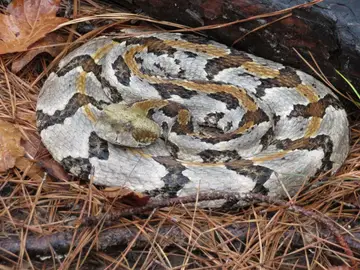
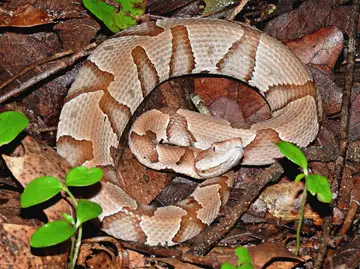
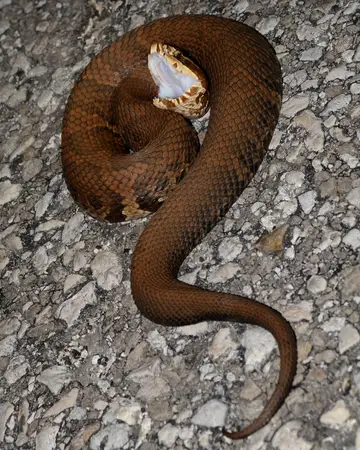
Virginia has 3 venomous snakes named by official sources: Canebrake Rattlesnake and Timber Rattlesnake (two forms of one species), Eastern Copperhead and Northern Cottonmouth. Each one is labelled venomous by Virginia DWR.
The 3 venomous snake species of Virginia
Recognize them from a distance; a photo cannot confirm that a snake is safe. Identifying animals safely.
“Timber rattlesnakes are common only in the mountainous regions of western Virginia and a small area of extreme southeastern Virginia where they are known as canebrake rattlesnakes; they are a state …” Virginia DWR
Size
Most adults 36 to 60 inches (3 to 5 feet); record 74.5 inches.
How to recognize it
Black tail ending in a rattle
Heat-sensing pit between nostril and eye
Large, thick head distinct from the neck; cat-like vertical pupil
Where in Virginia
Timber rattlesnakes are common only in the mountainous regions of western Virginia and a small area of extreme southeastern Virginia where they are known as canebrake … Virginia DWR
JFMAMJJASOND
51 records by month.What the sources say
Venom: “There are only 3 species of venomous snakes occurring in the Commonwealth: Northern Copperhead, Eastern Cottonmouth, and Timber Rattlesnake.” (Virginia DWR)
Range: Timber rattlesnakes are common only in the mountainous regions of western Virginia and a small area of extreme southeastern Virginia where they are known as canebrake rattlesnakes; they are a state endangered species.
“There are only three species of venomous snakes in Virginia …” Virginia DWR
Size
Adults usually about 2 to 3 feet (24-36 in); record about 53 inches.
How to recognize it
Vertical (cat-like) pupils and a heat-sensing pit between eye and nostril
Heavy-bodied; keeled scales
Head shape alone is not a reliable way to identify copperheads
JFMAMJJASOND
152 records by month.What the sources say
Venom: “There are only 3 species of venomous snakes occurring in the Commonwealth: Northern Copperhead, Eastern Cottonmouth, and Timber Rattlesnake.” (Virginia DWR)
“Water moccasins, also commonly referred to as cottonmouths, are found to the south and east of Petersburg and are common only in wet areas.” Virginia DWR
Size
Typically 30 to 48 inches (about 3 to 4 feet); recorded up to 75 inches.
How to recognize it
Heat-sensing pit between nostril and eye; no rattle
Head much wider than the neck, with a dark bar from the eye to the jaw; vertical (cat-eye) pupils
Gapes to show the white lining of its mouth when threatened
Where in Virginia
The distribution of cottonmouths in Virginia is primarily limited to the southeastern part of the state, particularly the southern regions of Virginia Beach and … Virginia DWR
Range: The distribution of cottonmouths in Virginia is primarily limited to the southeastern part of the state, particularly the southern regions of Virginia Beach and Chesapeake with isolated populations in Brunswick, Chesterfield, Dinwiddie, Greensville, Prince George, Southampton, Surry, Sussex, and York counties, and the cities of Suffolk and Newport News.
“Timber rattlesnakes are common only in the mountainous regions of western Virginia and a small area of extreme southeastern Virginia where they are known as canebrake rattlesnakes; they are a state …” Virginia DWR
Size
Most adults 36 to 60 inches (3 to 5 feet); record 74.5 inches.
How to recognize it
Black tail ending in a rattle
Heat-sensing pit between nostril and eye
Large, thick head distinct from the neck; cat-like vertical pupil
Where in Virginia
Timber rattlesnakes are common only in the mountainous regions of western Virginia and a small area of extreme southeastern Virginia where they are known as canebrake … Virginia DWR
JFMAMJJASOND
51 records by month.What the sources say
Venom: “There are only 3 species of venomous snakes occurring in the Commonwealth: Northern Copperhead, Eastern Cottonmouth, and Timber Rattlesnake.” (Virginia DWR)
Range: Timber rattlesnakes are common only in the mountainous regions of western Virginia and a small area of extreme southeastern Virginia where they are known as canebrake rattlesnakes; they are a state endangered species.
For 1 other snake on Virginia's list, no official source we use states whether it is venomous: Brahminy Blindsnake. That does not make them harmless. Leave every snake alone.
See all 36 snakes, venomous and not, on Virginia snakes. Virginia DWR gives Virginia 32 snake species in all; that page lists the 36 that official sources name one by one.
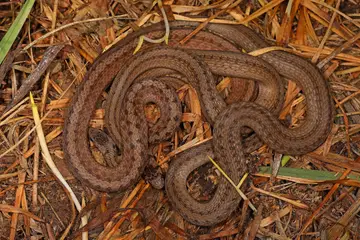
Copperheads have bold hourglass-shaped bands, and young copperheads under about 12 inches have bright yellow tail tips. Brown snakes have small spots, not hourglass bands.
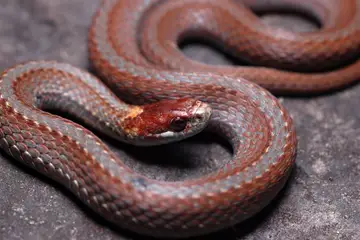
Brown Snake (Dekay's Brownsnake) or Red-bellied Snake?
Also venomous. Juvenile cottonmouths have many dark spots and speckles inside their dark crossbands (copperhead bands have none or at most one). The Florida Museum says adult Florida cottonmouths are typically uniformly dark, but SCDNR says cottonmouth color ranges from dark brown and black to olive drab and yellow-tan, so a pale snake is not ruled out. The copperhead's eye is not obscured by the dark facial band typical of the cottonmouth. Cottonmouths are almost always associated with wetlands.
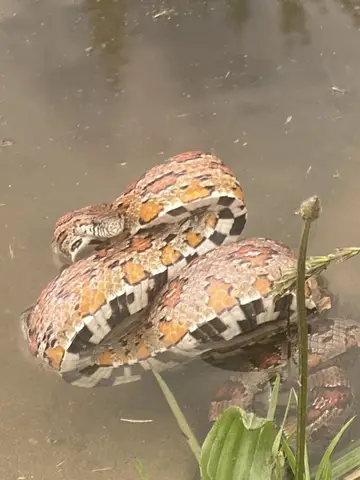
Milk snake blotches are outlined in black and widest across the middle of the back; belly is a black-and-white checkerboard (copperhead belly is mottled white to gray).
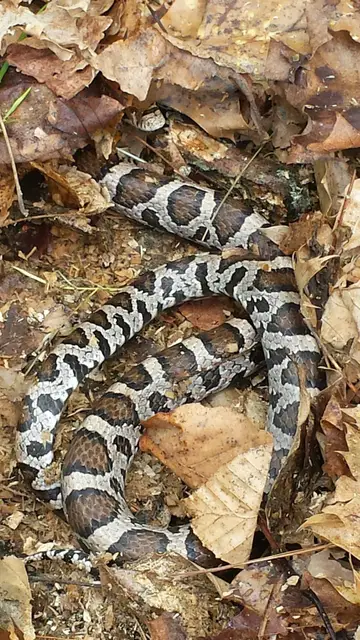
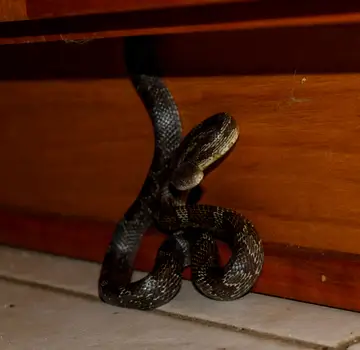
Young rat snakes (black rat snake / eastern ratsnake) Non-venomous
Hatchling and yearling rat snakes have irregular blotches, not hourglass bands, and turn virtually all black as adults (NJ Division of Fish and Wildlife). New Jersey says no other snake there has the copperhead's hourglass pattern; Delaware DNREC says the same for Delaware.
Photos show typical adults; individuals vary. Never get close to compare.
When venomous snakes are active in Virginia
Records of snakes in Virginia peak in April to June and September. They show when people record snakes, not how many there are (about month bars).
JanFebMarAprMayJunJulAugSepOctNovDec
3,083 records of snakes in Virginia by month (GBIF, CC0 and CC BY records).
Snakes leave their winter dens in early to mid-spring and become active. Virginia DWR
Snake eggs are usually laid in May or June and hatch in late summer; live-bearing species give birth in late summer. Virginia DWR
Baby snakes, including newborn copperheads, appear in late summer/September. Virginia DWR
If you are bitten or stung
Call 911 or Poison Help at 1-800-222-1222 right away. Poison Help connects you to your local poison center, any time of day.
Official advice from Virginia DWR and Blue Ridge Poison Center, UVA Health:
Leave snakes alone; even venomous snakes bite only as a last resort. Virginia DWR
“There are 32 species of snake in Virginia, but only three are venomous (cottonmouth, copperhead, and timber rattlesnake).”
“Some nonvenomous snakes (eastern milksnakes, black kingsnakes, and black racers) actually prey on other snakes, including venomous species.”
“Some of the more commonly encountered harmless (nonvenomous) snakes in Virginia include the eastern milksnake, northern ring-necked snake, eastern ratsnake (aka black snake), black racer, and northern watersnake”
“…other species of nonvenomous snake, such as the eastern hog-nosed snake, will also float on the water.”
“Northern Cottonmouth (venomous).”
“Northern Watersnake (nonvenomous).”
“Plain-bellied Watersnake (nonvenomous).”
“The distribution of cottonmouths in Virginia is primarily limited to the southeastern part of the state, particularly the southern regions of Virginia Beach and Chesapeake with isolated populations in Brunswick, Chesterfield, Dinwiddie, Greensville, Prince George, Southampton, Surry, Sussex, and York counties, and the cities of Suffolk and Newport News.”
“There are only 3 species of venomous snakes occurring in the Commonwealth: Northern Copperhead, Eastern Cottonmouth, and Timber Rattlesnake.”
“Leathery shelled eggs are usually deposited in May or June, with young hatching in late summer.”
Problems with Snakes. Virginia DWR. undated page; checked November 3, 2026.Quoted passages (4)
“Timber rattlesnakes are common only in the mountainous regions of western Virginia and a small area of extreme southeastern Virginia where they are known as canebrake rattlesnakes; they are a state endangered species.”
“There are only three species of venomous snakes in Virginia. The copperhead (found statewide) is the most common; and while it is usually not found inside homes, it may be common in gardens and woodlots.”
“Water moccasins, also commonly referred to as cottonmouths, are found to the south and east of Petersburg and are common only in wet areas.”
“Virginia Department of Wildlife Resources staff do not come to your home or property to remove snakes.”
Season of the Snake. Virginia DWR (blog). June 8, 2015; checked November 3, 2026.Quoted passages (2)
“Snakes, even venomous snakes, will not bite a person unless it were a very last resort.”
“Every year around early- to mid-spring, we receive phone calls, emails, and the occasional visitor with questions about, photos of, specimens of snakes. This is the time of year these animals begin to venture out of their hibernacula in search of food, mates, and shelter.”
“To be safe, assume a snake may be venomous and leave it alone.”
“A bite victim should go to an emergency care facility”
It’s Baby Snake Season! Virginia DWR (J.D. Kleopfer/DWR). September 18, 2019; checked November 3, 2026.Quoted passages (1)
“It’s that time of the year when eggs laid back in the spring have hatched and live-bearing snakes, which includes eastern copperheads, have given birth.”
“If you are experiencing a problem with wildlife, please dial our toll-free wildlife conflict helpline at 1-855-571-9003.”
Invasive Species. Virginia DWR. undated page; checked November 3, 2026.Quoted passages (1)
“In Virginia since 2004, the snakehead species has shown up in the Potomac and Rappahannock rivers and their tributaries as well as in various ponds and lakes.”