States Wildlife

Venomous Snakes in Montana: 1 Species & How to Tell

Last checked November 3, 2026 against official sources.

On this page
  1. The venomous snake
  2. Lookalikes
  3. When they are active
  4. If you are bitten or stung
  5. How to report
  6. About this list
  7. Sources

Montana has 1 venomous snake named by official sources: Prairie Rattlesnake. It is labelled venomous by Montana State University Extension.

The venomous snake of Montana

Recognize them from a distance; a photo cannot confirm that a snake is safe. Identifying animals safely.

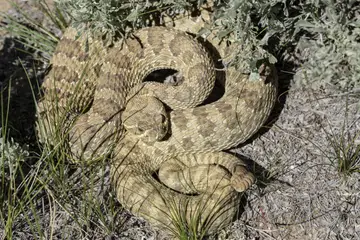
Prairie Rattlesnake
Photo: Cecelia Alexander · CC0 1.0 · iNaturalist

Prairie Rattlesnake

Crotalus viridis

Venomous per Montana State University Extension

Danger to people
“On rare occasions, rattlesnake bites have caused severe injury – even death.” Montana State University Extension
Size
Usually about 3 to 4 feet; Montana gives 15 to 60 inches and NPS says up to 5 feet. Arizona gives a maximum of 28 to 64 inches (excluding rattle) depending on subspecies; in Colorado it is rarely over 39 inches.
How to recognize it
  • Rattle (or a button in newborns) at the tail tip
  • Head much broader than the neck, many small scales on top of the head, heat-sensing pit between eye and nostril
  • Vertical (cat-like) pupils
Where in Montana
Prairie Rattlesnakes occur throughout Montana, typically below 6,500 feet Montana State University Extension
Conservation
State Rank S4; FWP SWAP: SGCN
48 records by month.
What the sources say

Venom: “Montana only has 10 native snake species, of which, only the Prairie Rattlesnake (Crotalus viridis) is venomous.” (Montana State University Extension)

Habitat: Favor open and arid country but are also found in ponderosa pine stands and mixed grass-coniferous forests (Montana State University Extension)

Full Prairie Rattlesnake guide

See all 10 snakes, venomous and not, on Montana snakes.

Snakes people confuse

Rubber Boa or Racer (Western Yellow-bellied Racer)?

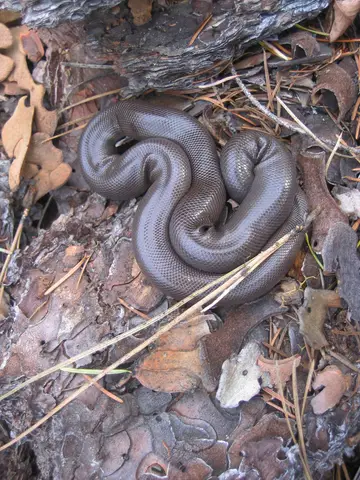
Rubber Boa
Photo: NPS Staff · Public domain · Wikimedia Commons

Rubber Boa Non-venomous

Racer (Western Yellow-bellied Racer)
Photo: Everglades NPS from Homestead, Florida, United States · Public domain · Wikimedia Commons

Racer (Western Yellow-bellied Racer) Non-venomous

WDFW: racers have large eyes, large back scales and a tail that tapers to a point; rubber boas have small eyes, tiny scales and a blunt tail. Racers are fast and will strike and bite if cornered or handled; rubber boas are slow and non-aggressive. Yellowstone adds that racers have round pupils.

Prairie Rattlesnake or Bullsnake (gopher snake)?

Prairie Rattlesnake
Photo: Cecelia Alexander · CC0 1.0 · iNaturalist

Prairie Rattlesnake Venomous

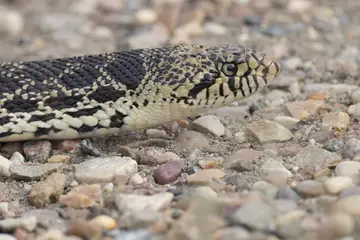
Bullsnake (gopher snake)
Photo: Cephas · CC BY-SA 4.0 · Wikimedia Commons · resized

Bullsnake (gopher snake) Non-venomous

The bullsnake has no rattle, an oval or rounded head and large round pupils; the prairie rattlesnake has a triangular head, slit pupils and a rattle. Bullsnakes are often mistaken for rattlesnakes: when threatened they may coil, flatten the head, hiss and vibrate the tail in dry leaves to sound like a rattle, so do not judge by behavior or by head shape alone.

Prairie Rattlesnake or Western hognose snake?

Prairie Rattlesnake
Photo: Cecelia Alexander · CC0 1.0 · iNaturalist

Prairie Rattlesnake Venomous

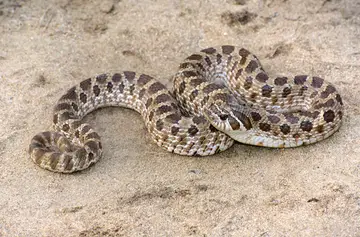
Western hognose snake
Photo: Dean Hester · CC BY 4.0 · iNaturalist

Western hognose snake Non-venomous

The Montana Field Guide names the western hog-nosed snake as a lookalike and says that in Montana no other snake has rattles: a hognose has no rattle.

Photos show typical adults; individuals vary. Never get close to compare.

When venomous snakes are active in Montana

Records of snakes in Montana peak in May to July. They show when people record snakes, not how many there are (about month bars).

318 records of snakes in Montana by month (GBIF, CC0 and CC BY records).

If you are bitten or stung

Call 911 or Poison Help at 1-800-222-1222 right away. Poison Help connects you to your local poison center, any time of day.

Official advice from Montana State University Extension and Montana Fish, Wildlife & Parks:

How to report

Boat or trailer with aquatic organisms: 1-800-TIP-MONT (1-800-847-6668). FWP main office: (406) 444-2535. Montana Fish, Wildlife & Parks

About this list

The species list comes from Montana Field Guide: Reptiles (snake families); FWP: Living with Snakes (Montana Natural Heritage Program (Montana State Library) with Montana Fish, Wildlife & Parks: Montana Field Guide, Internet Archive captures 2025-05-06 to 2026-09-02, one per family page (each listed below)).

Venom labels come only from official sources and link to them; "Not stated" never means harmless. How labels work.

Sources

  1. Contact Us. Montana Fish, Wildlife & Parks. archived copy, captured October 19, 2026; checked November 3, 2026.
  2. Montana Field Guide: Reptiles and Amphibians (family species lists). Montana Natural Heritage Program (Montana State Library) with Montana Fish, Wildlife & Parks: Montana Field Guide. archived copy, captured May 6, 2025; checked November 3, 2026.
  3. Living with Snakes. Montana Fish, Wildlife & Parks. archived copy, captured May 18, 2026; checked November 3, 2026.
    Quoted passages (2)
    “Of the 10 species of snakes found in Montana only the western rattlesnake is poisonous.”
    “If you have a problem with snakes, the best advice is to just leave them alone.”
  4. Plains Hog-nosed Snake - Heterodon nasicus. Montana Natural Heritage Program (Montana State Library) with Montana Fish, Wildlife & Parks: Montana Field Guide. archived copy, captured February 8, 2026; checked November 3, 2026.
    Quoted passages (1)
    “The Western Hog-nosed Snake contains slightly toxic saliva secretions, which have caused mild envenomations in some humans”
  5. Rattlesnake Safe in Montana (MontGuide MT202201AG). Montana State University Extension. Revised January 2022; checked November 3, 2026.
    Quoted passages (7)
    “Montana only has 10 native snake species, of which, only the Prairie Rattlesnake (Crotalus viridis) is venomous.”
    “On rare occasions, rattlesnake bites have caused severe injury – even death.”
    “If you encounter a snake, simply maintain a safe distance (three times the body length) and walk around, allowing plenty of space.”
    “Do not attempt to kill the snake, as many bites occur during the process.”
    “Do not handle a freshly-killed snake, as it can still inject venom for some time following death.”
    “Most bites occur between the months of April and September when snakes and humans are most active outdoors.”
    “Snakes are generally not active when temperatures dip below 60° F.”
  6. Report a suspected AIS. Montana Fish, Wildlife & Parks. archived copy, captured May 3, 2026; checked November 3, 2026.
    Quoted passages (1)
    “If you see a boat or trailer with aquatic organisms attached to it, call 1-800-TIP-MONT (1-800-847-6668) immediately.”
  7. GBIF.org occurrence records, human observations licensed CC0 1.0 or CC BY 4.0 only, accessed November 3, 2026. The datasets behind these counts are listed on our Sources page.