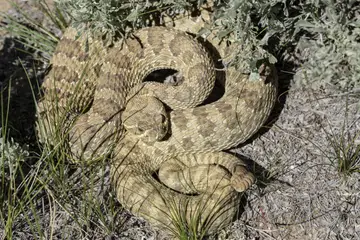
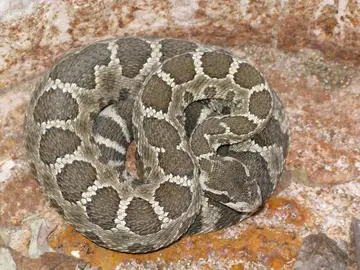
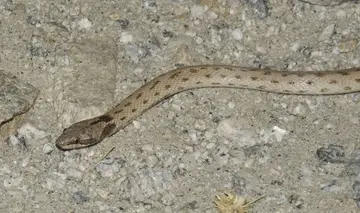
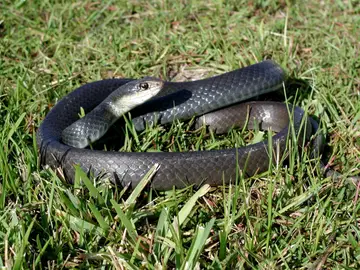
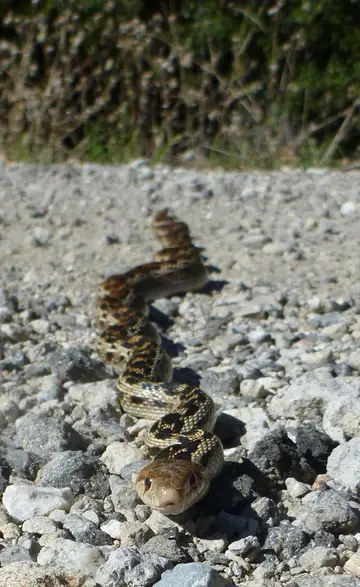
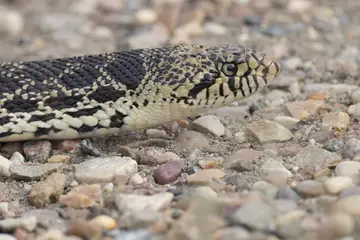
Idaho has 2 venomous snakes named by official sources: Western Rattlesnake and Prairie Rattlesnake. Each one is labelled venomous by Idaho Department of Fish and Game. Digital Atlas of Idaho, Idaho State University also lists 1 snake as mildly venomous; it is shown separately below.
The 2 venomous snakes of Idaho
Recognize them from a distance; a photo cannot confirm that a snake is safe. Identifying animals safely.
Usually about 3 to 4 feet; Montana gives 15 to 60 inches and NPS says up to 5 feet. Arizona gives a maximum of 28 to 64 inches (excluding rattle) depending on subspecies; in Colorado it is rarely over 39 inches.
How to recognize it
Rattle (or a button in newborns) at the tail tip
Head much broader than the neck, many small scales on top of the head, heat-sensing pit between eye and nostril
Vertical (cat-like) pupils
Where in Idaho
East-central Idaho and a small section near the northeastern border with Montana; especially common in the Frank Church River of No Return Wilderness. Idaho Department of Fish and Game
Conservation
IDAPA classification: Predatory; State Conservation Rank S3
What the sources say
Venom: “Rattlesnakes are the only dangerous snakes in Idaho. They use venom to kill their prey.” (Idaho Department of Fish and Game)
Habitat: Sagebrush deserts, forests, grasslands or around water; rocky areas for shelter. (Idaho Department of Fish and Game)
Varies by area and subspecies: up to 63 in. excluding rattle (Arizona); largest in the Northwest 59 in., most Washington adults around 2 ft; 18 to 36 in. average (Oregon); C. o. concolor rarely over 26 in. (Colorado).
How to recognize it
Rattle on the tail; broad triangular head; facial pits
Vertical pupils and heat-sensing pits near the nostrils
Strongly keeled scales
Where in Idaho
Most common rattlesnake in Idaho; across southern Idaho and up along the western borders with Oregon and Washington. Idaho Department of Fish and Game
Conservation
IDAPA classification: Predatory; State Conservation Rank S4
JFMAMJJASOND
40 records by month.What the sources say
Venom: “Rattlesnakes are the only dangerous snakes in Idaho. They use venom to kill their prey.” (Idaho Department of Fish and Game)
Habitat: Sagebrush deserts, forests, grasslands or around water; rocky areas for shelter. (Idaho Department of Fish and Game)
For 9 other snakes on Idaho's list, no official source we use states whether it is venomous: Common Gartersnake, Long-nosed Snake, North American Racer, Northern Rubber Boa, Ring-necked Snake, Smooth Greensnake, Striped Whipsnake and Terrestrial Gartersnake and others. That does not make them harmless. Leave every snake alone.
Mildly venomous snakes
Digital Atlas of Idaho, Idaho State University lists this snake as mildly venomous. Each card quotes what the source says about its venom. Like any snake, leave them alone.
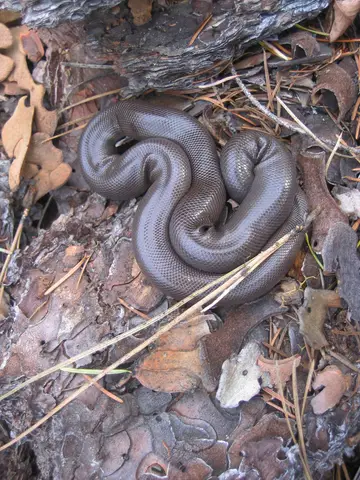
WDFW: racers have large eyes, large back scales and a tail that tapers to a point; rubber boas have small eyes, tiny scales and a blunt tail. Racers are fast and will strike and bite if cornered or handled; rubber boas are slow and non-aggressive. Yellowstone adds that racers have round pupils.
Western Rattlesnake or Gopher snake (gophersnake)?
WDFW (Washington): no rattle and no facial pits, oval pupils, smaller square spots, a narrow eye stripe and less keeled scales. It can coil, strike, hiss loudly and vibrate its tail like a rattlesnake, so behavior alone does not tell them apart.
The bullsnake has no rattle, an oval or rounded head and large round pupils; the prairie rattlesnake has a triangular head, slit pupils and a rattle. Bullsnakes are often mistaken for rattlesnakes: when threatened they may coil, flatten the head, hiss and vibrate the tail in dry leaves to sound like a rattle, so do not judge by behavior or by head shape alone.
Photos show typical adults; individuals vary. Never get close to compare.
When venomous snakes are active in Idaho
Records of snakes in Idaho peak in May to July. They show when people record snakes, not how many there are (about month bars).
JanFebMarAprMayJunJulAugSepOctNovDec
403 records of snakes in Idaho by month (GBIF, CC0 and CC BY records).
If you hear a rattlesnake you are too close; move away from the sound. Never try to grab a rattlesnake or any snake. Idaho Department of Fish and Game
Rattlesnake country: wear tall leather boots and long loose pants; do not lift anything a snake could be under with your hands. Idaho Department of Fish and Game
How to report
Invasive species: Idaho Invasive Species Hotline 1-877-336-8676 (ISDA). Wildlife crimes: Citizens Against Poaching 1-800-632-5999 (IDFG). Bear sightings and conflicts: report to the state wildlife agency (IDFG regional offices). Idaho State Department of Agriculture
About this list
The species list comes from Idaho Species Catalog, Reptilia Class (In Idaho? = Yes) (Idaho Department of Fish and Game, 2017 (Internet Archive capture 2017-05-02); species status from IDFG species pages captured 2025-2026; same species on the 2024-09-12 capture of the unfiltered Reptilia class page (sources/v-idaho-2.txt)).
Venom labels come only from official sources and link to them; "Not stated" never means harmless. How labels work.
Sources
About Fish and Game. Idaho Department of Fish and Game. archived copy, captured September 23, 2026; checked November 3, 2026.
Charina bottae species account. Digital Atlas of Idaho, Idaho State University (digitalatlas.cose.isu.edu). archived copy, captured May 15, 2024; checked November 3, 2026.
Coluber constrictor species account. Digital Atlas of Idaho, Idaho State University (digitalatlas.cose.isu.edu). archived copy, captured April 9, 2025; checked November 3, 2026.
Masticophis taeniatus species account. Digital Atlas of Idaho, Idaho State University (digitalatlas.cose.isu.edu). archived copy, captured June 6, 2024; checked November 3, 2026.
“Rattlesnakes are the only dangerous snakes in Idaho. They use venom to kill their prey.”
“This is a harmless gopher snake pretending to be a rattlesnake to scare away danger.”
“If you have cell service, call 911.”
“If you hear a rattlesnake, you are too close and should move away from the sound.”
“…they are mostly nocturnal, especially during hot summer months.”
“In Idaho, the babies, call snakelets, are born between late August and early October.”
“Rattlesnakes are found everywhere in Idaho except in the far north and higher mountain elevations.”
Diadophis punctatus species account. Digital Atlas of Idaho, Idaho State University (digitalatlas.cose.isu.edu). archived copy, captured June 4, 2024; checked November 3, 2026.
Hypsiglena torquata species account. Digital Atlas of Idaho, Idaho State University (digitalatlas.cose.isu.edu). archived copy, captured August 9, 2024; checked November 3, 2026.Quoted passages (1)
“Night Snakes are mildly venomous (although not dangerous to humans)”
Pituophis catenifer species account. Digital Atlas of Idaho, Idaho State University (digitalatlas.cose.isu.edu). archived copy, captured October 14, 2024; checked November 3, 2026.
Rhinocheilus lecontei species account. Digital Atlas of Idaho, Idaho State University (digitalatlas.cose.isu.edu). archived copy, captured June 5, 2024; checked November 3, 2026.
Sonora semiannulata species account. Digital Atlas of Idaho, Idaho State University (digitalatlas.cose.isu.edu). archived copy, captured January 17, 2025; checked November 3, 2026.
Thamnophis elegans species account. Digital Atlas of Idaho, Idaho State University (digitalatlas.cose.isu.edu). archived copy, captured February 12, 2025; checked November 3, 2026.
Thamnophis sirtalis species account. Digital Atlas of Idaho, Idaho State University (digitalatlas.cose.isu.edu). archived copy, captured October 14, 2024; checked November 3, 2026.
“If you are working or playing in rattlesnake country, it's good practice to wear tall, leather boots, and long, loose pants.”
Crotalus viridis species account. Digital Atlas of Idaho, Idaho State University (digitalatlas.cose.isu.edu). archived copy, captured April 22, 2025; checked November 3, 2026.Quoted passages (1)
“Active from about April to November over most of range, and from late March to October in southern British Columbia and northern Idaho.”
Invasive Species / Pests / Invertebrates. Idaho State Department of Agriculture (Invasive Species of Idaho program). undated page; checked November 3, 2026.Quoted passages (1)
“Idaho Invasive Species Hotline [toll-free]: 1-877-336-8676”