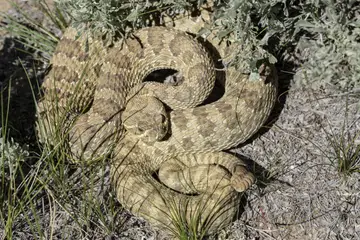
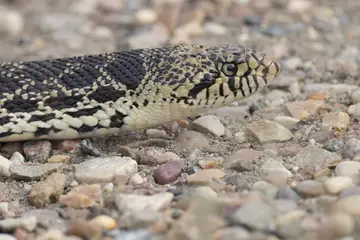
Usually about 3 to 4 feet; Montana gives 15 to 60 inches and NPS says up to 5 feet. Arizona gives a maximum of 28 to 64 inches (excluding rattle) depending on subspecies; in Colorado it is rarely over 39 inches.
How to recognize it
Rattle (or a button in newborns) at the tail tip
Head much broader than the neck, many small scales on top of the head, heat-sensing pit between eye and nostril
Western Rattlesnake Sensitive – Critical (Willamette Valley)
What the sources say
Venom: “There are 15 native snake species in Oregon. Of these, only the Western Rattlesnake has poisonous venom that is dangerous to humans.” (Oregon Department of Fish and Wildlife)
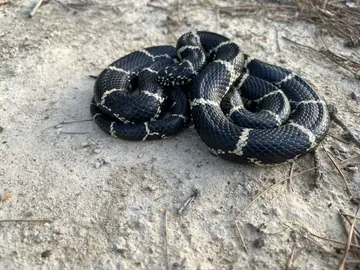
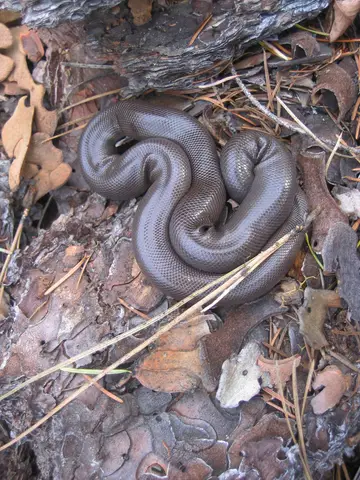
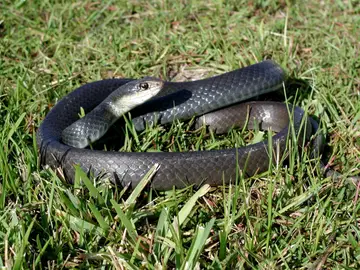
For 10 other snakes on Oregon's list, no official source we use states whether it is venomous: California Mountain Kingsnake, Common Kingsnake, Forest Sharp-tailed Snake, Ground Snake, Night Snake, Racer, Ring-necked Snake and Rubber Boa and others. That does not make them harmless. Leave every snake alone.
See all 16 snakes, venomous and not, on Oregon snakes. Oregon Department of Fish and Wildlife gives Oregon 15 snake species in all; that page lists the 16 that official sources name one by one.
WDFW: racers have large eyes, large back scales and a tail that tapers to a point; rubber boas have small eyes, tiny scales and a blunt tail. Racers are fast and will strike and bite if cornered or handled; rubber boas are slow and non-aggressive. Yellowstone adds that racers have round pupils.
The bullsnake has no rattle, an oval or rounded head and large round pupils; the prairie rattlesnake has a triangular head, slit pupils and a rattle. Bullsnakes are often mistaken for rattlesnakes: when threatened they may coil, flatten the head, hiss and vibrate the tail in dry leaves to sound like a rattle, so do not judge by behavior or by head shape alone.
Photos show typical adults; individuals vary. Never get close to compare.
When venomous snakes are active in Oregon
Records of snakes in Oregon peak in April to August. They show when people record snakes, not how many there are (about month bars).
JanFebMarAprMayJunJulAugSepOctNovDec
1,703 records of snakes in Oregon by month (GBIF, CC0 and CC BY records).
Invasive species sightings: Oregon Invasives Hotline, oregoninvasiveshotline.org or 1-866-INVADER; wildlife conflicts: local ODFW office (ODFW main phone 503-947-6000) Oregon Invasives Hotline
About this list
The species list comes from Living with Wildlife: Snakes (ODFW) and ODFW Wildlife Viewing: Snakes (Oregon Department of Fish and Wildlife, undated PDF (uploaded to myodfw.com 2026-01 per file path); as of retrieval 2026-11-03). 1 more entry comes from other official sources named on each card.
Venom labels come only from official sources and link to them; "Not stated" never means harmless. How labels work.
Sources
Wildlife Viewing. Oregon Department of Fish and Wildlife. undated page; checked November 3, 2026.
Living with Wildlife: Snakes. Oregon Department of Fish and Wildlife. undated page; checked November 3, 2026.Quoted passages (15)
“There are 15 native snake species in Oregon. Of these, only the Western Rattlesnake has poisonous venom that is dangerous to humans.”
“Garter snakes are non-venomous and harmless to humans, though the saliva of a garter snake may be mildly toxic to amphibians and other small animals.”
“Although it is not poisonous, this aggressive behavior leads many to believe that it is a rattlesnake.”
“While human deaths from rattlesnake bites are rare, a doctor should be consulted immediately as a bite can be lethal.”
“If you encounter a rattlesnake, move away.”
“Wear over-the-ankle boots and loose-fitting long pants.”
“Never attempt to capture a snake.”
“Do not release snakes into the wild—it is illegal under state law ORS 498.052.”
“Emergence from hibernation can begin as early as March, depending on the species, location and weather.”
“Because they are particularly active and less wary during the breeding season, be on the lookout for them in spring.”
“They are most likely to be seen during the spring and fall when moving to and from hibernation sites.”
“Young hatch from July through September and fend for themselves after hatching, although there has been documentation of rattlesnake mothers defending their young for a period after birth.”
“It is most commonly seen during periods when slugs are active in the fall when the ground is wet but before it begins to freeze at night and in the spring before it becomes too dry.”
“The Western Rattlesnake (Crotalus viridis) is Oregon’s only indigenous rattlesnake. Two sub-species are recognized in Oregon: the Northern Pacific Rattlesnake (C. v. oreganus) … and the Great Basin Rattlesnake (C. v. lutosus)”
“These snakes are often killed when people mistakenly think they are venomous coral snakes native to the southeastern U.S. and as far west as southern Arizona.”
Bites & Stings. Oregon Poison Center, Oregon Health & Science University (poison-control program serving Oregon). undated page; checked November 3, 2026.Quoted passages (1)
“To treat a venomous snake bite, seek medical treatment immediately by calling 9-1-1 or the poison center at 1-800-222-1222.”
Oregon Invasives Hotline. Oregon Invasives Hotline (Oregon Invasive Species Council; "Maintained by Oregon State University"). undated page; checked November 3, 2026.Quoted passages (1)
“Report potential invasive species you've found to the Online Hotline. Your submission will provide vital early detection information to the experts working to stop the next invasion before it starts!”