Great white shark
Carcharodon carcharias · also called White shark, Great white and White pointer · Last checked November 3, 2026.
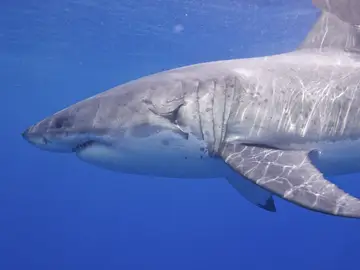

The great white (white) shark is a large ocean shark found in temperate and subtropical seas worldwide; in U.S. waters NOAA Fisheries gives its range as Maine to the Gulf of America and the U.S. Caribbean in the Atlantic, and Alaska to California and Hawaii in the Pacific. It lives in salt water near shore and offshore. It can bite people: California officials say white sharks are involved in most of that state's shark incidents and all likely fatalities there, while also calling such incidents extremely rare. It is a protected, prohibited species that may not be kept in most U.S. waters. NOAA Fisheries
On this page
Is the great white shark dangerous?
California officials say shark bites on people are extremely rare there, but white sharks were involved in most incidents and likely in all of the fatal ones. Marine Region
“Since 1950, there have been less than 250 shark incidents in California involving many species of sharks, the vast majority of which involved white sharks. Of those, fewer than 20 were fatal and all of the fatalities likely involved white sharks”
Bites and stings: Yes. Officials describe bites on people as rare, but some have been serious or fatal (CDFW for California; NPS for Cape Cod; SCDNR calls it very dangerous to people).
No official source we use states whether this animal is venomous. That does not mean it is harmless: do not handle it.
How to identify a great white shark
A photo or description can narrow it down, but cannot confirm what an animal is or that it is safe. Look from a distance and do not handle wild animals.
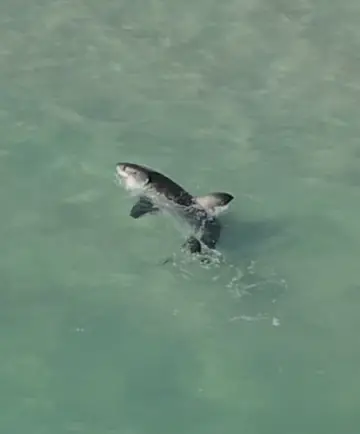
Size: Born about 4 feet long; grows to about 20-21 feet and over 4,000 pounds (NOAA quick facts: up to 4,500 pounds). NOAA Fisheries
Colors: White underside; dark gray to brown on top. Pattern: Often a black spot on the underside of the pectoral fins.
Key features
- Torpedo-shaped body, conical snout, prominent keel at the base of a crescent-shaped tail NOAA Fisheries
- Large first dorsal fin, usually with a pointed tip NOAA Fisheries
- Broad, triangular, serrated teeth NOAA Fisheries
Young
Pups and juveniles stay in near-shore, shallow, warmer waters; nursery areas off southern California and Long Island, New York.
Animals mistaken for the great white shark
Great white shark or Shortfin mako shark?
Great white shark
Shortfin mako shark Isurus oxyrinchus
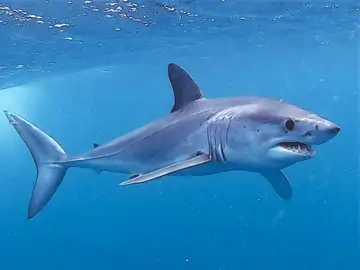
Mako lacks black tips on the undersides of the fins and has thin, pointed teeth without serrations. Marine Region
Great white shark or Salmon shark?
Great white shark
Salmon shark Lamna ditropis
Salmon shark has a generally darker back, larger eye and shorter snout, white coloring above the pectoral fins, and pointed teeth without serrations. Marine Region
Where the great white shark lives
- Native or listed
- Nonnative or not established
- No official record in our data
- 1–9
- 10–99
- 100–999
- 1,000+
On our state guides
- Alaska sharks and marine life
- California sharks and marine life
- Delaware sharks and marine life
- Florida sharks and marine life
- Georgia sharks and marine life
- Hawaii sharks and marine life
- Maine sharks and marine life
- Massachusetts sharks and marine life
- New Hampshire sharks and marine life
- New York sharks and marine life
- North Carolina sharks and marine life
- Oregon sharks and marine life
- South Carolina sharks and marine life
- Virginia sharks and marine life
State boundaries: U.S. Census Bureau, cartographic boundary file cb_2024_us_state_20m.
When it is active
Migrates seasonally following water of about 50-80 °F; off New York, juveniles use Long Island coastal waters in the warm season. NOAA Fisheries
US open-licence records peak in October to December.
Habitat and habits
Habitat: Near-shore coastal waters and offshore open ocean; young stay near shore, older sharks split time between seal and sea lion colonies and the open ocean. NOAA Fisheries
Behavior: Ambush predator; regionally endothermic (partly warm-blooded).
Diet: Fish, invertebrates and marine mammals; large sharks gather at seal and sea lion colonies and scavenge dead whales.
Young: Grows slowly; males mature at about 26 and females at about 33 years (NOAA); estimates of maximum age range from 30 to over 70 years.
Legal status and reporting
Federal: Prohibited species (no retention) in most U.S. waters and fisheries; also protected in some National Marine Sanctuaries and internationally (CITES Appendix II). Note: another section of the same NOAA page says "all U.S. waters and fisheries". NOAA Fisheries
Protection: Protected: may not be kept; must be released immediately if caught (NOAA). California: illegal to catch, pursue, hunt, capture or kill a white shark, protected since January 1, 1994 (CDFW). Prohibited/no-harvest species in North Carolina and Florida state rules.
Report: New York DEC asks the public to report shark incidents (bites) to the Florida Museum of Natural History; at Cape Cod National Seashore, report non-emergency sightings via the Sharktivity app or ranger stations (508) 255-2112 / (508) 487-2100; emergencies: 911. New York State DEC
Questions about the great white shark
Great white shark size
NOAA Fisheries: born about 4 feet long, it can grow to about 20 feet (quick facts: up to 21 feet) and over 4,000 pounds (up to 4,500 pounds).
Great white shark lifespan
NOAA Fisheries lists a lifespan of 70 years or more; it says maximum age is hard to determine and estimates range from 30 to over 70 years.
Great white shark teeth
NOAA Fisheries: broad, triangular teeth with distinct serrations; the lower teeth are usually narrower.
Great white shark attack
Bites on people are rare, but they happen and some are fatal. California officials count fewer than 250 shark incidents there since 1950, mostly involving white sharks, with fewer than 20 fatal. Cape Cod National Seashore reports three bites off Truro and Wellfleet since 2012, one fatal in 2018. In an emergency, call 911.
Great white sharks cape cod
Yes. The National Park Service says great white sharks feed on seals close to shore at Cape Cod and have become more numerous as the seal population grew; spotter planes have seen them near swimming beaches.
Sources
- White Shark. NOAA Fisheries. updated by NOAA Fisheries on 09/30/2026; checked November 3, 2026.
Quoted passages (10)
“The white shark is born at approximately 4 feet long and can grow up to about 20 feet long, weighing over 4,000 pounds.”
“…the white shark has a torpedo-shaped body with a conical snout and a prominent keel at the base of its crescent-shaped tail.”
“It has a large first dorsal fin, which typically has a pointed apex (tip).”
“White shark teeth are broad and triangular with distinct serrations.”
“There are nursery areas for juvenile white sharks in near-shore waters of southern California and off Long Island, New York.”
“The white shark occurs in both near-shore coastal waters and offshore pelagic waters.”
“The white shark has a diverse and opportunistic diet of fish, invertebrates, and marine mammals.”
“…often migrating seasonally to follow its preferred temperature range (approximately 50 to 80 °F).”
“Males mature at approximately 26 years old and females at approximately 33 years old. Maximum age is hard to determine and estimates range from 30 to over 70 years old.”
“The white shark is a prohibited species (no retention allowed) in most U.S. waters and fisheries.”
- White Shark Information. California Department of Fish and Wildlife (Marine Region). undated page; checked November 3, 2026.
Quoted passages (4)
“Since 1950, there have been less than 250 shark incidents in California involving many species of sharks, the vast majority of which involved white sharks. Of those, fewer than 20 were fatal and all of the fatalities likely involved white sharks”
“Both adult and juvenile white sharks are ambush predators, which means they rapidly attack their prey from a concealed position.”
“…the mako shark (Isurus oxyrinchus), which lacks black tips on the undersides of the fins and has thin, pointed teeth without serrations”
“…the salmon shark (Lamna ditropis), which has a generally darker back, larger eye, and shorter snout. It also has white coloration above the pectoral fins, and pointed teeth without serration.”
- Shark Public Safety. New York State DEC. archived copy, captured May 15, 2026; checked November 3, 2026.
Quoted passages (1)
“DEC asks the public to report all incidents to the Florida Museum of Natural History (FMNH).”
- Shark Safety at Cape Cod. National Park Service, Cape Cod National Seashore. updated August 19, 2026; checked November 3, 2026.
- GBIF.org occurrence records, human observations licensed CC0 1.0 or CC BY 4.0 only, accessed November 3, 2026. The datasets behind these counts are listed on our Sources page.
- State boundaries: U.S. Census Bureau, cartographic boundary file cb_2024_us_state_20m.