Shortfin Mako Shark
Isurus oxyrinchus · also called Mako shark, Blue pointer, Bonito shark and Atlantic mako shark · Last checked November 3, 2026.
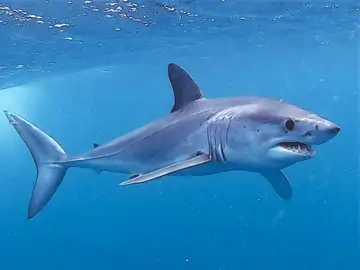
The shortfin mako is a large, very fast offshore shark. It is deep blue on top and white below, with a pointed snout and a crescent-shaped tail. South Carolina's wildlife agency calls it one of the more dangerous sharks but says attacks on local swimmers are unlikely because it rarely comes close to shore. Florida Museum records 10 unprovoked attacks, one of them fatal. In the US, NOAA Fisheries places it off the East Coast from New England to Florida, in the Gulf from Florida to Texas, and off the West Coast, where it is most common off California. It also occurs off Hawaii. Under a NOAA rule announced June 30, 2022, Atlantic shortfin makos may not be kept. SCDNR Marine Resources Division
On this page
Is the shortfin mako shark dangerous?
SCDNR: one of the more dangerous species of sharks, but because it seldom comes close to shore, the chance of an attack on local swimmers is remote. SCDNR Marine Resources Division
“One of the more dangerous species of sharks, however, due to its infrequent occurrence close to shore, the probability of attack on local swimmers is remote.”
Bites and stings: Yes, rarely. The International Shark Attack File lists 10 confirmed unprovoked attacks by shortfin makos worldwide (1 fatal), plus 8 non-fatal attacks by makos not identified to species. Florida Museum adds that hooked makos often damage boats and injure fishers.
No official source we use states whether this animal is venomous. That does not mean it is harmless: do not handle it.
If someone is bitten or stung, call 911 or Poison Help at 1-800-222-1222.
How to identify a shortfin mako shark
A photo or description can narrow it down, but cannot confirm what an animal is or that it is safe. Look from a distance and do not handle wild animals.
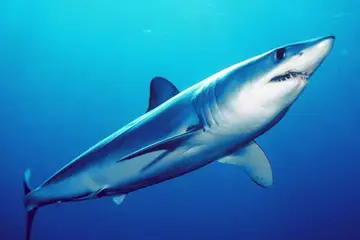

Size: Up to about 13 ft (NOAA, Atlantic; Florida Museum); Pacific: up to 12 ft, averaging 6 to 7 ft (NOAA). SCDNR: averages 5 to 8 ft. NOAA Fisheries
Colors: Dark blue/gray back, light metallic blue sides, white underside; underside of snout and mouth white. Pattern: Sharp line between blue back and white belly.
Key features
- Very pointed snout and long gill slits NOAA Fisheries
- Crescent-shaped (lunate) tail with a single strong keel on each side of the tail base SCDNR Marine Resources Division
- Long, slender, smooth-edged teeth, visible even with the mouth closed
- Short pectoral fins Hawaii DLNR Division of Aquatic Resources
Young
Juveniles have a black blotch on the snout tip and are common in coastal waters; pups are about 2 ft at birth.
Animals mistaken for the shortfin mako shark
Shortfin Mako Shark or Longfin mako?
Shortfin Mako Shark
Longfin mako Isurus paucus
The longfin mako has much longer pectoral fins, larger eyes, a different body shape and a darker underside to the snout. NOAA Fisheries
Shortfin Mako Shark or White shark?
Shortfin Mako Shark
White shark Carcharodon carcharias
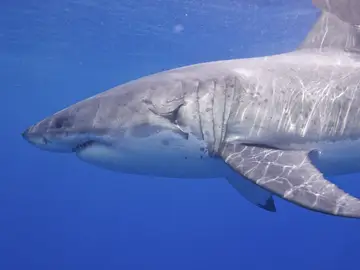

The white shark has broad, triangular, serrated teeth; mako teeth are slender and smooth-edged. SCDNR Marine Resources Division
See the white shark page for official statements.
Shortfin Mako Shark or Porbeagle?
Shortfin Mako Shark
Porbeagle Lamna nasus
The porbeagle's teeth have small side points, and it has a second keel on each side of the tail. SCDNR Marine Resources Division
Where the shortfin mako shark lives
- Native or listed
- Nonnative or not established
- No official record in our data
- 1–9
- 10–99
- 100–999
- 1,000+
On our state guides
- California sharks and marine life
- Delaware sharks and marine life
- Florida sharks and marine life
- Georgia sharks and marine life
- Hawaii sharks and marine life
- Maine sharks and marine life
- Massachusetts sharks and marine life
- New Jersey sharks and marine life
- New York sharks and marine life
- North Carolina sharks and marine life
- South Carolina sharks and marine life
- Virginia sharks and marine life
State boundaries: U.S. Census Bureau, cartographic boundary file cb_2024_us_state_20m.
When it is active
US open-licence records peak in June to July.
Habitat and habits
Habitat: Open ocean (pelagic), in the upper zones of the sea; juveniles are common in coastal waters, while adults are mostly offshore. NOAA Fisheries
Behavior: Extremely active and fast; known for twisting and jumping out of the water. NY DEC and Florida Museum call it the fastest shark, with bursts up to 43 mph.
Diet: Top predator: bluefish, swordfish, tuna, marine mammals and other sharks.
Young: Slow to mature: males at about 8 years (about 6 ft), females at about 19 years (about 9 ft). Three-year breeding cycle, about 18-month pregnancy, live pups about 2 ft long, average litter of 12.
Legal status and reporting
Federal: Atlantic: NOAA set a zero retention limit, so no shortfin mako may be landed or kept in any US Atlantic highly migratory species fishery until further notice (NOAA feature story dated June 30, 2022; effective date not stated on the page). The Atlantic stock is overfished. Listed as a pelagic shark in 50 CFR 635 Appendix A. NOAA Fisheries
Protection: Florida prohibits harvest in state waters; New York lists it as prohibited (possession illegal); Louisiana lists it among prohibited sharks. In federal Atlantic waters the retention limit is zero. FWC
Sources
- Sharks of South Carolina. SCDNR Marine Resources Division (C. H. Farmer III). 2004; checked November 3, 2026.
Quoted passages (5)
“One of the more dangerous species of sharks, however, due to its infrequent occurrence close to shore, the probability of attack on local swimmers is remote.”
“…a single, well-developed lateral keel on each side of caudal peduncle, 6) a lunate caudal fin”
“An extremely active and fast-swimming pelagic shark restricted to waters well offshore. Covers great distances in pursuit of prey. Noted for its acrobatics of twisting and jumping from the water.”
“7) long, slender, smooth-edged teeth without lateral points on sides of cusps. … SIMILAR SPECIES: • The white shark (p. 72) has broad, triangular teeth with serrated edges.”
“The porbeagle shark (p. 78) has long, slender, smooth-edged teeth with lateral points and a secondary keel on each side of the caudal fin.”
- Shortfin Mako (Discover Fishes species profile). Florida Museum of Natural History (University of Florida). undated page; checked November 3, 2026.
Quoted passages (1)
“The juvenile mako has a distinctive black blotch on the tip of its snout (Compagno et al. 2005).”
- Atlantic Shortfin Mako Shark. NOAA Fisheries. updated by NOAA Fisheries on 06/20/2025; checked November 3, 2026.
Quoted passages (6)
“Shortfin mako sharks grow slowly, reach up to 13 feet long, and can live to be over 30 years old.”
“Shortfin mako sharks have very pointed snouts and long gill slits.”
“Shortfin mako sharks are a pelagic species. Their habitat ranges widely in the upper zones of the oceans.”
“Shortfin mako sharks are aggressive predators that feed near the top of the food web on marine fishes such as bluefish, swordfish, tuna, marine mammals, and other sharks.”
“They are not able to reproduce until about 8 years old (~6 feet) for males and 19 years old (~9 feet) for females. They have a 3-year reproductive cycle and a gestation period of approximately 18 months.”
“Compared to shortfin mako sharks, longfin mako sharks have much longer pectoral fins and larger eyes, a different body shape, and the underside of their snout is darker.”
- Pacific Shortfin Mako Shark. NOAA Fisheries. updated by NOAA Fisheries on 06/29/2026; checked November 3, 2026.
- Hawaii Sharks: Species List. Hawaii DLNR Division of Aquatic Resources. undated page; checked November 3, 2026.
- Zero Atlantic Shortfin Mako Shark Retention Limit. NOAA Fisheries. June 30, 2022; checked November 3, 2026.
Quoted passages (1)
“No shortfin mako sharks may be landed or retained in any U.S. Atlantic highly migratory species fishery until further notice.”
- Shark Identification Guide. Hawaii DLNR Division of Aquatic Resources. undated page; checked November 3, 2026.
Quoted passages (1)
“Short pectoral fins; very pointed conical snout with long dagger-like teeth; tail lobes nearly equal in size; pronounced keel at base of tail”
- Sharks (saltwater recreational regulations). Florida Fish and Wildlife Conservation Commission (FWC). archived copy, captured October 14, 2026; checked November 3, 2026.
Quoted passages (1)
“Sharks that are prohibited from harvest in state waters include: … Shortfin mako (Isurus oxyrinchus)”
- GBIF.org occurrence records, human observations licensed CC0 1.0 or CC BY 4.0 only, accessed November 3, 2026. The datasets behind these counts are listed on our Sources page.
- State boundaries: U.S. Census Bureau, cartographic boundary file cb_2024_us_state_20m.