Fisher
Pekania pennanti (older sources: Martes pennanti) · also called fisher cat, fishercat, black cat and pekan · Last checked November 3, 2026.
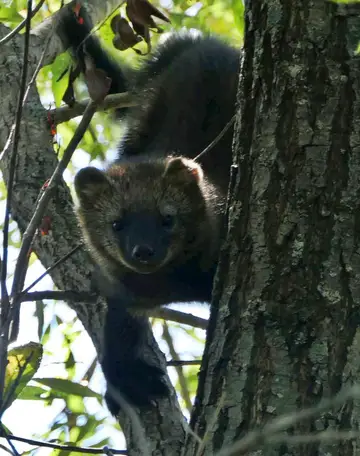
The fisher, often called a fisher cat, is not a cat. It is a large, dark brown member of the weasel family with a long body, short legs and a bushy tail, and it rarely eats fish. No official source reviewed gives a risk level for people; agencies describe fishers as shy and rarely seen. MassWildlife says they prey on free-roaming cats, rabbits and poultry; Vermont calls the threat of an attack on a cat low. Fishers live in forests across the northern US, south to Virginia in the East, and in parts of the West, where one California population is federally endangered. New York State Department of Environmental Conservation
On this page
Is the fisher dangerous?
MassWildlife says problems are usually limited to attacks on domestic birds, rabbits and free-ranging house cats. No official source reviewed states a risk level for people. MassWildlife
“Problems with fishers may sometimes arise, but are usually restricted to predatory attacks on domestic birds, rabbits, and free ranging house cats.”
How to identify a fisher
A photo or description can narrow it down, but cannot confirm what an animal is or that it is safe. Look from a distance and do not handle wild animals.

Size: New York: males 7 to 15 pounds and 35 to 47 inches; females 3 to 7 pounds and 30 to 37 inches. Figures vary by state. New York State Department of Environmental Conservation
Colors: Dark brown to nearly black; head and shoulders lighter and often grizzled, especially in males; tail, rump and feet darkest. Pattern: Some have a white or cream patch on the chest, throat or groin.
Key features
- Low to the ground with short legs, small ears and a well-furred tail New York State Department of Environmental Conservation
- Tail about one-third of total length Pennsylvania Game Commission
- Five toes and sharp semi-retractable claws; bright green eyeshine at night Pennsylvania Game Commission
- Hind feet rotate nearly 180 degrees for headfirst descents New York State Department of Environmental Conservation
Young
Kits are silver-gray until 3 to 4 weeks, then chocolate brown
Animals mistaken for the fisher
Fisher or American mink?
Fisher
American mink
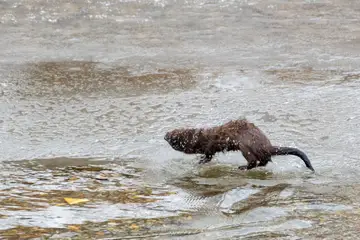
Much smaller, almost always with a small white chin patch, and generally close to water. New York State Department of Environmental Conservation
Fisher or River otter?
Fisher
River otter

Similar size but slightly lighter brown with much shorter, sleeker fur, in or near water. New York State Department of Environmental Conservation
Fisher or American marten?
Fisher
American marten
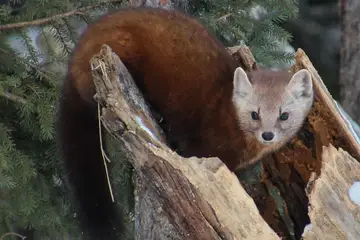
Much smaller and much lighter brown with a grayer head (New York: Adirondacks only). New York State Department of Environmental Conservation
Fisher or Pacific marten?
Fisher
Pacific marten
Smaller (1.5 to 2.5 feet), lighter, with a much shorter tail. Washington Department of Fish & Wildlife
Where the fisher lives
- Native or listed
- Nonnative or not established
- No official record in our data
- 1–9
- 10–99
- 100–999
- 1,000+
On our state guides
- California mammals
- Connecticut mammals
- Idaho mammals
- Iowa mammals
- Maine mammals
- Maryland mammals
- Montana mammals
- New Hampshire mammals
- New York mammals
- North Dakota mammals
- Ohio mammals
- Rhode Island mammals
- Vermont mammals
- Virginia mammals
- Washington mammals
- Wyoming mammals
State boundaries: U.S. Census Bureau, cartographic boundary file cb_2024_us_state_20m.
When it is active
Active year-round and at any hour, generally most at dawn and dusk; Massachusetts notes more daytime activity in winter. New York State Department of Environmental Conservation
US open-licence records peak in January to May and December.
Habitat and habits
Habitat: Forests with heavy canopy; can also live in fragmented and suburban woods in the Northeast. MassWildlife
Behavior: Solitary, shy and rarely seen, even where abundant. New York DEC says a screaming call has never been documented; Rhode Island DEM attributes the night screams to red foxes.
Diet: Opportunistic: small mammals and squirrels, birds, fruit, nuts, carrion and porcupines. Despite the name, rarely fish.
Young: Delayed implantation of 10 to 11 months; an average of 2 to 3 kits born in March or April, usually in a hollow tree high above the ground.
Legal status and reporting
Federal: Southern Sierra Nevada Distinct Population Segment is endangered (California). ECOS shows the Northern California/Southern Oregon segment and the species wherever found as Not Listed. US Fish & Wildlife Service
Protection: State rules differ. Washington: state endangered with no trapping season. New York: protected small game with a regulated season. Rhode Island: protected furbearer. Massachusetts: furbearer with a regulated trapping season. Ohio: Special Interest (occurs periodically, minimal management). Washington Department of Fish & Wildlife
Report: New York DEC asks for fisher sightings; Washington asks for observations through the WDFW reporting form; Massachusetts directs fisher problems to the nearest MassWildlife office. New York State Department of Environmental Conservation
Sources
- Fisher. New York State Department of Environmental Conservation. archived copy, captured July 25, 2026; checked November 3, 2026.
Quoted passages (10)
“…with males weighing between 7 and 15 pounds, and females between 3 and 7 pounds. Total lengths for males range from 35-47 inches, and females, 30-37 inches.”
“Their stature is relatively low to the ground, with short legs, small ears, and a well-furred tail.”
“They are capable of rotating their hind feet nearly 180º, which allows for a headfirst descent from trees.”
“They are the only known North American mammal that regularly preys on porcupines.”
“They have been found to be active at any time during the day or night but are generally most active at dawn and dusk hours.”
“Females give birth to an average of 2-3 kits in March or April.”
“If you’ve seen a fisher, DEC wants to hear about it!”
“Mink are similar in color to fisher, but are much smaller in size, almost always have a small white chin patch, and are generally found in close proximity to water.”
“River otters are similar in size to fishers, but have a slightly lighter brown color with much shorter and sleeker fur, and are generally found in or close to water.”
“American martens are much smaller than fishers, have a much lighter brown coloration, grayer head, and are only found in the Adirondack region.”
- Learn about fishers. Massachusetts Division of Fisheries and Wildlife (MassWildlife). archived copy, captured April 11, 2026; checked November 3, 2026.
Quoted passages (3)
“Problems with fishers may sometimes arise, but are usually restricted to predatory attacks on domestic birds, rabbits, and free ranging house cats.”
“Their preferred habitat is mixed forest with heavy canopy cover, as they tend to avoid traveling in large open areas.”
“Fishers are shy and elusive animals that are rarely seen even in areas where they are abundant.”
- Fisher. Maine Department of Inland Fisheries and Wildlife. undated page; checked November 3, 2026.
- Fisher (Wildlife Fact Sheet). Connecticut DEEP Wildlife Division. rev. 2/18; checked November 3, 2026.
- Species Profile for Fisher (Pekania pennanti), ECOS. U.S. Fish & Wildlife Service. rendered 2026-11-03 in a headless browser; checked November 3, 2026.
Quoted passages (1)
“Endangered 06-15-2020 Pacific Southwest Region (Region 8) Southern Sierra Nevada Distinct Population Segment”
- Fisher. Pennsylvania Game Commission. undated page; checked November 3, 2026.
Quoted passages (3)
“…a full tail that comprises about one third of its total length.”
“Fisher eyes have a horizontal oval pupil that produces a bright green eyeshine at night.”
“The pelage of juveniles has been described as silver-gray until three to four weeks of age, turning to the characteristic chocolate brown thereafter.”
- Fisher. Washington Department of Fish & Wildlife. undated page; checked November 3, 2026.
Quoted passages (2)
“In Washington, the fisher is listed as a state endangered species and there is no trapping season for this species.”
“A fisher may be confused with a Pacific marten which is smaller (between 1.5 to 2.5 feet in length), lighter in color, and have a much shorter tail (6.5 to 7.5 inches).”
- GBIF.org occurrence records, human observations licensed CC0 1.0 or CC BY 4.0 only, accessed November 3, 2026. The datasets behind these counts are listed on our Sources page.
- State boundaries: U.S. Census Bureau, cartographic boundary file cb_2024_us_state_20m.