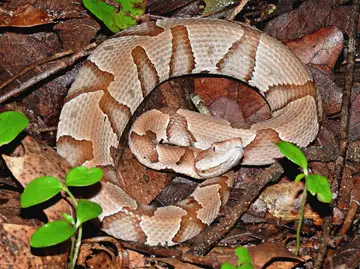
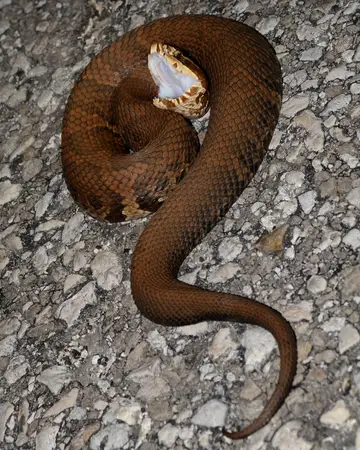
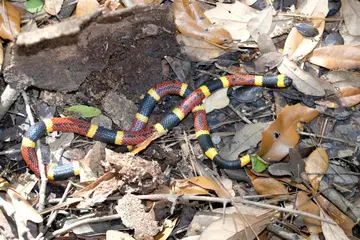
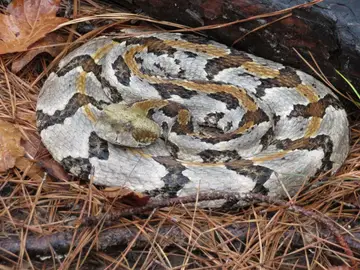
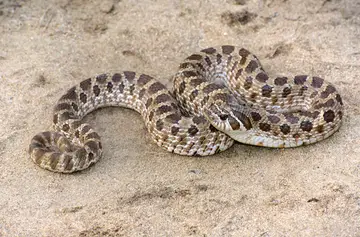
Arkansas has 6 venomous snakes named by official sources: Copperhead, Cottonmouth, Western Diamondback Rattlesnake, Timber Rattlesnake, Western Pigmy Rattlesnake and Texas Coral Snake. Each one is labelled venomous by AGFC.
The 6 venomous snakes of Arkansas
Recognize them from a distance; a photo cannot confirm that a snake is safe. Identifying animals safely.
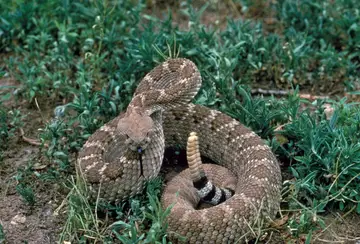
“Arkansas’ rarest venomous snake Western Diamondback Rattlesnake” AGFC
Size
Usually about 3.5 to 4.5 feet; Texas says it can reach seven feet. Arizona's maximum is 66 inches excluding the rattle; Saguaro National Park gives a range of 30 to 90 inches.
How to recognize it
Rattle at the end of the tail
Broad triangular head on a slender neck; vertical pupils
Thin light stripe from behind the eye down to the upper lip
Where in Arkansas
Uplands of Ouachita Mountains and southwestern Ozark highlands AGFC
What the sources say
Habitat: Found in upland rocky, open pine-hardwood forests and rocky outcrops (AGFC)
For 1 other snake on Arkansas's list, no official source we use states whether it is venomous: Lined Snake. That does not make them harmless. Leave every snake alone.
See all 37 snakes, venomous and not, on Arkansas snakes. AGFC gives Arkansas 36 snake species in all; that page lists the 37 that official sources name one by one.
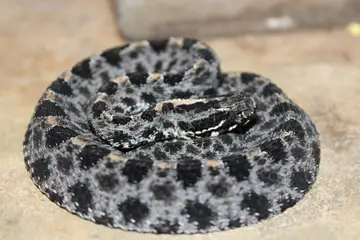
Also venomous. Juvenile cottonmouths have many dark spots and speckles inside their dark crossbands (copperhead bands have none or at most one). The Florida Museum says adult Florida cottonmouths are typically uniformly dark, but SCDNR says cottonmouth color ranges from dark brown and black to olive drab and yellow-tan, so a pale snake is not ruled out. The copperhead's eye is not obscured by the dark facial band typical of the cottonmouth. Cottonmouths are almost always associated with wetlands.
Photo: U.S. Fish and Wildlife Service - Midwest Region · Public domain · Wikimedia Commons
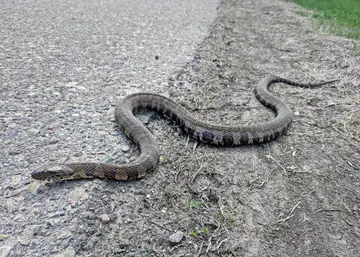
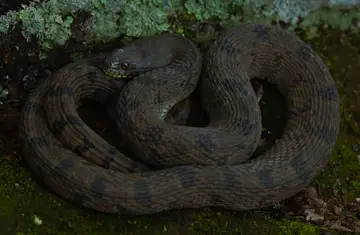
Northern water snake Non-venomous
Its dark bands form a 'reverse hourglass': wider across the back and narrower on the sides (the copperhead's are narrow on the back, wide on the sides). Older water snakes can look solid dark.
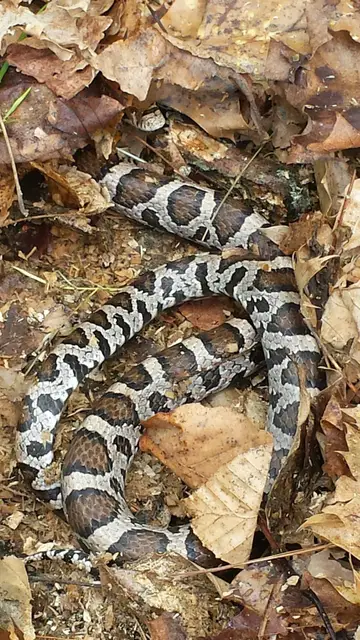
Milk snake blotches are outlined in black and widest across the middle of the back; belly is a black-and-white checkerboard (copperhead belly is mottled white to gray).
Named by Delaware DNREC and Rutgers as a frequent copperhead misidentification. Use the hourglass test: in Delaware only the copperhead has dark hourglass crossbands narrowest at the center of the back.
Seen from directly above, a watersnake's eyes are visible but a cottonmouth's are not. Watersnakes have round pupils and no facial pit, and they usually have thin dark vertical lines on the lips.
Alabama DCNR says this snake is often confused with the cottonmouth. TWRA: the diamond-backed watersnake is lighter, with a chain-like pattern; watersnakes in general lack the cottonmouth's facial pits (see the watersnake entry above).
Photos show typical adults; individuals vary. Never get close to compare.
When venomous snakes are active in Arkansas
Records of snakes in Arkansas peak in April to June. They show when people record snakes, not how many there are (about month bars).
JanFebMarAprMayJunJulAugSepOctNovDec
1,251 records of snakes in Arkansas by month (GBIF, CC0 and CC BY records).
Copperhead: active April-November (AGFC Arkansas Snake Guide). AGFC
Cottonmouth: active April-November (AGFC Arkansas Snake Guide). AGFC
Western Diamondback Rattlesnake: active April-October (AGFC Arkansas Snake Guide). AGFC
Timber Rattlesnake: active April-October (AGFC Arkansas Snake Guide). AGFC
Western Pigmy Rattlesnake: active April-October (AGFC Arkansas Snake Guide). AGFC
Texas Coral Snake: active late February through mid-November (AGFC Arkansas Snake Guide). AGFC
Scarlet Snake: active March-October (AGFC Arkansas Snake Guide). AGFC
Milk Snake: active March-October (AGFC Arkansas Snake Guide). AGFC
Plainbelly Water Snake: active March-November (AGFC Arkansas Snake Guide). AGFC
Broad-banded Water Snake: active late March-October (AGFC Arkansas Snake Guide). AGFC
Diamondback Water Snake: active March-October (AGFC Arkansas Snake Guide). AGFC
Northern Water Snake: active March-October (AGFC Arkansas Snake Guide). AGFC
Great Plains Rat Snake: active March-October (AGFC Arkansas Snake Guide). AGFC
Black Rat Snake: active March-November (AGFC Arkansas Snake Guide). AGFC
Eastern Hognose Snake: active March-October (AGFC Arkansas Snake Guide). AGFC
Prairie Kingsnake: active March-October (AGFC Arkansas Snake Guide). AGFC
Speckled Kingsnake: active March-November (AGFC Arkansas Snake Guide). AGFC
Western Ribbon Snake: active March-October (AGFC Arkansas Snake Guide). AGFC
Common Garter Snake: active March-November (AGFC Arkansas Snake Guide). AGFC
Mud Snake: active April-October (AGFC Arkansas Snake Guide). AGFC
Glossy Crayfish Snake: active March-October (AGFC Arkansas Snake Guide). AGFC
Queen Snake: active late March-October (AGFC Arkansas Snake Guide). AGFC
Eastern Worm Snake: active March-November (AGFC Arkansas Snake Guide). AGFC
Western Worm Snake: active March-November (AGFC Arkansas Snake Guide). AGFC
Ringneck Snake: active March-November (AGFC Arkansas Snake Guide). AGFC
Ground Snake: active April-October (AGFC Arkansas Snake Guide). AGFC
Brown Snake: active late March-October (AGFC Arkansas Snake Guide). AGFC
Redbelly Snake: active March-October (AGFC Arkansas Snake Guide). AGFC
Flathead Snake: active March-October (AGFC Arkansas Snake Guide). AGFC
Rough Earth Snake: active April-October (AGFC Arkansas Snake Guide). AGFC
Smooth Earth Snake: active April-October (AGFC Arkansas Snake Guide). AGFC
If you are bitten or stung
Call 911 or Poison Help at 1-800-222-1222 right away. Poison Help connects you to your local poison center, any time of day.
Official advice from AGFC and University of Arkansas System Division of Agriculture, Cooperative Extension Service:
Leave snakes alone; they bite only if cornered or threatened. AGFC
Do not try to capture, handle or kill a venomous snake. AGFC
Do not rely on pupil shape or head shape to identify a venomous snake. AGFC
Snake repellents have not been shown to work; mow, remove debris and seal the house instead. AGFC
Nuisance wildlife hotline 833-345-0315, 8 a.m.-4:30 p.m., voicemail any time; alligator nuisance calls answered 24/7. Aquatic nuisance species sightings: AGFC Aquatic Nuisance Species Form (www.agfc.com/ans); suspected apple snails also to the ANS Program Coordinator at 501-604-0485. Mountain lion sightings with verifiable evidence: nearest AGFC office. AGFC
About this list
The species list comes from Arkansas Snake Guide (AGFC pocket guide) (Arkansas Game and Fish Commission (AGFC), undated; PDF created 2023-01-06; linked from AGFC Free Publications). 1 more entry comes from other official sources named on each card.
Venom labels come only from official sources and link to them; "Not stated" never means harmless. How labels work.
Sources
Nuisance Wildlife. Arkansas Game and Fish Commission (AGFC). undated page; checked November 3, 2026.Quoted passages (1)
“The nuisance wildlife hotline, 833-345-0315, is available during 8 a.m.-4:30 p.m. for immediate assistance, although voicemails can be left at any time that will be returned during normal working hours. Alligator nuisance calls will be answered 24/7 via an emergency liaison. … Report sightings immediately by filling out the Aquatic Nuisance Species Form … report the location immediately to AGFC at www.agfc.com/ans or immediately call the Aquatic Nuisance Species (ANS) Program Coordinator, Matt Horton, at 501-604-0485 … The public is encouraged to contact their nearest AGFC office with any sightings of mountain lions with verifiable evidence.”
“Spoiler alert: Said snake is harmless to humans. … Hognose snakes also produce a mild venom with their saliva … it has little effect on humans although some people have experienced a bit of swelling along with a burning and tingling sensation, all short-lived.”
Snakes of Arkansas (FSA9102). University of Arkansas System Division of Agriculture, Cooperative Extension Service. PDF created 2021-08-11, modified 2025-04-04; checked November 3, 2026.Quoted passages (1)
“All native snakes, including venomous snakes, are protected by law.”
Encountering Native Snakes in Arkansas. University of Arkansas System Division of Agriculture, Cooperative Extension Service. undated page; checked November 3, 2026.Quoted passages (1)