States Wildlife

Are There Venomous Snakes in Maine? Not Anymore

Last checked November 3, 2026 against official sources.

On this page
  1. The venomous snake once found
  2. Lookalikes
  3. When they are active
  4. If you are bitten or stung
  5. How to report
  6. About this list
  7. Sources

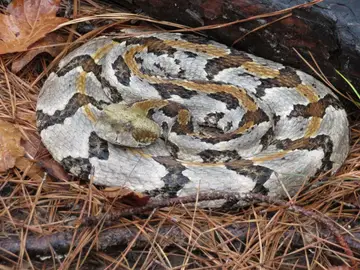
No venomous snake is known to live in Maine today. The timber rattlesnake is on the official list with the status: Extirpated (native populations removed) from Maine. It is labelled venomous by Maine Department of Inland Fisheries and Wildlife. The card below helps you recognize it; if you think you have seen one, leave it alone and report it.

The venomous snake once found in Maine

Recognize them from a distance; a photo cannot confirm that a snake is safe. Identifying animals safely.

Timber Rattlesnake
Photo: NPS Photo · Public domain · Wikimedia Commons

Timber Rattlesnake

Crotalus horridus

Venomous per Maine Department of Inland Fisheries and Wildlife

Danger to people
“Heavily persecuted by early New England settlers, last seen in Maine ca. 1860” Maine Department of Inland Fisheries and Wildlife
Size
Most adults 36 to 60 inches (3 to 5 feet); record 74.5 inches.
How to recognize it
  • Black tail ending in a rattle
  • Heat-sensing pit between nostril and eye
  • Large, thick head distinct from the neck; cat-like vertical pupil
Where in Maine
Formerly southern region only Maine Department of Inland Fisheries and Wildlife
Conservation
Extirpated (native populations removed) from Maine
What the sources say

Venom: “Natural History Notes Venomous” (Maine Department of Inland Fisheries and Wildlife)

Habitat: Upland hardwood forest (Maine Department of Inland Fisheries and Wildlife)

Full Timber Rattlesnake guide

See all 10 snakes, venomous and not, on Maine snakes. Maine Department of Inland Fisheries and Wildlife gives Maine 9 snake species in all; that page lists the 10 that official sources name one by one.

Snakes people confuse

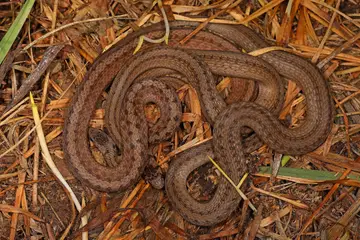
Brown Snake (Dekay's Brownsnake) or Red-bellied Snake?

Brown Snake (Dekay's Brownsnake)
Photo: Judy Gallagher · CC BY 2.0 · Wikimedia Commons

Brown Snake (Dekay's Brownsnake) Non-venomous

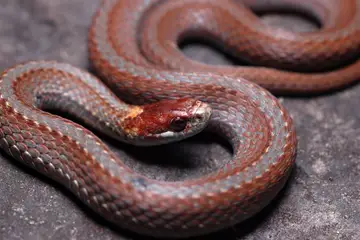
Red-bellied Snake
Photo: Rstanton13 · CC BY-SA 4.0 · Wikimedia Commons · resized

Red-bellied Snake Non-venomous

The red-bellied snake has a red underside; the brown snake's belly is cream, yellow or pink.

Brown Snake (Dekay's Brownsnake) or Ring-necked Snake?

Brown Snake (Dekay's Brownsnake)
Photo: Judy Gallagher · CC BY 2.0 · Wikimedia Commons

Brown Snake (Dekay's Brownsnake) Non-venomous

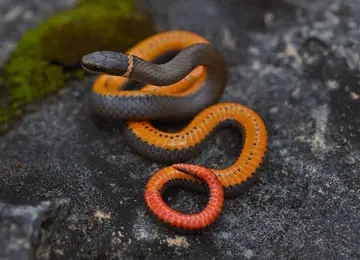
Ring-necked Snake
Photo: Peter Paplanus from St. Louis, Missouri · CC BY 2.0 · Wikimedia Commons

Ring-necked Snake Non-venomous

Ring-necked snakes have smooth scales and yellow bellies with paired dots down the center.

Black Racer or Timber rattlesnake?

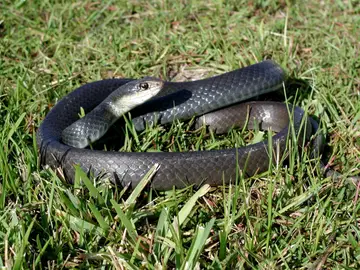
Black Racer
Photo: Everglades NPS from Homestead, Florida, United States · Public domain · Wikimedia Commons

Black Racer Non-venomous

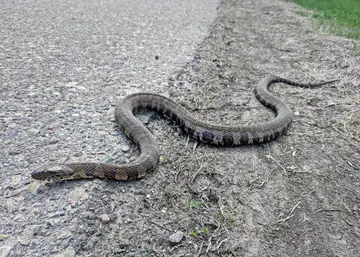
Timber rattlesnake
Photo: NPS Photo · Public domain · Wikimedia Commons

Timber rattlesnake Venomous

NH Fish and Game: the rattlesnake has a blunt rattle, is thicker, and has keeled scales and a triangular head.

Black Racer or Northern water snake?

Black Racer
Photo: Everglades NPS from Homestead, Florida, United States · Public domain · Wikimedia Commons

Black Racer Non-venomous

Northern water snake
Photo: U.S. Fish and Wildlife Service - Midwest Region · Public domain · Wikimedia Commons

Northern water snake Non-venomous

NH lists it as commonly confused; it gives no separating feature.

Red-bellied snake or Dekay's brownsnake?

Red-bellied snake
Photo: Clay Gibbons · CC BY 4.0 · iNaturalist

Red-bellied snake Non-venomous

Dekay's brownsnake
Photo: Judy Gallagher · CC BY 2.0 · Wikimedia Commons

Dekay's brownsnake Non-venomous

Tennessee: Dekay's brownsnake has a yellowish, tan or pinkish belly with very small black dots on the sides.

Red-bellied snake or Ring-necked snake?

Red-bellied snake
Photo: Clay Gibbons · CC BY 4.0 · iNaturalist

Red-bellied snake Non-venomous

Ring-necked snake
Photo: Peter Paplanus from St. Louis, Missouri · CC BY 2.0 · Wikimedia Commons

Ring-necked snake Non-venomous

Connecticut: juvenile redbelly snakes have neck spots that look like a ring, which causes confusion with the ring-necked snake.

Photos show typical adults; individuals vary. Never get close to compare.

When venomous snakes are active in Maine

Records of snakes in Maine peak in June to September. They show when people record snakes, not how many there are (about month bars).

392 records of snakes in Maine by month (GBIF, CC0 and CC BY records).

If you are bitten or stung

Call 911 or Poison Help at 1-800-222-1222 right away. Poison Help connects you to your local poison center, any time of day.

How to report

Stranded, entangled or injured whales, dolphins, porpoises, seals or sea turtles: Maine Marine Animal Reporting Hotline 1-800-532-9551 (DMR). White shark sightings: DMR identification form. Reptile and amphibian sightings, especially listed species: Maine Amphibian & Reptile Atlas Project (IFW). Sick or injured bears: local Game Warden or Regional Wildlife Biologist. Browntail moth and forest-pest questions: dial 211. Maine Department of Marine Resources

About this list

The species list comes from Reptiles & Amphibians: Species Information (Maine IFW species list and species pages) (Maine Department of Inland Fisheries and Wildlife, undated pages (footer copyright 2026); retrieved 2026-11-03). 10 more entries come from other official sources named on each card.

Venom labels come only from official sources and link to them; "Not stated" never means harmless. How labels work.

Sources

  1. Listed Species (Maine Endangered and Threatened Species). Maine Department of Inland Fisheries and Wildlife. undated page; checked November 3, 2026.
  2. Reptiles & Amphibians: Species Information. Maine Department of Inland Fisheries and Wildlife. undated page; checked November 3, 2026.
    Quoted passages (2)
    “Among Maine’s inland (nonmarine) reptiles are seven turtle species and nine snake species. Maine’s 10th snake species, the timber rattlesnake, is extirpated”
    “Maine’s 10th snake species, the timber rattlesnake, is extirpated, with no credible evidence of the species available since the mid 1800s.”
  3. Common Gartersnake (species page). Maine Department of Inland Fisheries and Wildlife. undated page; checked November 3, 2026.
  4. Common Watersnake (species page). Maine Department of Inland Fisheries and Wildlife. undated page; checked November 3, 2026.
    Quoted passages (1)
    “Writhes, bites, and voids feces when handled, but like all Maine snakes is non-venomous”
  5. Dekays Brownsnake (species page). Maine Department of Inland Fisheries and Wildlife. undated page; checked November 3, 2026.
  6. Eastern Milksnake (species page). Maine Department of Inland Fisheries and Wildlife. undated page; checked November 3, 2026.
  7. Eastern Ribbonsnake (species page). Maine Department of Inland Fisheries and Wildlife. undated page; checked November 3, 2026.
  8. North American Racer (species page). Maine Department of Inland Fisheries and Wildlife. undated page; checked November 3, 2026.
    Quoted passages (1)
    “May react aggressively if cornered, although like all Maine snakes is harmless”
  9. Red Bellied Snake (species page). Maine Department of Inland Fisheries and Wildlife. undated page; checked November 3, 2026.
  10. Ring Necked Snake (species page). Maine Department of Inland Fisheries and Wildlife. undated page; checked November 3, 2026.
    Quoted passages (2)
    “So-called ‘rear-fanged,’ mildly venomous (but harmless to humans)”
    “…mildly venomous, harmless to humans”
  11. Smooth Greensnake (species page). Maine Department of Inland Fisheries and Wildlife. undated page; checked November 3, 2026.
    Quoted passages (1)
    “Hibernates in burrows from October through April, often with other snakes”
  12. Timber Rattlesnake (species page). Maine Department of Inland Fisheries and Wildlife. undated page; checked November 3, 2026.
    Quoted passages (2)
    “Natural History Notes Venomous”
    “Heavily persecuted by early New England settlers, last seen in Maine ca. 1860”
  13. Protected Species In The Gulf Of Maine (DMR species information). Maine Department of Marine Resources. undated page; checked November 3, 2026.
    Quoted passages (1)
    “Marine Animal Reporting Hotline 1-800-532-9551 To report a live, dead, stranded, or entangled whale, dolphin, porpoise, seal, or sea turtle.”
  14. GBIF.org occurrence records, human observations licensed CC0 1.0 or CC BY 4.0 only, accessed November 3, 2026. The datasets behind these counts are listed on our Sources page.