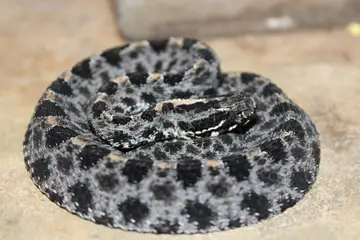
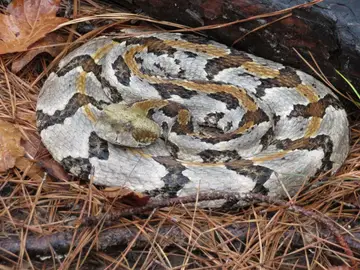
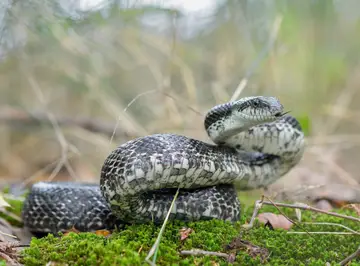
Alabama has 6 venomous snakes named by official sources: Copperhead, Cottonmouth, Eastern Coral Snake, Eastern Diamondback Rattlesnake, Pigmy Rattlesnake and Timber Rattlesnake. Each one is labelled venomous by Outdoor Alabama.
The 6 venomous snakes of Alabama
Recognize them from a distance; a photo cannot confirm that a snake is safe. Identifying animals safely.
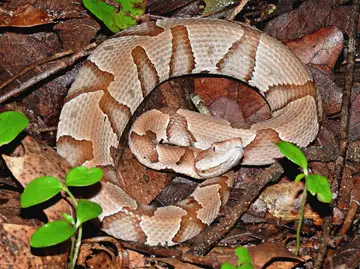
Adults usually about 2 to 3 feet (24-36 in); record about 53 inches.
How to recognize it
Vertical (cat-like) pupils and a heat-sensing pit between eye and nostril
Heavy-bodied; keeled scales
Head shape alone is not a reliable way to identify copperheads
Where in Alabama
The northern copperhead is found from the Alabama-Tennessee boundary southward to the Tennessee River … Outdoor Alabama
Conservation
Lowest Conservation Concern
JFMAMJJASOND
39 records by month.What the sources say
Venom: “There are six species of venomous snakes in Alabama. Those species include the copperhead, cottonmouth, eastern diamondback rattlesnake, timber rattlesnake, pygmy rattlesnake, and eastern coral snake.” (Outdoor Alabama)
Range: The northern copperhead is found from the Alabama-Tennessee boundary southward to the Tennessee River. It may be found in extreme northeastern Alabama below the Tennessee River.
Habitat: Copperheads are found in greatest numbers in forested areas that have numerous rocky bluffs and ravines. (Outdoor Alabama)
“The bite of the cottonmouth is highly dangerous and may be fatal.” Outdoor Alabama
Size
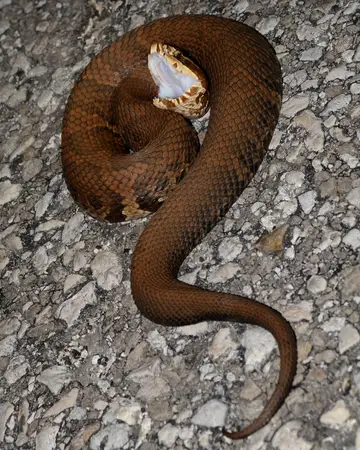
Typically 30 to 48 inches (about 3 to 4 feet); recorded up to 75 inches.
How to recognize it
Heat-sensing pit between nostril and eye; no rattle
Head much wider than the neck, with a dark bar from the eye to the jaw; vertical (cat-eye) pupils
Gapes to show the white lining of its mouth when threatened
Where in Alabama
Agkistrodon piscivorus is found in the southeastern states of Alabama, Florida, Georgia, Mississippi, North Carolina, South Carolina, Virginia, and east Texas. Outdoor Alabama
Conservation
Lowest Conservation Concern
JFMAMJJASOND
90 records by month.What the sources say
Venom: “There are six species of venomous snakes in Alabama. Those species include the copperhead, cottonmouth, eastern diamondback rattlesnake, timber rattlesnake, pygmy rattlesnake, and eastern coral snake.” (Outdoor Alabama)
Habitat: Any wetlands or waterways within their range. (Outdoor Alabama)
“Although not considered aggressive, species does possess the most toxic venom of any North American snake; thus, potentially very hazardous to humans and should never be handled.” Outdoor Alabama
Where in Alabama
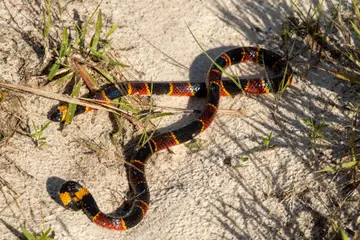
East of the Mississippi River, extending from southeastern North Carolina southward through parts of South Carolina and Georgia, all of Florida and westward through … Outdoor Alabama
Venom: “There are six species of venomous snakes in Alabama. Those species include the copperhead, cottonmouth, eastern diamondback rattlesnake, timber rattlesnake, pygmy rattlesnake, and eastern coral snake.” (Outdoor Alabama)
Range: East of the Mississippi River, extending from southeastern North Carolina southward through parts of South Carolina and Georgia, all of Florida and westward through southern parts of Alabama and Mississippi, into the southeastern extreme of Louisiana (Roze and Tilger 1983). In Alabama, formerly considered “common” along the lower Coastal Plain and infrequent in the Red Hills.
Habitat: A variety in the Southern Pine Plains and Hills ecoregion. (Outdoor Alabama)
“The venom of the eastern diamondback rattlesnake attacks blood, tissue, and the nervous system.” Outdoor Alabama
Size
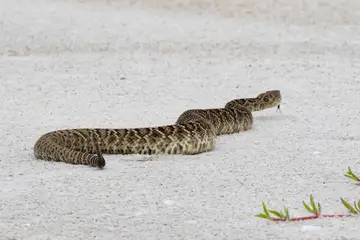
Most adults 33 to 72 inches (about 3 to 6 feet); record 99 inches.
How to recognize it
Light-bordered dark stripe running diagonally through each eye
Tail ends in a rattle, often held above the ground
Cat-like vertical pupil and a deep heat-sensing pit between nostril and eye
Where in Alabama
The eastern diamondback rattlesnake is locally common in suitable habitat regions of extreme south Alabama in the lower coastal plains and the adjacent band of red hills … Outdoor Alabama
Conservation
HIGH CONSERVATION CONCERN; Sale and live possession restricted: Alabama Reg. 220-2-.92(3)
What the sources say
Venom: “There are six species of venomous snakes in Alabama. Those species include the copperhead, cottonmouth, eastern diamondback rattlesnake, timber rattlesnake, pygmy rattlesnake, and eastern coral snake.” (Outdoor Alabama)
Range: The eastern diamondback rattlesnake is locally common in suitable habitat regions of extreme south Alabama in the lower coastal plains and the adjacent band of red hills to the north.
Habitat: Favored habitats for the diamondback include dry pine flatwoods and longleaf pine-turkey oak hills. (Outdoor Alabama)
“There are no documented cases of death caused by a pigmy rattler, although a bite can be very painful and could cause the loss of a digit.” Outdoor Alabama
Size
Adults usually 12-24 inches (30-61 cm); record 31-33 inches. Newborns about 5-6 inches.
How to recognize it
Tiny rattle at the end of a slender tail; buzz sounds like an insect
Pit viper: heat-sensing pit between nostril and eye, vertical (cat-like) pupils, keeled scales; nine large plates on top of the head
Large head scales (other rattlesnakes have small scales on the head)
Where in Alabama
In Alabama, Carolina pigmy rattlesnakes occur across the northern one-third of the state and in the eastern portion of the state southward to Lee County … Outdoor Alabama
What the sources say
Venom: “There are six species of venomous snakes in Alabama. Those species include the copperhead, cottonmouth, eastern diamondback rattlesnake, timber rattlesnake, pygmy rattlesnake, and eastern coral snake.” (Outdoor Alabama)
Range: In Alabama, Carolina pigmy rattlesnakes occur across the northern one-third of the state and in the eastern portion of the state southward to Lee County. Dusky pigmy rattlesnakes are restricted to the Lower Coastal Plain, typically in sandy pinelands and scrubby areas.
Habitat: This species is found in a variety of habitats including everglades prairies, palmetto-pine flatwoods, sandhills, mixed pine-hardwood forests, borders of cypress ponds, and in the vicinity of lakes and marshes. (Outdoor Alabama)
Venom: “There are six species of venomous snakes in Alabama. Those species include the copperhead, cottonmouth, eastern diamondback rattlesnake, timber rattlesnake, pygmy rattlesnake, and eastern coral snake.” (Outdoor Alabama)
Habitat: Timber rattlesnakes inhabit upland and lowland habitats such as hardwood forest with rocky outcrops, pine flatwoods, bottomland hardwood forests, and cane thickets. (Outdoor Alabama)
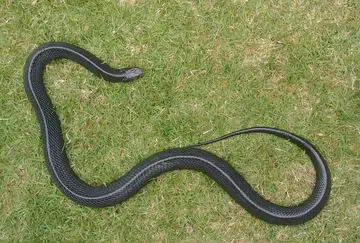
NPS says black racers can resemble the venomous water moccasin and advises leaving alone any snake you cannot identify. It gives no safe field mark, and none is offered here.
Black Racer or Timber rattlesnake?
Photo: Everglades NPS from Homestead, Florida, United States · Public domain · Wikimedia Commons
Racers are smaller and thinner, usually have a white chin and throat, and duller black color (Florida Museum). Alabama adds that the racer is slender and fast, the indigo stout and slow, and the racer has a divided anal plate.
Photos show typical adults; individuals vary. Never get close to compare.
When venomous snakes are active in Alabama
Records of snakes in Alabama peak in April to June and August to September. They show when people record snakes, not how many there are (about month bars).
JanFebMarAprMayJunJulAugSepOctNovDec
822 records of snakes in Alabama by month (GBIF, CC0 and CC BY records).
Keep snakes out of yards by removing cover and food Outdoor Alabama
How to report
Nuisance wildlife: permitted Nuisance Wildlife Control Operators or the WFF district office; Wildlife Section 334-242-3469. Sea turtle strandings 1-866-732-8878. Dolphin and whale strandings 877-942-5343. Manatee sightings 866-493-5803. Invasive carp [email protected] or (256)-353-2634. Outdoor Alabama
About this list
The species list comes from Snakes; Venomous Snakes; Non Venomous Snakes (Outdoor Alabama) (Alabama Department of Conservation and Natural Resources (Outdoor Alabama), undated page; as of retrieval 2026-11-03). 50 more entries come from other official sources named on each card.
Venom labels come only from official sources and link to them; "Not stated" never means harmless. How labels work.
Sources
Watchable Wildlife. Alabama Department of Conservation and Natural Resources (Outdoor Alabama). undated page; checked November 3, 2026.
Snakes. Alabama Department of Conservation and Natural Resources (Outdoor Alabama). undated page; checked November 3, 2026.
Black Kingsnake. Alabama Department of Conservation and Natural Resources (Outdoor Alabama). undated page; checked November 3, 2026.
Non Venomous Snakes. Alabama Department of Conservation and Natural Resources (Outdoor Alabama). undated page; checked November 3, 2026.Quoted passages (1)
“Below is a list of non venomous Snakes found in alabama.”
Black Pine Snake. Alabama Department of Conservation and Natural Resources (Outdoor Alabama). undated page; checked November 3, 2026.
Black Racer. Alabama Department of Conservation and Natural Resources (Outdoor Alabama). undated page; checked November 3, 2026.Quoted passages (1)
“They are usually between three and five feet long, but some individuals may reach lengths of more than six feet.”
Black "Speckled" Kingsnake. Alabama Department of Conservation and Natural Resources (Outdoor Alabama). undated page; checked November 3, 2026.
Brown Water Snake. Alabama Department of Conservation and Natural Resources (Outdoor Alabama). undated page; checked November 3, 2026.
Brownsnake. Alabama Department of Conservation and Natural Resources (Outdoor Alabama). undated page; checked November 3, 2026.
Diamond-backed Water Snake. Alabama Department of Conservation and Natural Resources (Outdoor Alabama). undated page; checked November 3, 2026.Quoted passages (1)
“Diamondback water snakes often are confused with the venomous, but more docile, cottonmouth, a.k.a. water moccasin (Agkistrodon piscivorus), and are killed needlessly.”
Eastern Coachwhip. Alabama Department of Conservation and Natural Resources (Outdoor Alabama). undated page; checked November 3, 2026.
Eastern Garter Snake. Alabama Department of Conservation and Natural Resources (Outdoor Alabama). undated page; checked November 3, 2026.
Eastern Hognose Snake. Alabama Department of Conservation and Natural Resources (Outdoor Alabama). undated page; checked November 3, 2026.
Eastern Indigo Snake. Alabama Department of Conservation and Natural Resources (Outdoor Alabama). undated page; checked November 3, 2026.Quoted passages (1)
“A distinct difference between the indigo snake and the black racer is the anal plate which is entire on the indigo and divided on the black racer.”
Eastern Kingsnake. Alabama Department of Conservation and Natural Resources (Outdoor Alabama). undated page; checked November 3, 2026.
Eastern Milk Snake. Alabama Department of Conservation and Natural Resources (Outdoor Alabama). undated page; checked November 3, 2026.Quoted passages (1)
“Eastern milk snakes (Lampropeltis triangulum triangulum) are medium sized snakes that range in total length from 24-52 inches.”
Eastern Ribbon Snake. Alabama Department of Conservation and Natural Resources (Outdoor Alabama). undated page; checked November 3, 2026.
Eastern Smooth Earth Snake. Alabama Department of Conservation and Natural Resources (Outdoor Alabama). undated page; checked November 3, 2026.
Florida Green Water Snake. Alabama Department of Conservation and Natural Resources (Outdoor Alabama). undated page; checked November 3, 2026.
Florida Pine Snake. Alabama Department of Conservation and Natural Resources (Outdoor Alabama). undated page; checked November 3, 2026.
Glossy Crayfish Snake. Alabama Department of Conservation and Natural Resources (Outdoor Alabama). undated page; checked November 3, 2026.
Gray Ratsnake. Alabama Department of Conservation and Natural Resources (Outdoor Alabama). undated page; checked November 3, 2026.
Gulf Saltmarsh Snake. Alabama Department of Conservation and Natural Resources (Outdoor Alabama). undated page; checked November 3, 2026.
Midland Water Snake. Alabama Department of Conservation and Natural Resources (Outdoor Alabama). undated page; checked November 3, 2026.
Mississippi Green Water Snake. Alabama Department of Conservation and Natural Resources (Outdoor Alabama). undated page; checked November 3, 2026.
Mole Kingsnake. Alabama Department of Conservation and Natural Resources (Outdoor Alabama). undated page; checked November 3, 2026.
Mud Snake. Alabama Department of Conservation and Natural Resources (Outdoor Alabama). undated page; checked November 3, 2026.
North Florida Swamp Snake. Alabama Department of Conservation and Natural Resources (Outdoor Alabama). undated page; checked November 3, 2026.
Northern Pine Snake. Alabama Department of Conservation and Natural Resources (Outdoor Alabama). undated page; checked November 3, 2026.
Northern Red-bellied Snake. Alabama Department of Conservation and Natural Resources (Outdoor Alabama). undated page; checked November 3, 2026.
Northern Scarlet Snake. Alabama Department of Conservation and Natural Resources (Outdoor Alabama). undated page; checked November 3, 2026.
Pine Woods Littersnake. Alabama Department of Conservation and Natural Resources (Outdoor Alabama). undated page; checked November 3, 2026.
Plain-bellied Water Snake. Alabama Department of Conservation and Natural Resources (Outdoor Alabama). undated page; checked November 3, 2026.
Prairie Kingsnake. Alabama Department of Conservation and Natural Resources (Outdoor Alabama). undated page; checked November 3, 2026.
Queen Snake. Alabama Department of Conservation and Natural Resources (Outdoor Alabama). undated page; checked November 3, 2026.
Rainbow Snake. Alabama Department of Conservation and Natural Resources (Outdoor Alabama). undated page; checked November 3, 2026.
Red Cornsnake. Alabama Department of Conservation and Natural Resources (Outdoor Alabama). undated page; checked November 3, 2026.
Red Milk Snake. Alabama Department of Conservation and Natural Resources (Outdoor Alabama). undated page; checked November 3, 2026.
Ringneck Snake. Alabama Department of Conservation and Natural Resources (Outdoor Alabama). undated page; checked November 3, 2026.
Rough Earth Snake. Alabama Department of Conservation and Natural Resources (Outdoor Alabama). undated page; checked November 3, 2026.
Rough Green Snake. Alabama Department of Conservation and Natural Resources (Outdoor Alabama). undated page; checked November 3, 2026.
Scarlet Kingsnake. Alabama Department of Conservation and Natural Resources (Outdoor Alabama). undated page; checked November 3, 2026.
Southeastern Crowned Snake. Alabama Department of Conservation and Natural Resources (Outdoor Alabama). undated page; checked November 3, 2026.
Southern Hognose Snake. Alabama Department of Conservation and Natural Resources (Outdoor Alabama). undated page; checked November 3, 2026.
Southern Water Snake. Alabama Department of Conservation and Natural Resources (Outdoor Alabama). undated page; checked November 3, 2026.
Western Smooth Earth Snake. Alabama Department of Conservation and Natural Resources (Outdoor Alabama). undated page; checked November 3, 2026.
Worm Snake. Alabama Department of Conservation and Natural Resources (Outdoor Alabama). undated page; checked November 3, 2026.
Copperhead. Alabama Department of Conservation and Natural Resources (Outdoor Alabama). undated page; checked November 3, 2026.Quoted passages (1)
“Bites are painful but rarely fatal.”
Nongame Wildlife FAQs. Alabama Department of Conservation and Natural Resources (Outdoor Alabama). undated page; checked November 3, 2026.Quoted passages (2)
“There are six species of venomous snakes in Alabama. Those species include the copperhead, cottonmouth, eastern diamondback rattlesnake, timber rattlesnake, pygmy rattlesnake, and eastern coral snake.”
“The best way to keep snakes out of your yard is to get rid of the food source.”
Cottonmouth. Alabama Department of Conservation and Natural Resources (Outdoor Alabama). undated page; checked November 3, 2026.Quoted passages (1)
“The bite of the cottonmouth is highly dangerous and may be fatal.”
Eastern Coral Snake. Alabama Department of Conservation and Natural Resources (Outdoor Alabama). undated page; checked November 3, 2026.Quoted passages (3)
“Although not considered aggressive, species does possess the most toxic venom of any North American snake; thus, potentially very hazardous to humans and should never be handled.”
“…potentially very hazardous to humans and should never be handled”
“Rare and possibly threatened. Few recent observations may indicate that this secretive species has declined in Alabama.”
Eastern Diamondback Rattlesnake. Alabama Department of Conservation and Natural Resources (Outdoor Alabama). undated page; checked November 3, 2026.Quoted passages (1)
“The venom of the eastern diamondback rattlesnake attacks blood, tissue, and the nervous system.”
Pigmy Rattlesnake. Alabama Department of Conservation and Natural Resources (Outdoor Alabama). undated page; checked November 3, 2026.Quoted passages (2)
“The tip of their tail contains a very small delicate rattle or button that is not much wider than the end of the tail itself. When vibrated for a warning, the rattle is often difficult to hear and has been compared to the sound of an insect buzzing.”
“There are no documented cases of death caused by a pigmy rattler, although a bite can be very painful and could cause the loss of a digit.”
Timber Rattlesnake. Alabama Department of Conservation and Natural Resources (Outdoor Alabama). undated page; checked November 3, 2026.Quoted passages (1)
“Timber rattlesnakes hibernate in a den during the winter, forming a winter colony.”
Report Aquatic Invasive Species. Alabama Department of Conservation and Natural Resources (Outdoor Alabama). undated page; checked November 3, 2026.Quoted passages (1)
“Reports can be submitted at: [email protected] or by phone at (256)-353-2634.”