States Wildlife

Venomous Snakes in Utah: 5 Species & How to Tell

Last checked November 3, 2026 against official sources.

On this page
  1. The 5 venomous snakes
  2. Lookalikes
  3. When they are active
  4. If you are bitten or stung
  5. How to report
  6. About this list
  7. Sources

Utah has 5 venomous snakes named by official sources: Western rattlesnake, Prairie rattlesnake, Mojave rattlesnake, Sidewinder and Southwestern speckled rattlesnake. Each one is labelled venomous by DWR.

The 5 venomous snakes of Utah

Recognize them from a distance; a photo cannot confirm that a snake is safe. Identifying animals safely.

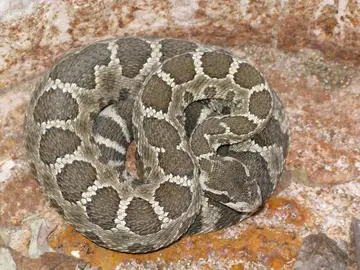
Mojave (or Mohave) rattlesnake
Photo: Court Harding · CC BY 4.0 · iNaturalist

Mojave (or Mohave) rattlesnake

Crotalus scutulatus

Venomous per DWR

Danger to people
“Rattlesnake bites are a serious medical emergency and require getting medical attention at a hospital as soon as possible.” DWR
Size
Up to 50 inches excluding the rattle (Arizona). Grand Canyon-Parashant National Monument says it averages 2 to 4 feet. Texas calls it smaller and more slender than the western diamondback.
How to recognize it
  • Rattle at the end of the tail
  • Broad triangular head on a slender neck; vertical pupils
  • Thin light stripe from the back corner of the eye running past the corner of the mouth
Where in Utah
Extreme southwest corner of the state Utah Division of Wildlife Resources (DWR); hosted by Wild Aware Utah
What the sources say

Venom: “Rattlesnakes use their venom to subdue prey so they can eat it, and a snake will only bite defensively if it feels threatened.” (DWR)

Full Mojave (or Mohave) rattlesnake guide

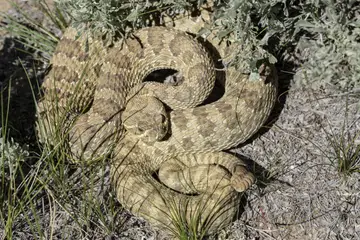
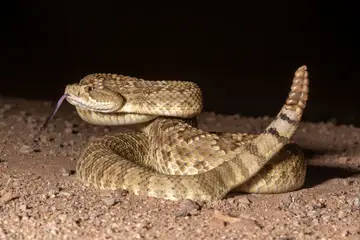
Prairie rattlesnake
Photo: Cecelia Alexander · CC0 1.0 · iNaturalist

Prairie rattlesnake

Crotalus viridis

Venomous per DWR

Danger to people
“Rattlesnake bites are a serious medical emergency and require getting medical attention at a hospital as soon as possible.” DWR
Size
Usually about 3 to 4 feet; Montana gives 15 to 60 inches and NPS says up to 5 feet. Arizona gives a maximum of 28 to 64 inches (excluding rattle) depending on subspecies; in Colorado it is rarely over 39 inches.
How to recognize it
  • Rattle (or a button in newborns) at the tail tip
  • Head much broader than the neck, many small scales on top of the head, heat-sensing pit between eye and nostril
  • Vertical (cat-like) pupils
Where in Utah
Southeastern Utah Utah Division of Wildlife Resources (DWR); hosted by Wild Aware Utah
What the sources say

Venom: “Rattlesnakes use their venom to subdue prey so they can eat it, and a snake will only bite defensively if it feels threatened.” (DWR)

Full Prairie rattlesnake guide

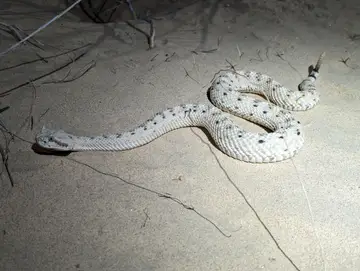
Sidewinder
Photo: Ken-ichi Ueda · CC BY 4.0 · iNaturalist

Sidewinder

Crotalus cerastes

Venomous per DWR

Danger to people
“Rattlesnake bites are a serious medical emergency and require getting medical attention at a hospital as soon as possible.” DWR
Size
Small: up to 25 in excluding the rattle (Arizona); typically 1.5 ft or less but can reach 3 ft (Death Valley NPS); 17-33 in (Nevada).
How to recognize it
  • Enlarged, upturned, horn-like scales above the eyes
  • Rattle on the tail, though rattles can break off (UC IPM)
  • Broad, triangular head and slender neck
Where in Utah
Extreme southwest corner of the state Utah Division of Wildlife Resources (DWR); hosted by Wild Aware Utah
What the sources say

Venom: “Rattlesnakes use their venom to subdue prey so they can eat it, and a snake will only bite defensively if it feels threatened.” (DWR)

Full Sidewinder guide

No confirmed photo of Southwestern speckled rattlesnake

Southwestern speckled rattlesnake

Crotalus pyrrhus

Venomous per DWR

Danger to people
“Rattlesnake bites are a serious medical emergency and require getting medical attention at a hospital as soon as possible.” DWR
Where in Utah
Extreme southwest corner of the state Utah Division of Wildlife Resources (DWR); hosted by Wild Aware Utah
What the sources say

Venom: “Rattlesnakes use their venom to subdue prey so they can eat it, and a snake will only bite defensively if it feels threatened.” (DWR)

Western rattlesnake
Photo: NPS Staff · Public domain · Wikimedia Commons

Western rattlesnake

Crotalus oreganus

Venomous per DWR

Danger to people
“Rattlesnake bites are a serious medical emergency and require getting medical attention at a hospital as soon as possible.” DWR
Size
Varies by area and subspecies: up to 63 in. excluding rattle (Arizona); largest in the Northwest 59 in., most Washington adults around 2 ft; 18 to 36 in. average (Oregon); C. o. concolor rarely over 26 in. (Colorado).
How to recognize it
  • Rattle on the tail; broad triangular head; facial pits
  • Vertical pupils and heat-sensing pits near the nostrils
  • Strongly keeled scales
Where in Utah
Western and eastern Utah (Great Basin subspecies throughout much of western Utah; midget faded subspecies throughout much of eastern Utah) Utah Division of Wildlife Resources (DWR); hosted by Wild Aware Utah
Conservation
subspecies midget faded rattlesnake (C. o. concolor) is a Utah Species of Greatest Conservation Need (2025), S3?
151 records by month.
What the sources say

Venom: “Rattlesnakes use their venom to subdue prey so they can eat it, and a snake will only bite defensively if it feels threatened.” (DWR)

Habitat: May range from mountaintops to desert plains (Utah Division of Wildlife Resources (DWR); hosted by Wild Aware Utah)

Full Western rattlesnake guide

For 18 other snakes on Utah's list, no official source we use states whether it is venomous: Arizona mountain kingsnake, California kingsnake, Coachwhip, Desert nightsnake, Glossy snake, Great Plains ratsnake, Long-nosed snake and North American racer and others. That does not make them harmless. Leave every snake alone.

See all 28 snakes, venomous and not, on Utah snakes.

Snakes people confuse

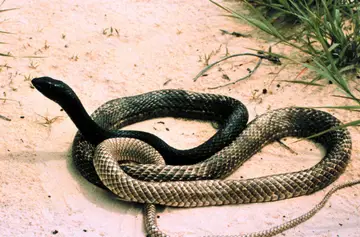
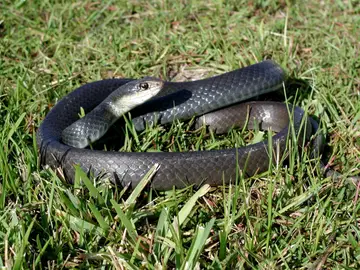
Coachwhip or North American racer (black racer)?

Coachwhip
Photo: NOAA · Public domain · Wikimedia Commons

Coachwhip Not stated

North American racer (black racer)
Photo: Everglades NPS from Homestead, Florida, United States · Public domain · Wikimedia Commons

North American racer (black racer) Not stated

TWRA: the racer lacks the coachwhip's reddish tint along the sides of the tail; an all-black coachwhip is distinctly lighter or reddish toward the rear. Oklahoma: the coachwhip is much larger.

Black Racer or Eastern coachwhip (black variant)?

Black Racer
Photo: Everglades NPS from Homestead, Florida, United States · Public domain · Wikimedia Commons

Black Racer Not stated

Eastern coachwhip (black variant)
Photo: NOAA · Public domain · Wikimedia Commons

Eastern coachwhip (black variant) Not stated

Distinctly lighter or reddish toward the rear of the body.

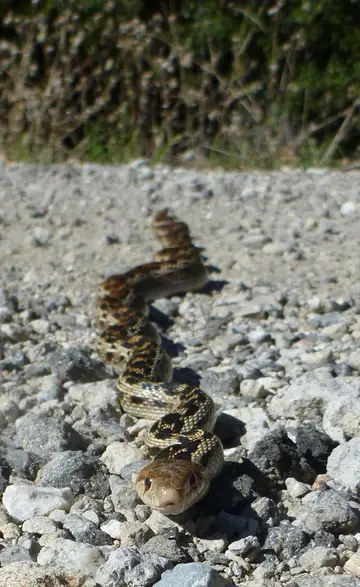
Gopher snake (gophersnake) or Glossy snake?

Gopher snake (gophersnake)
Photo: National Park Service from USA · Public domain · Wikimedia Commons

Gopher snake (gophersnake) Non-venomous

Glossy snake
Photo: Linda Jo Conn · CC BY 4.0 · iNaturalist

Glossy snake Not stated

AZGFD: gopher snake back scales are keeled, which distinguishes it from the similar-looking glossy snake

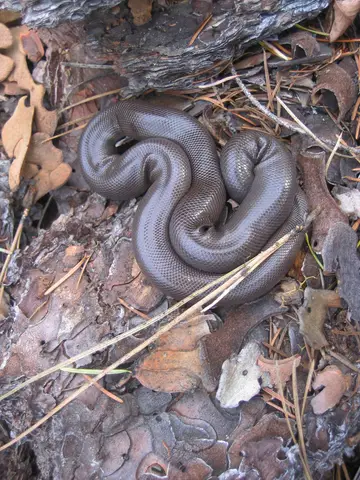
Rubber Boa or Racer (Western Yellow-bellied Racer)?

Rubber Boa
Photo: NPS Staff · Public domain · Wikimedia Commons

Rubber Boa Non-venomous

Racer (Western Yellow-bellied Racer)
Photo: Everglades NPS from Homestead, Florida, United States · Public domain · Wikimedia Commons

Racer (Western Yellow-bellied Racer) Not stated

WDFW: racers have large eyes, large back scales and a tail that tapers to a point; rubber boas have small eyes, tiny scales and a blunt tail. Racers are fast and will strike and bite if cornered or handled; rubber boas are slow and non-aggressive. Yellowstone adds that racers have round pupils.

Western Rattlesnake or Gopher snake (gophersnake)?

Western Rattlesnake
Photo: NPS Staff · Public domain · Wikimedia Commons

Western Rattlesnake Venomous

Gopher snake (gophersnake)
Photo: National Park Service from USA · Public domain · Wikimedia Commons

Gopher snake (gophersnake) Non-venomous

WDFW (Washington): no rattle and no facial pits, oval pupils, smaller square spots, a narrow eye stripe and less keeled scales. It can coil, strike, hiss loudly and vibrate its tail like a rattlesnake, so behavior alone does not tell them apart.

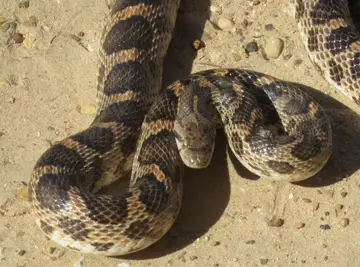
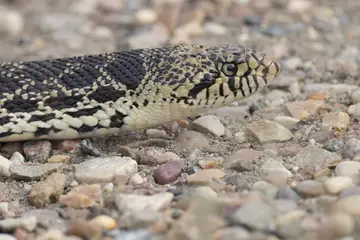
Prairie Rattlesnake or Bullsnake (gopher snake)?

Prairie Rattlesnake
Photo: Cecelia Alexander · CC0 1.0 · iNaturalist

Prairie Rattlesnake Venomous

Bullsnake (gopher snake)
Photo: Cephas · CC BY-SA 4.0 · Wikimedia Commons · resized

Bullsnake (gopher snake) Non-venomous

The bullsnake has no rattle, an oval or rounded head and large round pupils; the prairie rattlesnake has a triangular head, slit pupils and a rattle. Bullsnakes are often mistaken for rattlesnakes: when threatened they may coil, flatten the head, hiss and vibrate the tail in dry leaves to sound like a rattle, so do not judge by behavior or by head shape alone.

Photos show typical adults; individuals vary. Never get close to compare.

When venomous snakes are active in Utah

Records of snakes in Utah peak in May to July. They show when people record snakes, not how many there are (about month bars).

774 records of snakes in Utah by month (GBIF, CC0 and CC BY records).
  • Rattlesnakes are most active in late spring and early summer; activity peaks at dawn and dusk (DWR). DWR

If you are bitten or stung

Call 911 or Poison Help at 1-800-222-1222 right away. Poison Help connects you to your local poison center, any time of day.

Official advice from DWR:

  • Rattlesnake bites are a serious medical emergency needing hospital care as soon as possible. DWR
  • If you meet a rattlesnake, stay calm, keep at least 10 feet away, and go around it; do not try to kill it. DWR
  • If you cannot identify a snake, move away and treat it as venomous. DWR
  • Rattlesnakes, Gila monsters, desert tortoises, western (boreal) toads and Columbia spotted frogs must not be handled or tampered with. DWR

How to report

Report a rattlesnake repeatedly seen in a problem area, or in a public park, yard or play area, to the nearest DWR office; report aggressive wildlife to the nearest DWR office (after hours: local police or county sheriff). Report Gila monster sightings to DWR (435-879-8694). Report non-native reptiles/amphibians via iNaturalist (optional, per DWR). DWR

About this list

The species list comes from Species tables for Utah's reptiles and amphibians (DWR collection/possession classifications, R657-53) (Utah Division of Wildlife Resources (DWR), page last updated April 22, 2026).

Venom labels come only from official sources and link to them; "Not stated" never means harmless. How labels work.

Sources

  1. Who we are: About the Utah Division of Wildlife Resources. Utah Division of Wildlife Resources (DWR). page "Last updated: April 2, 2026"; checked November 3, 2026.
  2. Species tables for Utah's reptiles and amphibians. Utah Division of Wildlife Resources (DWR). page "Last updated: April 22, 2026"; checked November 3, 2026.
  3. Non-venomous Snakes (USU Extension Wildlife Damage Management Series NR/WD/007). Utah State University Extension in cooperation with Utah DWR; hosted by Wild Aware Utah. August 1998; checked November 3, 2026.
    Quoted passages (1)
    “The most common non-venomous snakes in Utah are the three species of garter snakes (Thamnophis spp.) which are commonly referred to by many as water snakes (Utah has no true water snakes), the rubber boa (Charina bottae), and gopher or bullsnake (Pituophis melanoleucus).”
  4. How to avoid conflicts with rattlesnakes in Utah this spring and summer (news release). Utah Division of Wildlife Resources (DWR). Published March 17, 2026; checked November 3, 2026.
    Quoted passages (7)
    “Rattlesnakes use their venom to subdue prey so they can eat it, and a snake will only bite defensively if it feels threatened.”
    “Rattlesnake bites are a serious medical emergency and require getting medical attention at a hospital as soon as possible.”
    “Remain calm and stay at least 10 feet from the snake.”
    “If you cannot identify a snake you encounter, the best course of action is to move away and treat the snake as if it were venomous.”
    “Rattlesnakes are most active during the late spring and early summer months.”
    “If you do repeatedly see a rattlesnake in a problematic area or if you encounter a rattlesnake in a public park, yard or play area, you can contact the nearest DWR office to report it.”
    “Rocky benches, high-elevation slopes and dry canyons are the most common places in Utah to encounter rattlesnakes, often while people are out hiking, rock climbing or biking.”
  5. Western Rattlesnake (Utah DWR Wildlife Notebook Series No. 22). Utah Division of Wildlife Resources (DWR); hosted by Wild Aware Utah. Wildlife Notebook Series No. 22, dated 7/2011 in the PDF; checked November 3, 2026.
  6. Ask a herpetologist (DWR blog, Native Herpetology Coordinator). Utah Division of Wildlife Resources (DWR). Published June 14, 2023; checked November 3, 2026.
    Quoted passages (1)
    “Rattlesnakes, Gila monsters, desert tortoises, western (boreal) toads and Columbia spotted frogs are prohibited from being handled or tampered with in any way.”
  7. GBIF.org occurrence records, human observations licensed CC0 1.0 or CC BY 4.0 only, accessed November 3, 2026. The datasets behind these counts are listed on our Sources page.