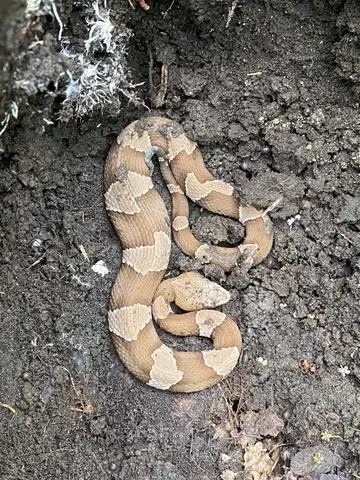
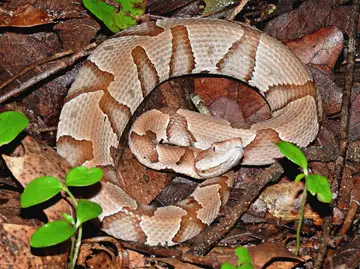
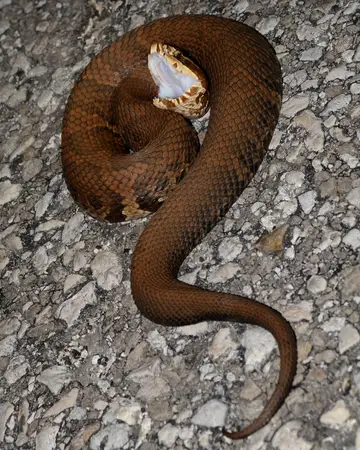
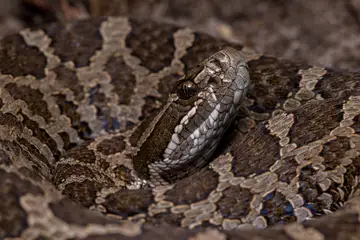
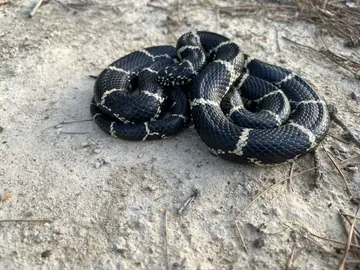
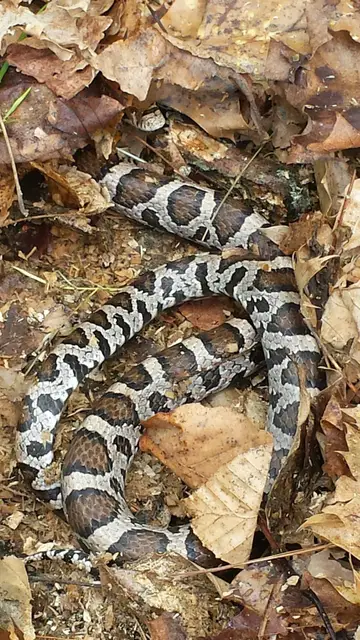
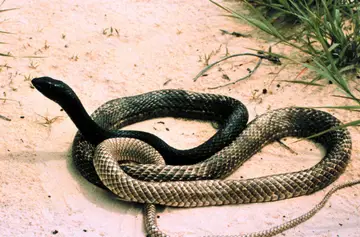
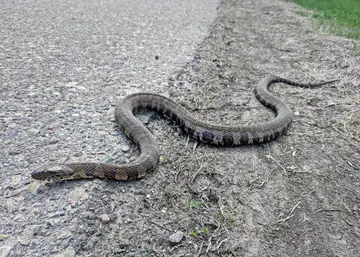
Oklahoma has 8 venomous snakes named by official sources: Copperhead, Cottonmouth, Western diamondback rattlesnake, Timber rattlesnake, Prairie rattlesnake, Massasauga, Pygmy rattlesnake and Broad-banded Copperhead. Each one is labelled venomous by Oklahoma Department of Wildlife Conservation and Sam Noble Oklahoma Museum of Natural History (SNOMNH) Herpetology, hosted by the Oklahoma Biological Survey, University of Oklahoma.
The 8 venomous snakes of Oklahoma
Recognize them from a distance; a photo cannot confirm that a snake is safe. Identifying animals safely.
Venom: “Oklahoma’s snake diversity includes 49 species, the large majority of which are considered nonvenomous. Beyond this bulk of ratsnakes, watersnakes, and less familiar species, the remaining eight species of rattlesnakes, copperheads, and cottonmouth are in the pit viper family and are considered venomous. … The broad-banded copperhead is one of two copperhead species thought to occur in Oklahoma.” (Oklahoma Department of Wildlife Conservation)
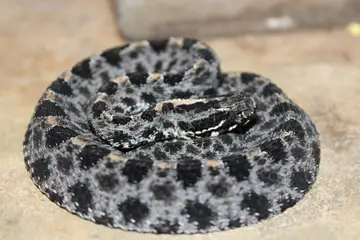
Usually 18 to 30 inches long (New York DEC: 18 to 40 inches, average 27.5). The western massasauga in Arizona reaches only about 22 inches.
How to recognize it
A segmented rattle (a single button in newborns) and vertical, catlike pupils. In Michigan it is the only snake with both.
Nine large plates on top of the head (the timber rattlesnake has many small scales there)
A heat-sensing pit on each side of the head between the eye and nostril; the head is flat and much wider than the neck
What the sources say
Venom: “! Massasauga (Sistrurus catenatus) N … N - venomous” (Sam Noble Oklahoma Museum of Natural History (SNOMNH) Herpetology, hosted by the Oklahoma Biological Survey, University of Oklahoma)
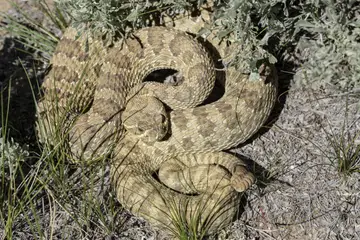
Usually about 3 to 4 feet; Montana gives 15 to 60 inches and NPS says up to 5 feet. Arizona gives a maximum of 28 to 64 inches (excluding rattle) depending on subspecies; in Colorado it is rarely over 39 inches.
How to recognize it
Rattle (or a button in newborns) at the tail tip
Head much broader than the neck, many small scales on top of the head, heat-sensing pit between eye and nostril
Vertical (cat-like) pupils
What the sources say
Venom: “! Prairie rattlesnake (Crotalus viridis) N … N - venomous” (Sam Noble Oklahoma Museum of Natural History (SNOMNH) Herpetology, hosted by the Oklahoma Biological Survey, University of Oklahoma)
Venom: “These venomous rattlesnakes are cryptically colored and usually lie motionless on the forest floor.” (Oklahoma Department of Wildlife Conservation)
Habitat: Western pygmy rattlesnakes are nearly always associated with forest habitats, including eastern deciduous forest and riparian woodlands. (Oklahoma Department of Wildlife Conservation)
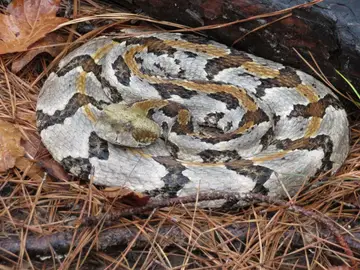
Most adults 36 to 60 inches (3 to 5 feet); record 74.5 inches.
How to recognize it
Black tail ending in a rattle
Heat-sensing pit between nostril and eye
Large, thick head distinct from the neck; cat-like vertical pupil
What the sources say
Venom: “It is critical to keep in mind that timber rattlesnakes are highly venomous and should not be handled or disturbed.” (Oklahoma Department of Wildlife Conservation)
Habitat: The west to east distribution of timber rattlesnakes in the United States extends from central Oklahoma nearly to Maine, and north to south from northern New York to central-east Texas. (Oklahoma Department of Wildlife Conservation)
“Being near the top of the food chain is one, but having one of the most deadly bites in the world gives the snake all the reason to act fearsome.” Oklahoma Department of Wildlife Conservation
Size
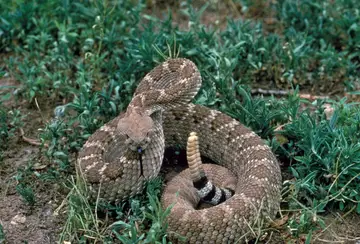
Usually about 3.5 to 4.5 feet; Texas says it can reach seven feet. Arizona's maximum is 66 inches excluding the rattle; Saguaro National Park gives a range of 30 to 90 inches.
How to recognize it
Rattle at the end of the tail
Broad triangular head on a slender neck; vertical pupils
Thin light stripe from behind the eye down to the upper lip
Conservation
ODWC field guide status: Species of Greatest Conservation Need
What the sources say
Venom: “The young are born complete with fangs and venom, armed and dangerous at birth, a good thing since the mother abandons them upon delivery.” (Oklahoma Department of Wildlife Conservation)
Habitat: Living in various habitats ranging from desert flats to river bottoms, the western diamondback spans across most of the southwest part of the United States, including most of Oklahoma. (Oklahoma Department of Wildlife Conservation)
See all 48 snakes, venomous and not, on Oklahoma snakes. Oklahoma Department of Wildlife Conservation gives Oklahoma 49 snake species in all; that page lists the 48 that official sources name one by one.
The copperhead's head is coppery with no marks; the milksnake's head is light with brownish marks (Pennsylvania). Tennessee: copperhead has a copper-colored, unmarked head and triangular shapes on the side of the body. Pennsylvania says the eastern milksnake is the snake most often killed by mistake for a copperhead. Belly colour is not used here: Pennsylvania's own pages describe the copperhead belly two different ways (uniform cream in one account, mottled white to gray in another).
TWRA: the racer lacks the coachwhip's reddish tint along the sides of the tail; an all-black coachwhip is distinctly lighter or reddish toward the rear. Oklahoma: the coachwhip is much larger.
Northern watersnake or Cottonmouth (water moccasin)?
Photo: U.S. Fish and Wildlife Service - Midwest Region · Public domain · Wikimedia Commons
Cottonmouths are heavier-bodied with a larger, chunky head, a pit between nostril and eye, darker color, and a light line from the eye to the corner of the mouth (Missouri). Cottonmouths have cat-like pupils; watersnakes have round pupils and no facial pit, and seen from above a cottonmouth's eyes are hidden while a watersnake's are visible (Florida Museum). Georgia DNR: banded watersnakes have bands widest on top; banded cottonmouths have bands widest on the sides (hourglass-shaped from above). Cottonmouths float on the water; watersnakes swim with the body just below the surface (Virginia DWR). Cautions from the same agencies: Virginia DWR says some other nonvenomous snakes, such as the eastern hog-nosed snake, also float, and that watersnakes often flatten the head when threatened so it looks diamond-shaped; CDFW says older northern watersnakes can look almost entirely dark brown or black.
Northern watersnake or Copperhead?
Photo: U.S. Fish and Wildlife Service - Midwest Region · Public domain · Wikimedia Commons
Florida Museum (midland watersnake): the watersnake's crossbands are darker, narrower and much more numerous than a copperhead's and turn into blotches halfway down the body. Watersnakes have round pupils and dark vertical lines near the mouth; copperheads have no such lines.
Photos show typical adults; individuals vary. Never get close to compare.
When venomous snakes are active in Oklahoma
Records of snakes in Oklahoma peak in April to June and September. They show when people record snakes, not how many there are (about month bars).
JanFebMarAprMayJunJulAugSepOctNovDec
754 records of snakes in Oklahoma by month (GBIF, CC0 and CC BY records).
In western Oklahoma ODWC staff find snakes year-round; September-October is the most hazardous time there as snakes head back to dens and young are born. Oklahoma Department of Wildlife Conservation
If you are bitten or stung
Call 911 or Poison Help at 1-800-222-1222 right away. Poison Help connects you to your local poison center, any time of day.
Official advice from University of Oklahoma Health Sciences, College of Pharmacy, Oklahoma Department of Wildlife Conservation and University of Oklahoma Health Sciences:
Report wildlife sightings (including mountain lions and bears) to ODWC online at wildlifedepartment.com/wildlife/report-wildlife; report suspected invasive aquatic species to ODWC at (918) 200-4815 or online. Oklahoma Department of Wildlife Conservation
Venom labels come only from official sources and link to them; "Not stated" never means harmless. How labels work.
Sources
About Us. Oklahoma Department of Wildlife Conservation. undated page; checked November 3, 2026.
Checklist of Oklahoma Amphibians and Reptiles. Sam Noble Oklahoma Museum of Natural History (SNOMNH) Herpetology, hosted by the Oklahoma Biological Survey, University of Oklahoma. PDF created 2014-09-09, modified 2016-06-06; checked November 3, 2026.Quoted passages (2)
“! Prairie rattlesnake (Crotalus viridis) N … N - venomous”
“! Massasauga (Sistrurus catenatus) N … N - venomous”
“Oklahoma’s snake diversity includes 49 species, the large majority of which are considered nonvenomous. Beyond this bulk of ratsnakes, watersnakes, and less familiar species, the remaining eight species of rattlesnakes, copperheads, and cottonmouth are in the pit viper family and are considered venomous.”
“Oklahoma’s snake diversity includes 49 species, the large majority of which are considered nonvenomous. Beyond this bulk of ratsnakes, watersnakes, and less familiar species, the remaining eight species of rattlesnakes, copperheads, and cottonmouth are in the pit viper family and are considered venomous. … The broad-banded copperhead is one of two copperhead species thought to occur in Oklahoma.”
“If you’re concerned about a bite or are bitten by a venomous snake, seek medical attention.”
“If a copperhead or other snake is encountered, Allen recommends backing several feet away and enjoying the view.”
“‘To me, that September through October timeframe is the most hazardous time in our area. Snakes are getting ready to go back to the den. And they’ve also just had a bunch of little snakes.”
Copperhead (ODWC Field Guide). Oklahoma Department of Wildlife Conservation. undated page; checked November 3, 2026.Quoted passages (2)
“And the copperhead is one of those venomous species.”
“Copperheads are mostly nocturnal during summer but are usually active during daylight in spring and fall. The mating season lasts from February to May and late August to October.”
“Ringed-neck snakes could be confused with the flat-headed snake, but flat-headed snakes have no neck ring, are lighter in color and have a pink belly with no spots.”
Oklahoma Poison Center Urges Caution During Snake Season. University of Oklahoma Health Sciences, College of Pharmacy (Oklahoma Center for Poison and Drug Information). Published: Thursday, April 30, 2026; checked November 3, 2026.Quoted passages (2)
“Call the Oklahoma Poison Center immediately at 1-800-222-1222.”
“Snake bites are more common than many people realize, especially during the spring and summer months,”
Spring Brings Snake Bite Calls to the Poison Center. University of Oklahoma Health Sciences (Oklahoma Center for Poison and Drug Information). Published: Wednesday, April 13, 2022; checked November 3, 2026.Quoted passages (1)
“DO NOT handle or play with snakes. Even dead snakes can bite reflexively. … Watch where you step and place your hands when outdoors.”
Aquatic Nuisance Species. Oklahoma Department of Wildlife Conservation. undated page; checked November 3, 2026.Quoted passages (1)
“If you think you have discovered any invasive species contact us at (918) 200-4815 or report online.”