Florida panther
Puma concolor coryi · also called puma, cougar and mountain lion · Last checked November 3, 2026.
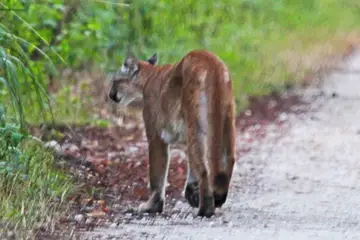

The Florida panther is the only puma population east of the Mississippi River: a large, uniformly tan cat (males weigh 100 to 160 pounds) that lives mainly in southwest Florida, where FWC estimates about 120 to 230 adults. It is a federally endangered species, and it is illegal to harm or harass one. FWC says panthers usually avoid confrontation and that there has never been a verified panther attack in Florida, but it publishes safety steps for meeting one, and panthers do kill pets and livestock. FWC
This page covers a subspecies (Puma concolor coryi), not a single species.
On this page
Is the Florida panther dangerous?
FWC: there has never been a verified panther attack in Florida; panthers typically avoid confrontation. FWC still advises how to act if you meet one, and if attacked, to fight back. FWC
“There has never been a verified panther attack in Florida.”
How to identify a Florida panther
A photo or description can narrow it down, but cannot confirm what an animal is or that it is safe. Look from a distance and do not handle wild animals.
Size: Males 100 to 160 lb, females 70 to 100 lb; 24 to 28 inches at the shoulder; 6 to 7.2 feet from nose to tail tip FWC
Colors: Uniform tan with lighter fur on the lower chest, belly and inner legs; shades vary from grayish to reddish to yellowish; never black. Pattern: Adults unspotted (solid color).
Key features
- Long, round tail nearly two-thirds the length of head and body FWC
- Often a right-angle kink at the tail tip, a cowlick mid-back, and white flecks on neck and back (kink and cowlick are not defining traits) FWC
- Does not roar; may chirp, peep, whistle, purr, moan, scream, growl and hiss FWC
Young
Kittens are spotted, with blue eyes and five dark rings on the tail; spots fade by the end of the first year
Animals mistaken for the Florida panther
Florida panther or Bobcat?
Florida panther
Bobcat Lynx rufus
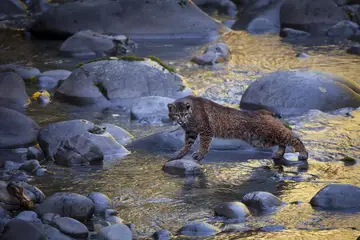

Bobcat is reddish brown with variable spots and a tail much shorter than its body; panther adults are uniformly tan, unspotted, with a tail nearly the length of the body. A bobcat track is about one-third the size of a panther track. FWC
Florida panther or "Black panther"?
Florida panther
"Black panther"
FWC: Florida panthers and all other pumas are never black, so a black big cat in Florida is not a Florida panther. FWC
Where the Florida panther lives
- Native or listed
- Nonnative or not established
- No official record in our data
- 1–9
- 10–99
- 100–999
- 1,000+
On our state guides
- Alabama mammals
- Alaska mammals
- Arizona mammals
- Arkansas mammals
- California mammals
- Colorado mammals
- Idaho mammals
- Iowa mammals
- Kansas mammals
- Maryland mammals
- Massachusetts mammals
- Michigan mammals
- Minnesota mammals
- Mississippi mammals
- Montana mammals
- Nebraska mammals
- Nevada mammals
- New Mexico mammals
- New York mammals
- North Dakota mammals
- Oklahoma mammals
- Rhode Island mammals
- South Dakota mammals
- Tennessee mammals
- Texas mammals
- Utah mammals
- Washington mammals
- West Virginia mammals
- Wisconsin mammals
- Wyoming mammals
State boundaries: U.S. Census Bureau, cartographic boundary file cb_2024_us_state_20m.
When it is active
Most active at dawn and dusk (crepuscular); FWC also says panthers are primarily active at night. Rest by day in palmetto thickets, especially in summer FWC
US open-licence records peak in January, March to June and November to December.
Habitat and habits
Habitat: In south Florida, prefers mature upland forests (hardwood hammocks and pinelands); found mainly in the Big Cypress/Everglades ecosystem National Park Service
Behavior: Solitary hunters that stalk prey and rush short distances, springing as far as 15 feet
Diet: Carnivore: about 70% of the diet is wild hog, white-tailed deer and raccoons; also armadillos and smaller animals; domestic goats, sheep and calves where available
Young: Gestation 92 to 96 days; 1 to 4 kittens; births any time of year, most often March to July; young leave their mothers by age two
Legal status and reporting
Federal: Endangered (ESA), wherever found; listed 03-11-1967 ECOS
Protection: Endangered Species Act: illegal to harm or harass panthers in any way FWC
Report: Sick, injured or dead panther, or a depredation: report online or call 888-404-FWCC (3922); cell #FWC or *FWC. Sightings and tracks: FWC panther sightings form (myfwc.com/panthersightings). FWC
Questions about the Florida panther
Are there any mountain lions in florida?
Yes. The Florida panther is a subspecies of puma (mountain lion or cougar). FWC estimates about 120 to 230 adults, mainly in southwest Florida, with the core population south of Lake Okeechobee.
Are there mountain lions in georgia?
Georgia DNR says no credible physical evidence of a mountain lion population exists in Georgia; the closest population is the Florida panther in south Florida. FWC reports that one male panther reached western Georgia, where he was shot and killed in 2008.
Florida panther
A federally endangered subspecies of puma, uniformly tan and never black, living mainly in the Big Cypress/Everglades region of southwest Florida. FWC says there has never been a verified panther attack in Florida.
Sources
- Florida Panther. Florida Fish and Wildlife Conservation Commission (FWC). archived copy, captured October 25, 2026; checked November 3, 2026. Archived copy.
Quoted passages (2)
“Panthers are listed as an Endangered Species under the Endangered Species Act and it is illegal to harm or harass them in any way.”
“If you see a sick, injured or dead Florida panther, or if you experience a panther depredation, you can report it online or call 888-404-FWCC (3922). Cell phone users can also call #FWC or *FWC.”
- Florida Panther: Description. Florida Fish and Wildlife Conservation Commission (FWC). archived copy, captured September 4, 2026; checked November 3, 2026. Archived copy.
Quoted passages (7)
“Male panthers are larger than female panthers. They weigh from 100 to 160 pounds; female panthers weigh from 70 to 100 pounds. Panthers vary in height at the shoulder from 24 to 28 inches and measure from 6 to 7.2 feet from nose to tip of the tail.”
“Pumas have long, round tails (nearly two-thirds the length of their head and body).”
“The Florida panther often has a right angle kink at the end of its tail, a whorl of hair or a "cowlick" in the middle of its back, and white flecks in the fur on its neck and back.”
“What sounds do they make? Well, they are usually quiet but sometimes they chirp, peep, whistle, purr, moan, scream, growl and hiss.”
“Puma kittens are spotted, which helps to camouflage them in the shadows of their den. These spots fade as they approach maturity at the end of their first year.”
“Description: reddish brown, spots evident but variable, tail much shorter than length of body.”
“Florida panthers and all other puma subspecies are never black.”
- A guide to living with Florida Panthers (brochure). Florida Fish and Wildlife Conservation Commission (FWC). archived copy, captured October 4, 2025; checked November 3, 2026. Archived copy.
Quoted passages (1)
“There has never been a verified panther attack in Florida.”
- ECOS species report: Florida panther (ESA listing status). U.S. Fish and Wildlife Service (ECOS). live ECOS database query 2026-11-03; checked November 3, 2026.
- Florida Panther: Species Profile - Everglades National Park. National Park Service. page 'Last updated: December 7, 2022'; checked November 3, 2026.
Quoted passages (1)
“In south Florida, panthers prefer mature upland forests (hardwood hammocks and pinelands) over other habitat types.”
- Florida Panther: Biology. Florida Fish and Wildlife Conservation Commission (FWC). archived copy, captured July 23, 2026; checked November 3, 2026. Archived copy.
Quoted passages (4)
“Seventy percent of a panther’s diet is comprised of wild hog, white-tailed deer and raccoons.”
“Unlike dogs and wolves, that chase their prey until it tires, panthers rush short distances and spring as far as 15 feet for the kill.”
“They are most active at the same time their prey is likely to be active: dawn and dusk.”
“The gestation period for panther kittens is 92 to 96 days, and litters consist of one to four kittens. Births can occur at any time of year but are most common between March and July.”
- Mountain Lion Sightings Not Likely in Georgia. Georgia DNR Wildlife Resources Division. undated page; checked November 3, 2026.
- GBIF.org occurrence records, human observations licensed CC0 1.0 or CC BY 4.0 only, accessed November 3, 2026. The datasets behind these counts are listed on our Sources page.
- State boundaries: U.S. Census Bureau, cartographic boundary file cb_2024_us_state_20m.